


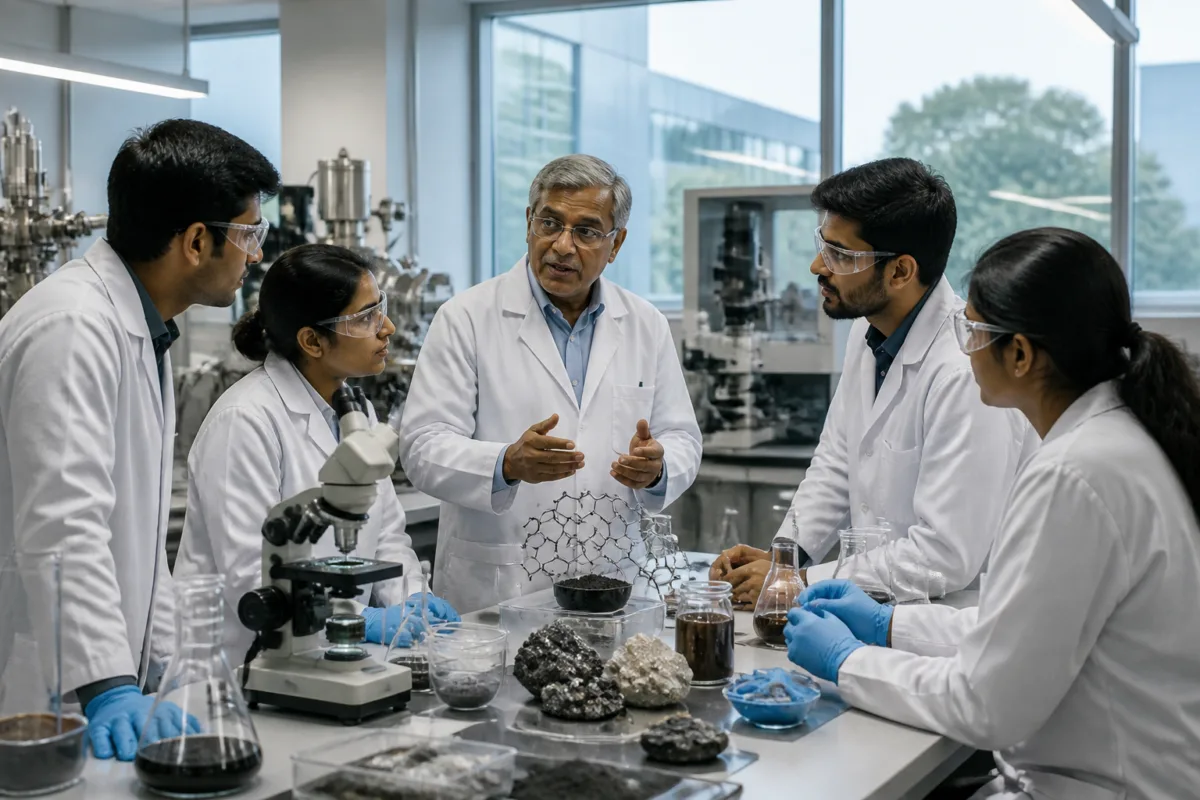
Lohum has appointed Nobel Laureate Konstantin ‘Kostya’ Novoselov as chief scientist of a new advanced materials incubation and venture platform designed to move technologies from laboratory research to industrial commercialisation.
The platform, being established by the critical minerals and advanced materials producer, will focus on closing the gap between early-stage research and market-ready products. Lohum founder and CEO Rajat Verma said the initiative would work across technology readiness levels (TRL) 1–4, which cover early research and laboratory development, through to TRL 7–8, when technologies are considered ready for industrial scaling.
Lohum will provide capital, infrastructure and strategic oversight for the platform. The resulting intellectual property and commercial returns will be managed through what the company described as a Central Funding Hub. Novoselov’s role will be structured through a joint venture model, with the platform managing a portfolio aimed at long-term commercial outcomes.
Novoselov shared the 2010 Nobel Prize in Physics with Andre Geim for experiments with graphene. His appointment is expected to support the platform’s proposed work in nanomaterials and two-dimensional structures, one of the sectors being assessed by the team.
“The path from a laboratory discovery in advanced materials to a market-ready product is where promising science often stalls,” Verma told BusinessLine. He said early research frequently remains within academic or preliminary laboratory settings, while commercial value is created only after technologies demonstrate viability and readiness for industrial scale-up.
Novoselov said many important advances in materials science, including graphene, began as laboratory discoveries, but faced a difficult transition before reaching commercial applications. He described the gap between discovery and application as a priority that needed to be addressed through strategies combining research, industrial capital and manufacturing at scale.
The platform is still assessing its focus sectors. They are likely to include strategic and critical minerals, nanomaterials and two-dimensional structures, and advanced magnetic materials, among other emerging technologies. Lohum said the full list would be announced after the incubation platform team finalises its scope.
The initiative comes as India seeks to expand domestic capabilities in strategic materials, batteries and clean-energy infrastructure. Lohum said the platform would bring together industry, academia and leading scientists to support the translation of advanced materials research into industrial applications.
“India has world-class science and a growing industrial base. What we need now is the bridge between the two,” Verma said. The next formal milestone is the announcement of the platform’s final focus sectors by its incubation team.

