


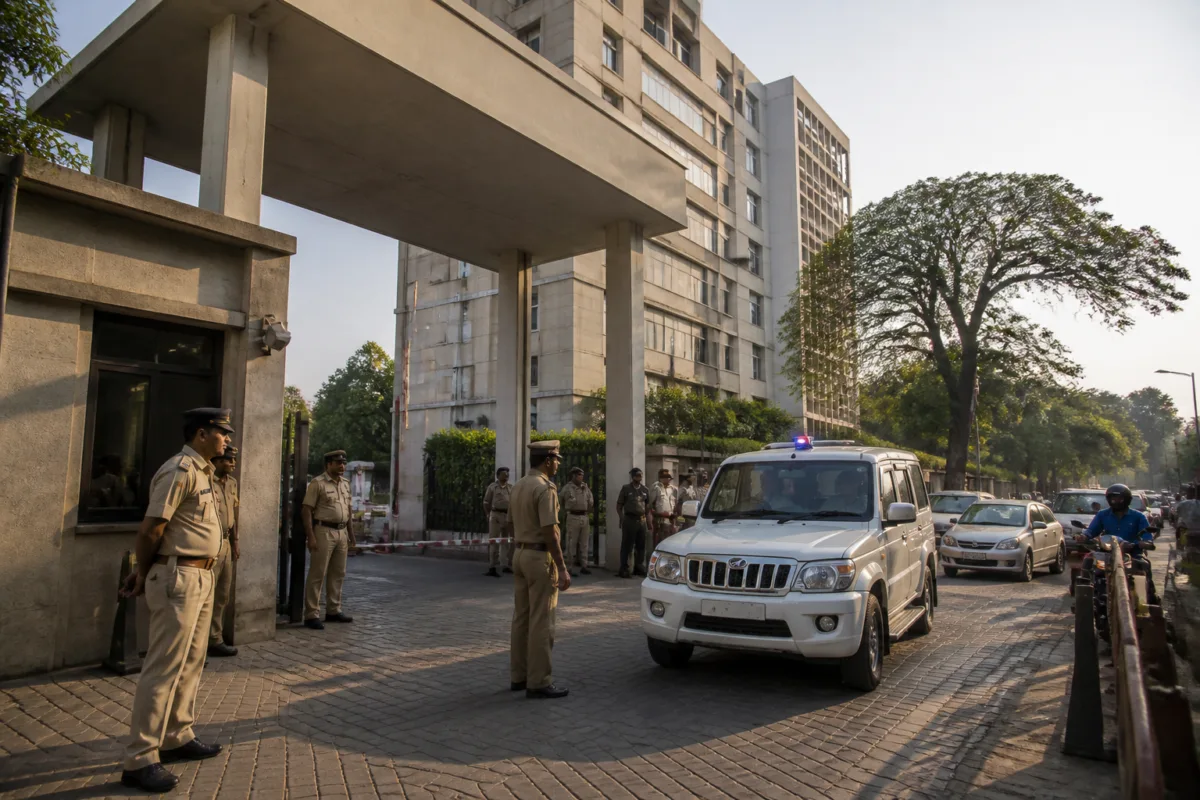
Pune Police’s decision to withdraw security cover for 20 prominent individuals, while continuing enhanced protection for a businessman injured in an attack, offers a glimpse into an administrative system that must constantly balance individual threat assessments with the deployment of limited police personnel. The decision followed a Special Branch review held on October 23, according to Pune Mirror, and included public figures, businesspeople, an advocate and an organisation head among those whose protection was discontinued.
The immediate event is straightforward: security arrangements were reviewed and altered. The institutional significance is broader. Police protection for prominent individuals is not described in the report as a permanent entitlement. It is reviewed periodically, with the Pune Police Commissioner authorised to decide who requires protection. The Special Branch Deputy Commissioner of Police assesses the security needs of protected persons under the commissioner’s supervision.
That structure places the decision within the ordinary functioning of urban policing rather than treating every withdrawal or continuation of protection as an isolated political or personal development. The review process is conducted every two months, according to the report, to determine whether existing arrangements should continue, be modified or be withdrawn. In administrative terms, the October 23 meeting was therefore part of a recurring cycle rather than a one-time exercise.
The list of people whose protection was withdrawn includes Vidyanand Bapat, who had come into the spotlight over the issue of noise pollution; Sanjay Nahar of the Sarhad organisation; Maharashtra Goseva Commission chairman Shekhar Mundanda; and advocate Ashish Satpute, who represented parties in the Koregaon Bhima case. The report also names Serum Institute’s Cyrus Poonawalla, businessman Puneet Balan, political analyst Tehseen Poonawalla, film producer Mihir Kulkarni, Ajinkya D.Y. Patil, businessman Michel Yohan Poonawalla and Yohan Zaveri Poonawalla. Some builders and other prominent business figures were also included.
The range of names is important because it shows that the review covers people from different parts of Pune’s public and economic life. The decision is not limited to one occupational category or one type of public profile. It applies across business, public advocacy, legal representation, politics, entertainment and institutional roles. However, the supplied report does not provide the individual threat assessments, the reasons for each withdrawal or the number of personnel released as a result. Those details remain material to understanding the scale and basis of the decision.
The continuing protection of businessman Rana Suryavanshi provides the clearest example of how the system responds to a specific security incident. Suryavanshi will continue to receive protection after sustaining serious injuries in an attack in the Baramati area. He has been given Y-plus category protection with an escort. The report also says that Laxman Hake has been assigned an escort vehicle along with one-plus-one armed security personnel.
These arrangements demonstrate that the review does not operate only by removing protection. It can also maintain or revise security measures when the police assessment identifies an ongoing requirement. In Suryavanshi’s case, the reported attack and serious injuries are the stated basis for continuing the arrangement. The report does not disclose the duration of the protection, the number of officers assigned beyond the stated category or whether the arrangement will be revisited at the next two-month review.
The use of categories such as Y-plus and one-plus-one also shows that protection is structured according to different levels of deployment. The report specifically links Y-plus protection with an escort in Suryavanshi’s case, while Hake’s arrangement consists of an escort vehicle and one-plus-one armed personnel. These descriptions indicate differentiated operational responses, although the article does not set out the full standards or criteria attached to each category.
That lack of publicly stated detail is one of the central governance questions raised by the review. The report identifies who lost protection and who retained or received it, but it does not publish the assessment framework used by the Special Branch. There is no information in the supplied material on how threat inputs are collected, how intelligence is evaluated, how costs are calculated or how individuals can seek a reconsideration. Without those details, the public can observe the outcome of the process but not fully assess its consistency.
This distinction matters in a city where police resources must serve multiple functions. Security personnel assigned to individuals are not available for other duties during the same period, although the supplied report does not quantify the staffing involved. Protection arrangements may include escorts, armed personnel and vehicles, as shown by the cases mentioned. A periodic review can therefore be understood as an administrative mechanism for ensuring that existing deployments continue to correspond with current assessments. The report, however, does not state how many officers will be redeployed after the latest withdrawals or where they will be assigned.
The two-month review cycle is the most significant institutional detail in the report. Regular reassessment creates a formal opportunity to respond to changing circumstances. A person who previously required protection may no longer be assessed in the same way, while a new incident can lead to additional measures. Suryavanshi’s continued protection following the Baramati attack illustrates the second possibility. The withdrawals illustrate the first, though the reasons for each individual decision are not provided.
The process also places responsibility at two connected levels. The Special Branch Deputy Commissioner of Police conducts the review of protected persons’ security needs, while the Pune Police Commissioner is authorised to decide who should receive police protection. This arrangement creates an internal chain of assessment and approval. It also means that the quality of the final decision depends on the information available to the Special Branch and the way that information is evaluated by the commissioner’s office.
The report does not indicate whether the October 23 meeting involved requests from the protected individuals, consultations with other agencies or fresh threat intelligence. It also does not say whether the people whose protection was withdrawn were informed in advance, whether alternative private arrangements were discussed or whether any of the decisions are subject to appeal. These are not facts that can be inferred from the outcome and would require further official clarification.
The presence of prominent business figures and builders on the list gives the decision an additional urban dimension. Pune’s economic and institutional life includes people whose public visibility may change over time, as well as individuals connected to contentious issues, legal cases or public campaigns. Yet prominence by itself is not the same as a demonstrated security threat. The stated purpose of the review, as reported, is to assess security requirements. The available material does not establish that the withdrawal of any named person was connected to status, profession, political affiliation or public controversy.
Bapat’s inclusion is notable because the report links his public profile to the issue of noise pollution. That connection shows how disputes over urban conditions can bring individuals into public view, but it does not explain the security decision. Similarly, Satpute’s representation of parties in the Koregaon Bhima case identifies his public role but does not establish the reason for the withdrawal. The distinction between public prominence and assessed threat is therefore essential when reading the list.
The latest review also highlights the difference between security protection and broader public safety. Individual protection arrangements are designed around specific people and assessed threats. They do not, by themselves, address the wider security environment of Pune or Baramati. The supplied report contains no citywide crime figures, no comparison of protection deployments over time and no information on whether the review has affected police availability in neighbourhoods or at public facilities.
For residents, the most relevant issue is not simply which prominent individuals have or have not received protection. It is whether the process is regular, evidence-based and accountable within the limits required for operational security. Some details of threat assessments may necessarily remain confidential. At the same time, the authority for decisions, the review frequency and the categories of protection can be stated publicly, as they have been in this report. Greater clarity on general criteria, without disclosing sensitive intelligence, would help explain how such decisions are reached.
The October 23 review therefore represents both a routine administrative action and a test of institutional transparency. It confirms that Pune’s system allows security cover to be withdrawn, continued or modified through periodic assessment. It also shows that the public record currently provides more information about the decisions than about the reasoning behind each one.
The next point to monitor is the police department’s future review cycle and whether it releases further details on the criteria, staffing implications or duration of the revised arrangements. Until then, the confirmed facts are limited to the names reported, the continuing protection for Suryavanshi, the specific arrangement assigned to Hake and the roles of the Special Branch Deputy Commissioner and Pune Police Commissioner in the review process.

