


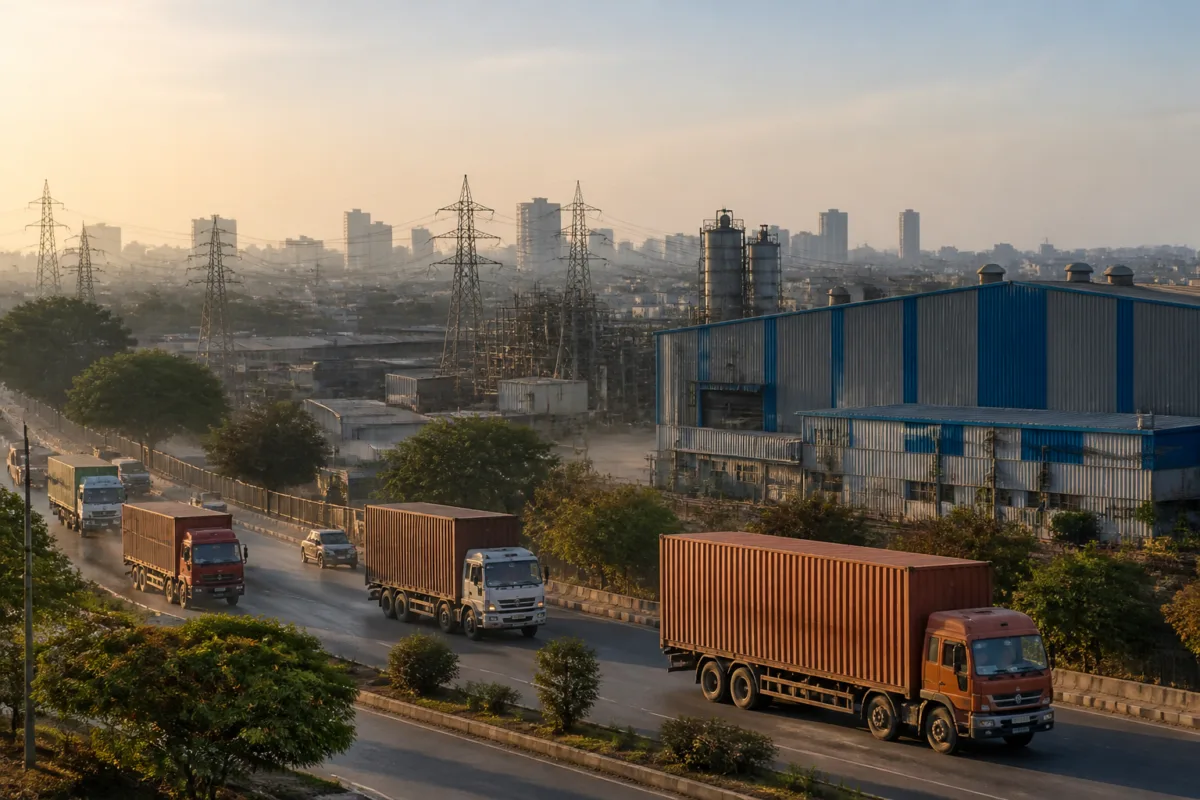
The most important message from the TOI Ideas for India 2026 summit was not that India lacks money. It was that the country may be directing too much attention towards ideas that are easy to showcase and too little capital towards the physical and organisational systems needed to make those ideas work. The discussion brought startups, artificial intelligence, global capability centres, manufacturing, power, logistics and small businesses into the same frame, revealing a central challenge for India’s urban economy: capital must reach the infrastructure beneath growth, not only the companies built on top of it.
Asish Mohapatra, co-founder of OfBusiness and Oxyzo, argued that entrepreneurs should not assume equity is the first or only source of finance. If a business has a credible idea, he said, cash can initially be drawn from operations through customer advances or supplier credit. Debt is another route, with India’s liquidity described at the summit as being 20 to 22 times the availability of equity. His broader argument was that the scarce resource is not capital but strong ideas capable of producing durable businesses.
That distinction matters for cities because urban growth depends on more than venture-backed companies. It relies on suppliers, industrial facilities, freight networks, power systems, construction capacity and the many small firms that keep larger enterprises functioning. A financing system that concentrates on equity-funded technology companies may generate visible success stories without necessarily resolving the less glamorous constraints that raise costs and reduce productivity across urban economies.
Mohapatra’s own investment preference, as described at the summit, was directed towards what he called India’s structural foundations. He identified heavy manufacturing, traditional thermal-backed power, infrastructure and logistics as areas requiring capital. While green energy attracts substantial public attention, he said he would rather invest in making thermal power more efficient. The statement does not settle the energy transition debate, but it identifies a practical tension: the existing power system remains part of the economy even as investment and policy attention move towards cleaner sources.
For cities, that tension is significant. Urban services, industrial production and logistics all depend on reliable electricity. A rapid expansion of new energy capacity does not automatically eliminate the operational importance of existing generation assets. At the same time, the discussion supplied no detailed investment plan, project list or implementation framework for improving thermal efficiency. The summit’s contribution was therefore to place reliability and system capacity alongside innovation as competing uses of capital, rather than to establish a new energy policy.
The second major theme was the condition of India’s medium and small businesses. Surinder Singh, senior vice-president at Optum Global, said he would invest in shared digital capabilities for lakhs of resource-constrained MSMEs rather than in a mega-factory. His argument was that large companies can absorb advanced technology relatively easily, while smaller firms often lack demand forecasting and logistics intelligence. “Productivity cannot stop with large companies,” he said.
This is an important urban-economy question because MSMEs are not separate from the functioning of cities. They are embedded in industrial clusters, supply chains, wholesale markets, service networks and employment systems. Yet the summit discussion did not present a national estimate of the productivity loss caused by weak digital capacity, nor did it specify who would own, fund or operate the proposed shared platforms. That gap is central. The issue is not simply whether digital tools exist, but whether smaller firms can access them at a cost and level of complexity they can manage.
Shared digital infrastructure could address part of that problem by reducing the need for every small firm to independently purchase sophisticated software, build data teams or negotiate technology contracts. But such a model would require more than software procurement. It would need common standards, trusted data practices, user support and a credible institutional operator. The summit supplied evidence of the problem and a direction for investment, but not the governance architecture required to deliver it.
The debate over artificial intelligence exposed a similar divide between technology availability and organisational readiness. Mohapatra remained sceptical about the immediate returns from AI implementation, arguing that the cost of adoption can outweigh benefits for businesses. Singh took the opposite view, saying AI is no longer an innovation theory but a core operating agenda. In his assessment, the bottleneck is not buying software; it is building data governance and risk frameworks.
Taken together, the two positions suggest that the AI question for Indian businesses is less about enthusiasm or resistance than about sequencing. Firms may be able to access tools before they have clean data, defined responsibilities or systems for managing risk. That is particularly relevant for smaller businesses and public-facing urban systems, where poor data quality can affect logistics, forecasting and operational decisions. However, the supplied discussion does not establish how many organisations are ready for AI, what implementation costs they face or which regulatory standards apply to them. Those questions remain open.
The same distinction between visibility and depth appears in the discussion of global capability centres. Singh said India’s roughly 2,500 GCCs have moved beyond their earlier image as low-cost back offices and have become global innovation centres. He also said India is “very far from peak GCC”. The point places India’s office economy within a longer transition: the opportunity is no longer limited to adding more routine employment, but extends to higher-value functions and innovation.
That transition has consequences for the built environment and urban planning, although the summit did not provide city-level data on office demand, vacancy, housing pressure or transport requirements. GCC growth can alter where skilled workers live and travel, the type of commercial space companies seek and the infrastructure required around employment districts. Yet the opportunity is not automatically inclusive. A more sophisticated office economy can coexist with weak manufacturing, constrained logistics and under-digitised small enterprises. The summit’s various speakers therefore described different parts of the same urban system rather than a single growth model.
Capital allocation is the connecting issue. Mohapatra said his founders’ fund has backed 50 to 60 startups in manufacturing and financial services, presenting this as evidence that founders of successful companies are recycling wealth into newer businesses. That flow can broaden access to finance, especially where conventional equity funding is limited. But startup investment alone cannot substitute for public infrastructure, utility reliability, industrial policy or institutional capacity. Private capital may identify promising firms, while governments and public agencies remain responsible for many of the systems on which those firms depend.
This division of responsibility is especially visible in infrastructure and logistics. A company can improve its own operations, but it cannot independently resolve road congestion, power constraints, fragmented freight systems or the absence of common digital standards. Similarly, a small manufacturer may be willing to adopt forecasting software but remain limited by weak demand, unreliable suppliers or expensive transport. The summit’s emphasis on debt, supplier credit and customer advances points to financing mechanisms within firms; its emphasis on infrastructure and logistics points to constraints beyond the firm.
The evidence presented at the summit supports a cautious conclusion. India’s growth challenge is not adequately described as a shortage of capital or a shortage of technology. It involves the distribution of capital, the quality of infrastructure, the readiness of organisations and the ability of smaller firms to participate in productivity gains. The speakers disagreed on the near-term value of AI and expressed different investment preferences, but both placed implementation capacity at the centre of the discussion.
For urban policymakers, the larger question is whether investment agendas can connect high-growth sectors with the physical networks and smaller enterprises that support them. For businesses, it is whether financing can be secured from operations and debt without ignoring the need for stronger systems. For cities, it is whether the next phase of economic growth will be built only around visible corporate and technology centres or also around the industrial, logistical and service ecosystems beneath them. The summit did not answer that question, but it made clear that India’s infrastructure needs cannot be separated from its startup, AI and MSME strategies.

