


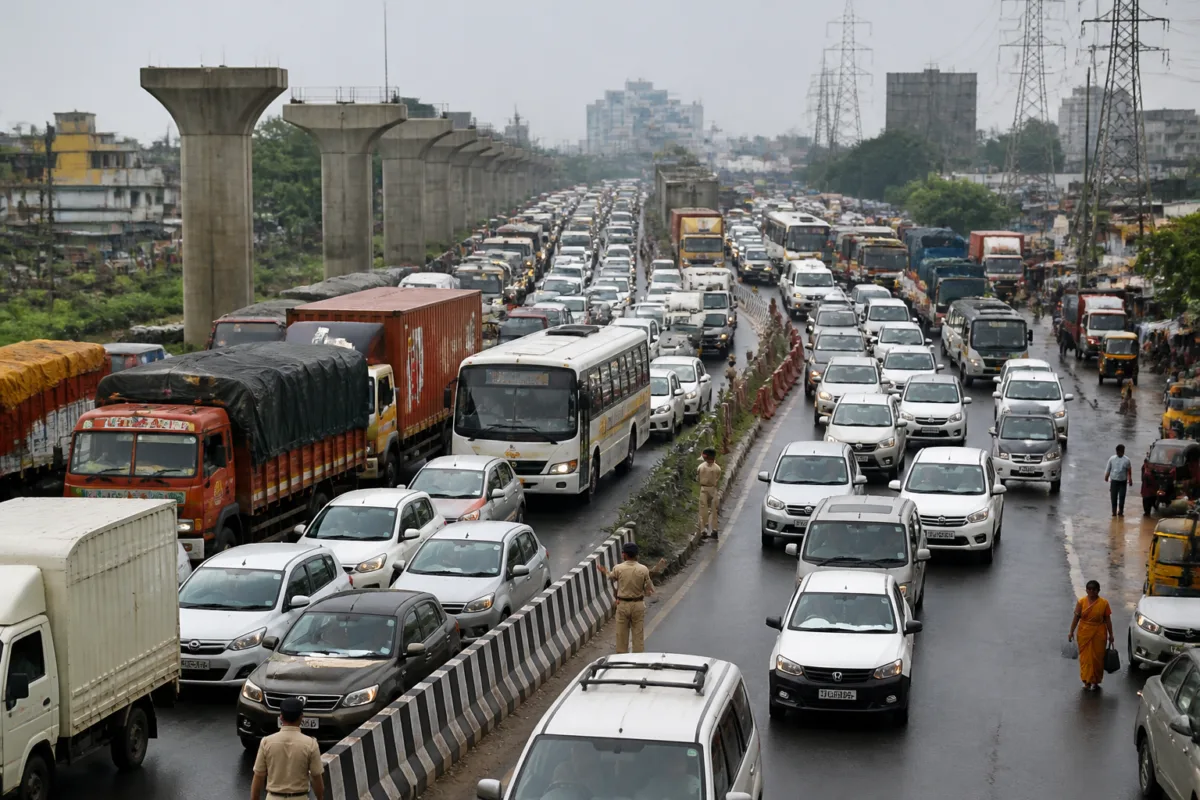
The Pune-Nashik Highway is expected to face heavier congestion ahead of the October 31 flag-hoisting ceremony for the Simhastha Kumbh Mela in Nashik and Trimbakeshwar, with pilgrim vehicles likely to add to existing industrial and commercial traffic between Nashik Phata and Rajgurunagar.
The highway is a key route for devotees travelling from Pune and western Maharashtra to Nashik. It is also a busy freight corridor connecting major urban and industrial areas. Traffic queues are commonly reported during the morning and evening peaks, when the approximately 21-kilometre stretch between Ambethan Chowk and Nashik Phata can take one to one-and-a-half hours to cross. During severe congestion, the journey can extend beyond two to three hours.
The expected increase in vehicles for the flag-hoisting ceremony could add pressure to a corridor already carrying heavy vehicles throughout the day. The congestion is linked to industrial traffic from the Talegaon Dabhade, Chakan and Ranjangaon areas, as well as vehicles travelling via Chakan towards Mumbai, Ahilyanagar and Chhatrapati Sambhajinagar. Vehicles transporting agricultural produce to the Pune and Mumbai agricultural market committees also use the route.
Traffic authorities are preparing additional measures for the expected increase in pilgrim movement. Vikrant Deshmukh, deputy commissioner in the Pimpri-Chinchwad traffic branch, said additional police personnel would be deployed along the highway. He said cranes would be made available to remove breakdown vehicles and that authorities would ensure vehicles were not parked on either side of the road.
The traffic police are also expected to manage vehicle movement at congestion-prone locations and provide information about alternative routes where necessary. The report did not specify a dedicated traffic diversion plan or a time-based restriction on heavy vehicles for October 31.
Work is also under way on parts of the highway. Dileep Shinde, technical consultant chief at the National Highways Authority of India, said junction widening, shoulder-filling and the closure of unnecessary road dividers were in progress. According to Shinde, these works are intended to help improve traffic flow.
The immediate challenge is the overlap between routine freight movement and a temporary increase in passenger vehicles travelling to the religious event. With industrial transport, market-bound agricultural vehicles and pilgrim traffic using the same corridor, the authorities’ response will depend on keeping junctions clear, removing disabled vehicles quickly and preventing roadside parking.
The additional police deployment, crane availability and ongoing junction works are the measures identified by the Pimpri-Chinchwad traffic branch and the National Highways Authority of India ahead of the October 31 ceremony.

