


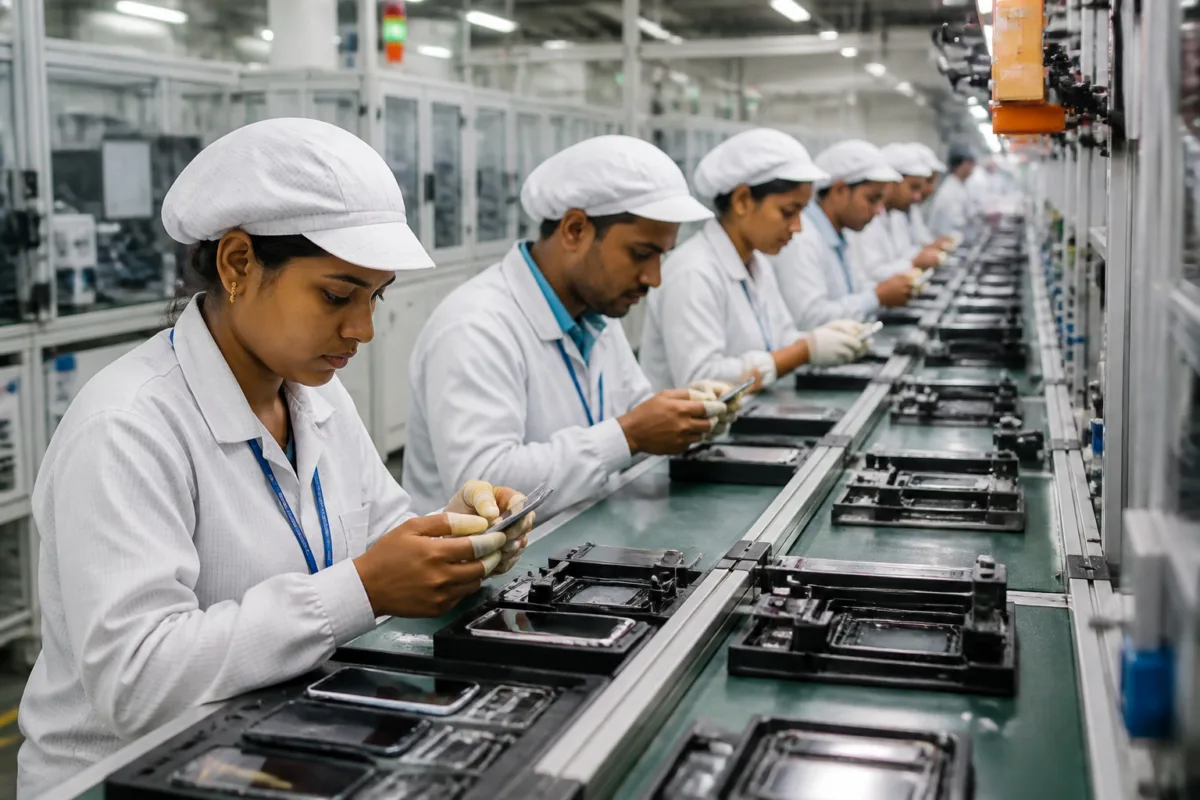
India’s mobile manufacturing sector has generated Rs 25,000 crore in direct tax collections and created 12 lakh jobs, Union electronics and information technology minister Ashwini Vaishnaw said on Wednesday, as the government defended its production-linked incentive model and outlined a larger scheme for the industry.
Vaishnaw said the sector’s direct tax contribution had exceeded the Rs 19,000 crore paid by the government as incentives under the existing production-linked incentive (PLI) scheme. He also attributed Rs 3,000 crore in Goods and Services Tax collections to the sector.
“Electronics manufacturing employs 25 Lakh people; mobile manufacturing alone employs 12 Lakh,” Vaishnaw said, highlighting the employment scale of an industry that has become a major part of India’s electronics manufacturing base.
The minister’s comments came as he dismissed reports questioning the effectiveness of India’s mobile manufacturing model. The government is now seeking to build on the existing production base by expanding output, increasing domestic sourcing of components and strengthening India’s position in global electronics supply chains.
The Union Cabinet approved the Mobile Phone Manufacturing Scheme (MPMS) in July with an allocation of Rs 62,500 crore. The programme will operate from financial year 2026-27 to financial year 2030-31. It is intended to increase mobile phone production, raise domestic value addition, strengthen supply chains and improve the global competitiveness of the industry.
Under the scheme, eligible mobile phone sales will receive incentives ranging from 2.25% to 5%. Companies can receive an additional benefit of up to 1.5% for domestic sourcing of key components and sub-assemblies. The programme also includes support for Indian mobile brands, with incentives linked to design and research and development.
According to the Ministry of Electronics and Information Technology, mobile phone production during the scheme’s tenure is expected to total approximately Rs 39 lakh crore. Exports are also projected to rise significantly, although the supplied figures do not specify the expected export value or the locations where additional manufacturing capacity will be created.
The new programme is expected to create around 60,000 direct jobs. That projected figure is separate from the 12 lakh mobile manufacturing jobs cited by Vaishnaw while defending the results of the earlier incentive programme.
The MPMS follows the completion of the Production Linked Incentive Scheme for Large Scale Electronics Manufacturing on March 31, 2026. Its design marks a shift from simply expanding assembly capacity towards deeper domestic sourcing, stronger component supply chains and the promotion of Indian-owned mobile brands. Implementation will begin in financial year 2026-27 and continue through financial year 2030-31.

