


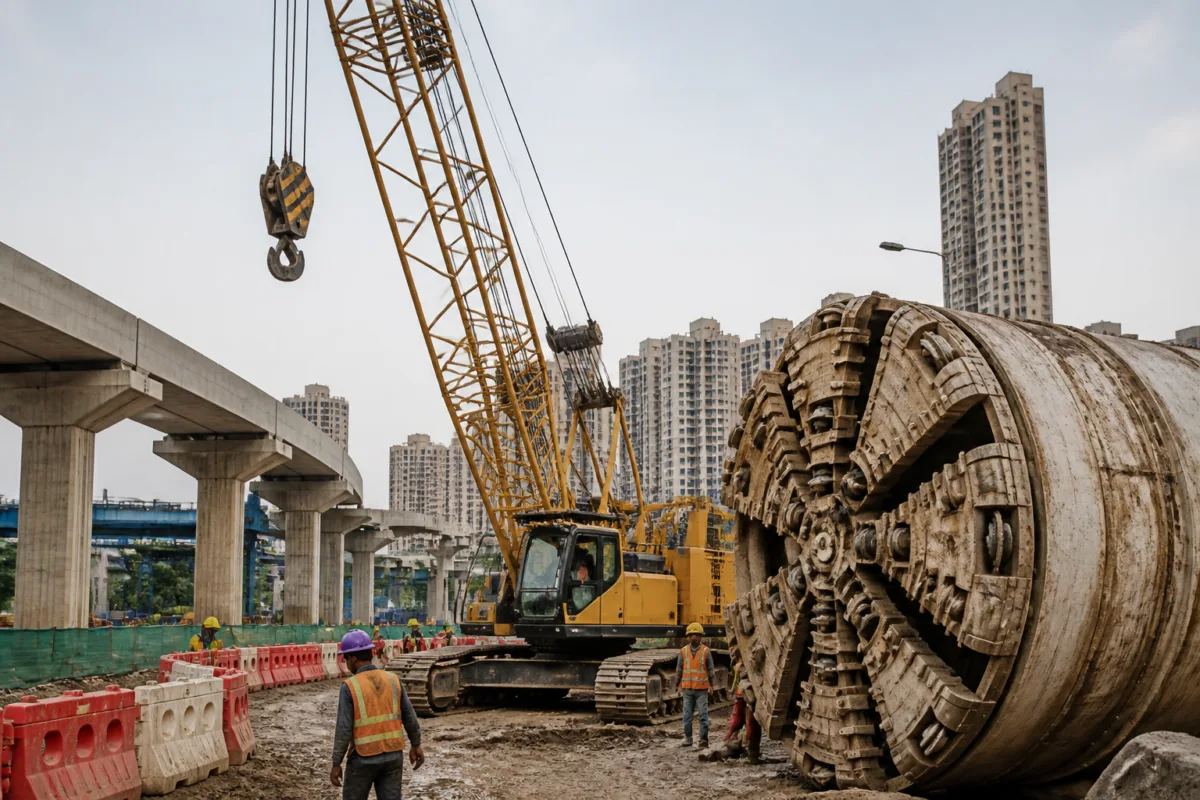
India’s plan to promote domestic production of around 120 products is moving beyond consumer goods and electronics into the machinery and industrial systems that determine how quickly the country can build infrastructure. The exercise, being driven by the Department for Promotion of Industry and Internal Trade (DPIIT), includes construction equipment, cranes, machine tools and a separate plan for tunnel boring machines after China imposed restrictions on their shipments, according to a report by The Times of India.
The significance of the exercise lies in what it attempts to address: not only the availability of finished products, but also the missing links in the production chains behind them. The products identified so far include intermediates, capital goods, chemicals such as acetic acid, pharmaceutical products and inputs, medical technology items, machine tools, textile looms, aerospace maintenance, repair and operations products, and parts of the footwear value chain. The list is still under discussion with other government agencies, and the report does not indicate that a final policy package has been notified.
For the built environment, the inclusion of construction equipment, cranes and tunnel boring machines is especially important. These are not ordinary consumer imports that can be substituted without affecting the wider economy. They are inputs into the delivery of roads, metro systems, tunnels, buildings, industrial facilities and other urban infrastructure. A shortage or delayed shipment of such machinery can affect project schedules even when funding, land and contracts are already in place.
Tunnel boring machines illustrate the vulnerability more clearly than most products. They are specialised systems used to excavate underground passages and are central to several forms of urban infrastructure, including metro and utility tunnels. The government is working on a separate plan for such machines following Chinese restrictions on shipments, the report said. The available material does not specify the nature, duration or commercial scope of those restrictions, but their inclusion in the policy discussion indicates that access to specialised construction technology is being treated as a strategic manufacturing concern.
The DPIIT-led exercise also suggests a shift in the way industrial policy is being framed. Earlier support programmes focused substantially on sectors such as pharmaceuticals, electronics, semiconductors, solar power equipment and white goods. The new list brings industrial machinery and intermediate products more visibly into the same policy conversation. That matters because local assembly of a final product does not necessarily mean the underlying production ecosystem is domestic.
The report identifies three broad interventions under consideration. The first is short-term protection for selected products so that Indian manufacturers can manage overseas competition, particularly from China, while supplies are diversified. The second is support for cost disadvantages through incentives, which could take the form of capital assistance or payments phased over a period and linked to turnover. The third is research and development assistance for products where the required technology is not currently available in the country.
Together, these proposals reveal the government’s attempt to address three different barriers: price competition, the cost of setting up capacity and the absence of domestic technology. Treating all three as the same problem would produce a weaker policy. A manufacturer may have the ability to make a product but be unable to compete with lower-priced imports. Another may require capital support to establish a production line. A third may not yet possess the design, process knowledge or intellectual property needed to make the product at scale. The proposed structure recognises these distinctions, although the report does not provide product-level details on which intervention would apply to which item.
The reference to mobile phones provides the clearest precedent in the supplied material. The government had adopted a similar strategy in the early years of domestic mobile-phone production, using support to help companies build local capacity while competing with imports. The report also links the current discussion to production-linked incentive schemes, the two semiconductor missions and a programme aimed at increasing domestic production of electronic components.
That experience has produced an important policy complication. A product can be described as locally produced even when critical components remain imported. The report cites battery production as an example: companies that have begun local production are essentially importing cells from China and selling battery packs, because the production chain and technology remain controlled by companies across the border. A similar pattern, it says, has been seen in solar panels.
This distinction is directly relevant to construction equipment. Manufacturing a crane, excavator or tunnel boring machine in India could still leave the country dependent on imported motors, control systems, specialised steel, electronics or software. The source does not establish which components of construction equipment are currently imported or how much domestic capacity exists. It does, however, show why the government is considering research and development support alongside protection and financial incentives: production capacity without control over critical technologies can reduce, but not eliminate, supply-chain vulnerability.
The urban consequences are therefore tied to the depth of localisation rather than simply the number of products added to a domestic list. If support results mainly in assembly, infrastructure agencies may continue to face exposure to external suppliers for the components that determine machine availability, maintenance and performance. If it supports a wider ecosystem of parts, engineering capability and research, the effect could extend to the resilience of infrastructure delivery. The present report does not establish which of these outcomes will follow.
The policy is also being shaped by recent disruptions. According to the report, the Atmanirbhar Bharat strategy has received renewed attention after the West Asia crisis, when several critical items were in short supply locally because of high import dependence. The Covid period provided another example, with supplies of products including medical inputs disrupted while China controlled important production chains. These events have broadened the policy argument from industrial growth to continuity of supply.
For cities, that distinction is material. Urban infrastructure projects operate through long chains of contractors, equipment suppliers, component manufacturers and maintenance providers. A disruption in one part of that chain can affect construction activity even if the project’s formal implementing agency is not directly dependent on a single foreign supplier. The source does not quantify delays or costs caused by such disruptions, so their impact should not be assumed. But the government’s decision to include capital goods and construction equipment in the exercise indicates that supply security is being considered at the level of infrastructure inputs, not only finished consumer products.
The institutional structure will determine whether the initiative moves beyond a broad product list. DPIIT is driving the exercise, but discussions are continuing with other government agencies. That suggests implementation will require coordination across industrial policy, finance, sectoral ministries and agencies responsible for infrastructure or strategic technologies. The report does not identify the agencies involved, the proposed budget, the eligibility criteria or the timeline for final decisions.
This uncertainty is important because each intervention creates different administrative requirements. Short-term protection would require decisions on the products covered and the period for which support remains in place. Capital incentives would require a funding mechanism and rules for measuring investment or output. Turnover-linked assistance would need safeguards to ensure that reported production reflects meaningful domestic value addition. R&D support would require a way to assess technology gaps and determine which projects can build capabilities rather than merely replicate imported systems.
The product list also raises a question about how success will be measured. Counting factories or announced investments would not be enough to establish whether dependence has been reduced. The battery and solar examples cited in the report show the difference between local assembly and control over the full production chain. For construction equipment and tunnel boring machines, relevant indicators would include the domestic availability of critical components, engineering and maintenance capabilities, technology development and the ability to continue supplies during an external disruption. The supplied material does not say whether such indicators have been finalised.
India’s local manufacturing push is therefore becoming relevant to the built environment in two ways. It may influence the availability and cost of equipment used to build infrastructure, and it may determine whether future infrastructure expansion is supported by a dependable domestic industrial base. The immediate announcement is the identification of around 120 products, not a completed programme. The next developments to monitor are the final product list, the agencies involved, the form of protection or incentives, the treatment of research and development, and the separate plan for tunnel boring machines.

