


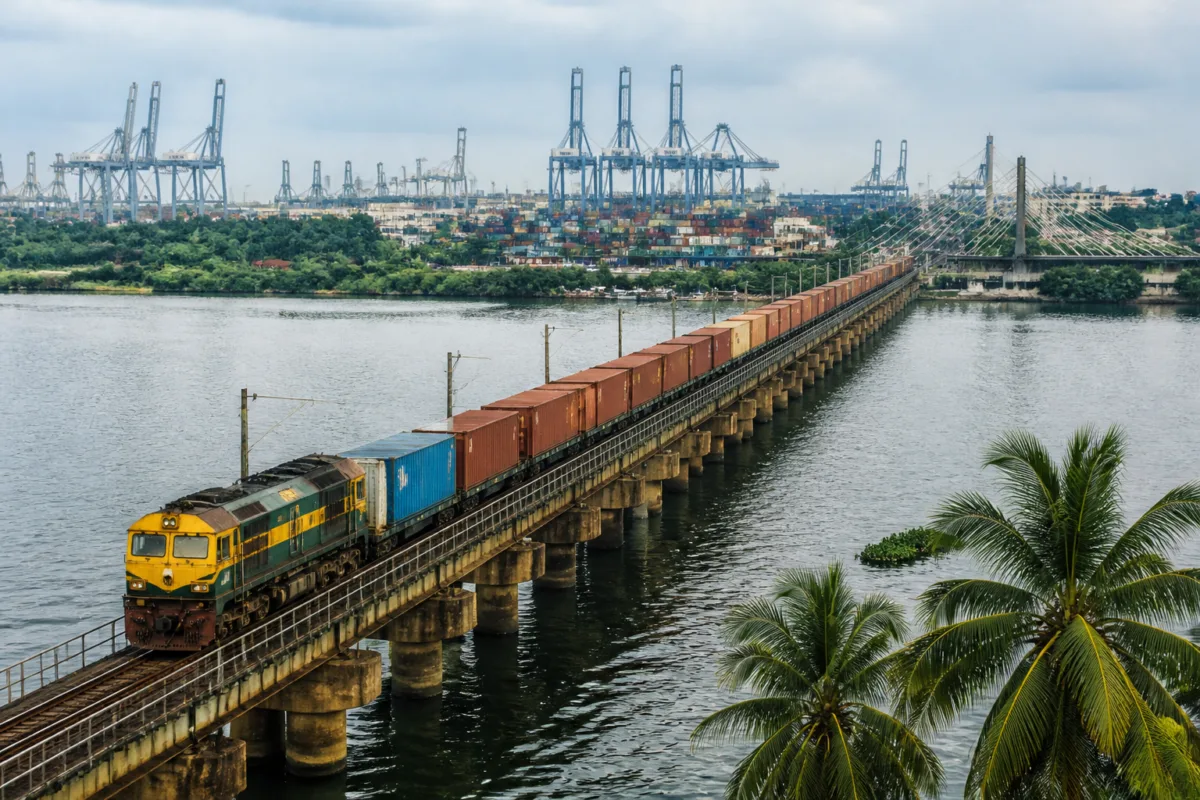
The gradual return of container trains to Vallarpadam Container Terminal is reviving a rail link that had remained largely unused for years, but the real test is whether Kochi can convert intermittent freight movement into a dependable multimodal logistics system. Container trains have begun arriving once or twice a month after a three-year period during which not a single train reached the terminal, according to a report by Kerala Kaumudi – Kochi.
The rail line was commissioned in 2011 as part of the infrastructure supporting Vallarpadam, which began with the expectation that India’s first container transshipment terminal would substantially strengthen Kochi’s position in maritime trade. When the terminal did not progress as anticipated, the railway connection also remained underused. Its recent activity therefore represents more than the return of a few freight services: it shows that the value of a major transport asset depends on the performance of the wider port, shipping and cargo network around it.
The services are being operated by the Container Corporation of India. Containers began arriving by rail from May, and the movement has continued at a frequency of roughly one or two trains a month over the following six months. The report also states that containers carrying export cargo have started arriving by rail, rather than being used only for one-way or empty-container movements.
That distinction is important for the economics of freight. A rail connection is most useful when it carries cargo in both directions and links the port with production centres and domestic markets. Empty containers returning from a terminal provide movement, but loaded containers moving towards the terminal for export indicate that businesses are using the system as part of their supply chain. The report identifies Bharat Petroleum Corporation as one example: the company has transported 360 containers of tar, a movement described as a positive sign for the port because loaded containers are leaving by rail.
The Vallarpadam rail corridor was built at a reported cost of Rs 350 crore. It is 8.86 kilometres long, including a 4.62-kilometre stretch across Vembanad Lake between Vaduthala and Vallarpadam. The lake crossing is described as the country’s second-longest railway bridge of its kind. These figures underline the scale of the public infrastructure involved and the gap between building connectivity and ensuring that freight actually uses it.
The central institutional question is now shifting from construction to utilisation. Port authorities are holding discussions with the Container Corporation of India to bring in more cargo, while Dubai Ports, the terminal operator, is considering measures to attract additional exporters. The report does not establish a fixed target for train frequency or cargo volumes, but it does indicate that port and terminal authorities are treating the recent services as an opening for broader freight mobilisation.
Vallarpadam’s performance is also linked to the shipping services available to cargo owners. A new fortnightly service began in September, connecting Kochi and Nhava Sheva with Fujairah in the United Arab Emirates, Sohar in Oman and Aden in Yemen. Such connections expand the destinations that can be served through the terminal, while stronger inland rail links can determine whether manufacturers and traders are willing to route their cargo through it.
The report states that efforts are under way to move cargo from companies with production units in Kerala to destinations including north India. This is the inland geography that Vallarpadam must capture if the rail line is to become a regular freight asset. A port does not operate independently of its hinterland. Its competitiveness depends on how efficiently cargo can move between berths, terminals, factories, warehouses, distribution centres and final markets.
Kochi’s rail revival therefore illustrates a familiar infrastructure problem: physical capacity can exist long before commercial demand is organised around it. The Vallarpadam line was completed and commissioned, but rail activity remained limited because the terminal’s expected growth did not materialise at the required scale. The current movement suggests that cargo availability, shipping connectivity and operator coordination may be beginning to align, although the evidence supplied so far points to an early-stage recovery rather than an established freight shift.
The road-versus-rail question gives the development a direct urban dimension. If containers travelling to and from Kerala and other states can increasingly use rail, some freight movement could be removed from the road network. The report links this possibility to lower congestion caused by container lorries and to reduced freight costs. It does not quantify the number of truck trips that could be displaced or the savings achieved, so the scale of the benefit remains unestablished. Nevertheless, the direction is clear: rail can offer a way to connect the port with distant markets without placing every container movement on roads around Kochi and its wider industrial region.
The potential benefits also depend on the type of cargo being handled. Export containers arriving by rail for shipment are one component. Imported containers moving onwards to domestic markets through the port are another. The source notes that such import containers could be sent through the port to inland markets, indicating that Vallarpadam’s opportunity is not limited to exports or transshipment. It could also serve as a gateway for domestic distribution if reliable rail services connect it to consumption and production centres.
This requires coordination across institutions with different responsibilities. The Container Corporation of India operates the train services. Port authorities are negotiating for additional cargo. Dubai Ports, as terminal operator, is considering exporter-attraction measures. Shipping lines determine maritime connectivity, while manufacturers, traders and logistics companies determine whether the combined service is commercially useful. The rail line’s performance will consequently depend on decisions beyond the railway track itself.
The new fortnightly shipping service adds another layer to this institutional arrangement. Its links with Nhava Sheva, Fujairah, Sohar and Aden give Vallarpadam a specific regional maritime network. But shipping connectivity alone cannot guarantee growth. Cargo owners must also find the port competitive in terms of inland movement, frequency, cost and reliability. The renewed rail services are significant because they address one part of that wider logistics chain.
The available numbers show both the infrastructure commitment and the limited scale of the revival so far. The line cost Rs 350 crore to build, extends 8.86 kilometres and includes 4.62 kilometres across Vembanad Lake. Against that substantial asset, the recent operating pattern is one or two container trains a month. The comparison does not establish that the infrastructure is underperforming permanently, but it does show why regular utilisation matters. A line designed to support a major container terminal cannot deliver its full urban and economic value through occasional movement alone.
The 360 containers of tar moved by Bharat Petroleum Corporation provide a concrete example of cargo using the rail link, but one company’s movement cannot yet be treated as evidence of a broad freight transition. The report says that authorities are seeking more exporters and more cargo, which indicates that scale-up remains an active objective. The next measure of progress will be whether additional companies begin using the corridor and whether services become more frequent and predictable.
For Kochi, the larger issue is whether port infrastructure can be integrated with the region’s industrial geography. Kerala-based production units need dependable links to national markets, while imported goods need efficient routes to domestic destinations. A rail-connected terminal can support both movements, but only when cargo volumes justify regular services and when the port, rail operator, shipping lines and logistics users work as one network.
Vallarpadam’s rail activity has therefore moved from prolonged inactivity to cautious revival. The evidence confirms renewed container movement, export cargo by rail, discussions for additional services and a new maritime connection. It does not yet establish a sustained transformation in freight volumes or a measurable reduction in road traffic. The developments that deserve monitoring are the frequency of container trains, the number and diversity of participating exporters, the movement of import cargo to inland markets and whether the new shipping service generates enough demand to keep the rail corridor active.

