


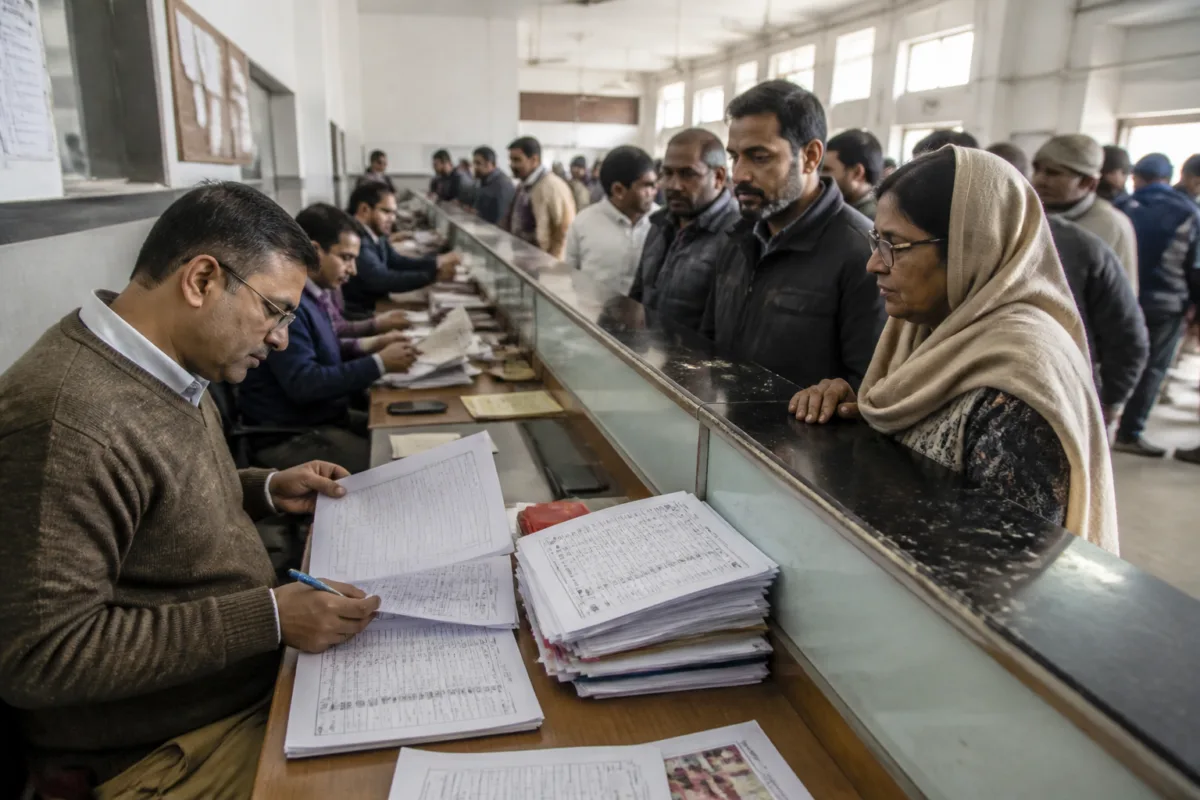
Delhi’s Special Intensive Revision of electoral rolls has reached a critical administrative stage: nearly 1.87 lakh cases remain outside the disposed-of category even as the deadline for completing the process approaches. The unresolved figure is not simply a backlog. It exposes a more consequential question about how the capital’s electoral administration will distinguish between names retained, names removed and cases still awaiting a decision before the final roll is published.
Figures released by the Chief Electoral Officer, Delhi, show that notices were issued to 33,14,032 electors. Of these, 31,26,576 cases, or 94.34 per cent, have been disposed of and parked for inclusion in the final electoral roll. The remaining 1,87,456 cases account for the gap between the total number of notices and the cases classified as disposed of.
The process is scheduled to move through several deadlines. The deadline for filing claims and objections is October 30, the deadline for disposing of notices is November 30, and the final electoral roll is scheduled for publication on December 4. These dates make the status of the remaining cases central to the credibility of the exercise, particularly because the latest figures do not provide a detailed breakdown of whether the cases have been approved, rejected or remain pending.
That distinction matters. In administrative terms, disposing of a notice does not necessarily establish that an elector’s name has ultimately been retained. A notice may lead to a case being resolved for consideration, but the figures supplied in the report do not show the final outcome for every case. Without that breakdown, the headline disposal rate offers only a partial view of how many electors will appear in the final roll.
The notices arose from two broad categories. The first involved non-mapping cases, numbering 13,79,789, in which electors could not be linked to the electoral rolls from the last Special Intensive Revision conducted in 2002. The second category comprised 19,34,243 cases involving logical discrepancies flagged by the system.
The categories point to two different administrative problems. Non-mapping indicates a break in the link between a current elector and the earlier roll used for comparison. Logical discrepancies, by contrast, concern inconsistencies identified through the revision process. Treating both categories as a single total can obscure the different kinds of evidence residents may need to provide and the different decisions electoral officials may have to make.
According to the Chief Electoral Officer’s office, notices were generated in all logical-discrepancy cases. Following instructions issued by the Election Commission on September 29, Electoral Registration Officers and Assistant Electoral Registration Officers collected supporting documents. This process resolved 18,96,675 cases, representing 98.05 per cent of the logical-discrepancy category, for consideration in the final roll.
The figure is substantial, but it also illustrates why the administrative language of resolution requires careful reading. The cases were resolved for consideration in the final roll; the material supplied does not state that every one of these electors has been definitively retained. The difference between document collection, notice disposal and final inclusion is therefore not a technical detail. It is the central institutional question in the last phase of the revision.
The scale of the exercise becomes clearer when compared with the size of Delhi’s roll at different stages. The draft electoral roll published on August 31 contained 97,53,577 electors. At the beginning of the revision exercise, the roll had 1,45,10,299 electors. That is a difference of 47,56,722 names between the earlier figure and the draft roll.
The enumeration phase recorded these 47,56,722 electors as cases involving people who were absent, had shifted, were dead or appeared as duplicates. The supplied figures do not provide a category-wise division of this total. As a result, they show the scale of the change but do not independently establish how many names were removed for each reason.
This is where the process moves beyond a routine update of an electoral database. Electoral rolls are an essential civic register, but they also depend on continuous administrative work: identifying residents, checking records, issuing notices, receiving documents, adjudicating objections and publishing an accurate final list. Each stage produces a different kind of record. A total number of notices does not show how many voters were affected; a disposal figure does not show the final decision; and a draft roll does not settle the position until claims and objections are processed.
For residents, the immediate consequence is the need to verify whether their names appear in the draft roll and to use the claims and objections process where necessary. The Election Commission has urged residents to check their names and submit claims or objections. The October 30 deadline is therefore an important point of public participation in a process that has already involved more than 33 lakh notices.
The administrative burden is also visible in the numbers. Electoral Registration Officers and Assistant Electoral Registration Officers have had to process nearly 19 lakh logical-discrepancy cases after the Election Commission’s September 29 instructions. The reported 98.05 per cent resolution rate indicates significant processing activity, but it does not answer whether the remaining cases have been rejected, retained for further consideration or left pending.
That missing breakdown is the most important evidence gap in the current account. It prevents readers from assessing the precise risk at the end of the process. A pending case may still be resolved before November 30. A rejected case may be subject to a claim or objection. An approved case may be included in the final roll. These outcomes have different implications, but the available figures combine them within a single unresolved total or describe cases as disposed of without publishing the final status of each category.
The issue is particularly significant in Delhi because the revision has produced a large numerical change between the roll at the start of the exercise and the draft roll published on August 31. The earlier roll contained 1,45,10,299 electors, while the draft roll contained 97,53,577. The reduction is linked in the supplied report to cases categorised as absent, shifted, dead or duplicate, but the available information does not establish the share attributable to each category or the number of names subsequently restored.
That distinction should shape how the final figures are interpreted. A lower draft-roll total can reflect genuine changes in the electorate, including migration, deaths and duplicate entries. It can also create a need for stronger public checking where residents have been incorrectly classified or have failed to return forms. The supplied data confirms the scale of the change, but not the accuracy of every individual classification.
The revision’s institutional structure places responsibility at multiple levels. The Election Commission issued instructions, while the Chief Electoral Officer’s office released the figures and Electoral Registration Officers and Assistant Electoral Registration Officers handled notices and supporting documents. The final roll will therefore represent the outcome of a chain of decisions rather than a single data operation.
That chain also explains why transparency about case status is important. Residents need to know not only that their documents were received, but what decision followed. Officials need to distinguish between cases resolved administratively and names finally included. Public scrutiny depends on the same distinction, because it allows the draft and final rolls to be compared using more than a headline disposal percentage.
The next dates provide the structure for that scrutiny. Claims and objections are due by October 30. Notices are to be disposed of by November 30. The final electoral roll is scheduled for December 4. The decisive evidence will be the final category-wise outcome: how many cases were retained, how many were excluded, how many objections were accepted and how many remained unresolved at the end of the process.
Delhi’s electoral roll revision therefore presents two parallel stories. The first is an administrative achievement, with 31,26,576 of 33,14,032 noticed cases reported as disposed of and 18,96,675 logical-discrepancy cases resolved for consideration. The second is an accountability gap, because the available figures do not yet explain the final status of the remaining 1,87,456 cases or confirm how the large reduction from the earlier roll will translate into the final list.
Until those details are published, the most defensible conclusion is limited but important: the revision has processed the overwhelming majority of notified cases, while a substantial number still require a clear final status. The October 30 claims deadline, the November 30 disposal deadline and the scheduled December 4 publication of the final roll will determine whether that gap is closed transparently.

