


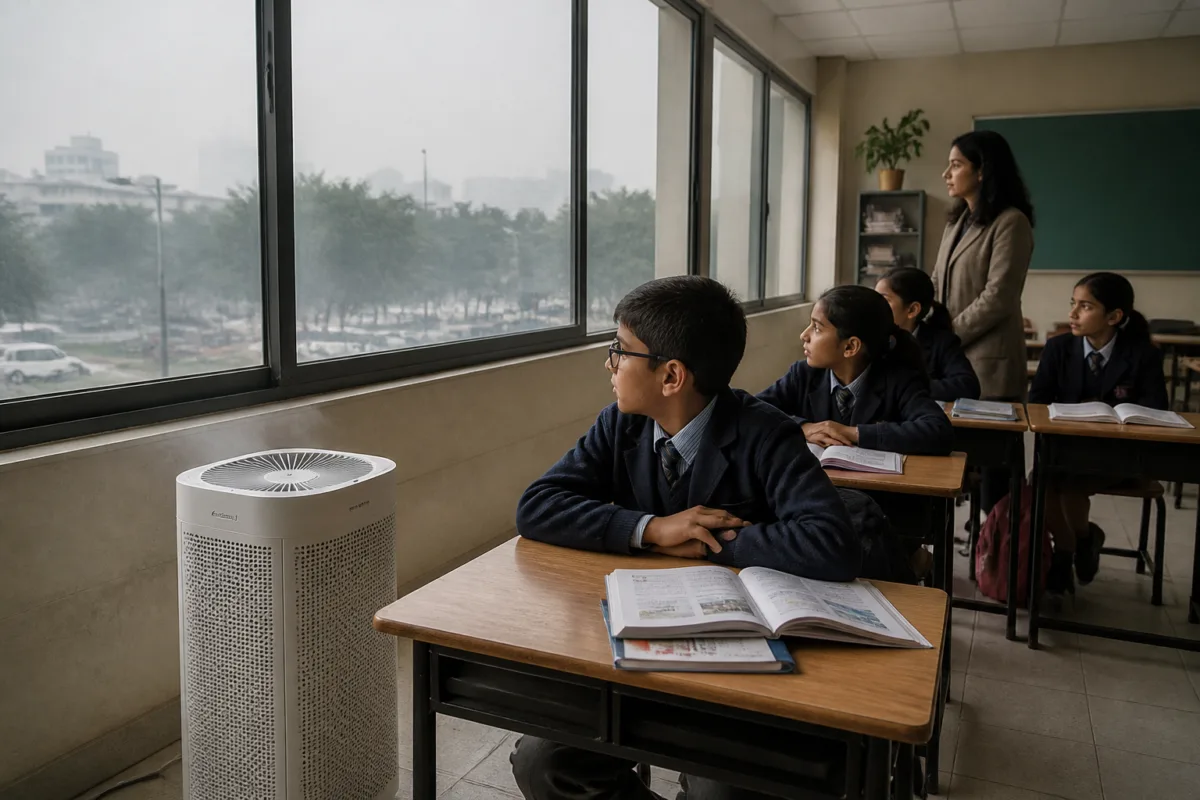
Delhi air pollution is no longer being experienced only as an outdoor public-health problem. A report from Jagran – New Delhi says some parents are sending children to school with portable air purifiers, while questioning whether schools are providing a safe indoor environment during the winter pollution season. The development exposes a difficult urban governance question: when air quality deteriorates, who is responsible for making classrooms safe—the school, the public authorities or individual families?
The reported response from parents is significant because it shifts the burden of protection from institutions to households. Families are buying equipment for children who spend a substantial part of their day inside classrooms, even as schools remain responsible for operating those spaces. The concern is not simply whether a purifier exists, but whether indoor air is being measured, whether equipment is correctly installed and maintained, and whether all students receive the same level of protection.
According to the report, parents have asked school managements what happened to air purifiers used in the previous year. They were reportedly told that as students moved into higher classes, the equipment moved with them. That explanation points to a logistical weakness in how classroom air-quality measures are planned. If equipment is treated as belonging to a particular cohort rather than as shared school infrastructure, younger students may be left without equivalent protection when the next pollution season arrives.
The episode also shows how a seasonal emergency can become an annual administrative problem. Delhi’s winter pollution is recurring, yet the reported arrangements appear to depend on individual school decisions, parent consent and one-time contributions. A school may purchase equipment during one season, move it between classrooms or attach the cost to a particular fee cycle, but those steps do not by themselves establish a durable indoor-air-quality system.
The report cites an internal school communication concerning Tagore International School in Vasant Vihar. The communication said a project had cost approximately Rs 63.3 lakh, with a one-time contribution of about Rs 3,800 per student. A November 2025 circular reportedly proposed installing two air purifiers in every classroom after receiving the consent of 85-90% of parents. It proposed adding a one-time charge of Rs 600 to the December fee for students from nursery to Class 11, excluding Economically Weaker Section students.
These figures reveal the administrative mechanics behind what can otherwise appear to be a simple purchase of appliances. A school-wide purification programme requires capital expenditure, recurring maintenance, replacement filters, electricity, monitoring and a method of deciding which rooms receive equipment first. It also raises questions about whether a one-time fee can cover a system whose effectiveness depends on continued operation and upkeep.
The exclusion of EWS students from the proposed charge is an important detail because it shows that the school recognised the need to distinguish between families’ ability to pay. At the same time, a parent-funded model can still create unequal protection if equipment, maintenance or classroom monitoring varies between schools. Children’s exposure to polluted air should not depend on whether their parents can buy a personal purifier or whether a school can mobilise additional contributions.
One parent quoted in the report, Deepali Jain, said her child had recently started attending school and that she was concerned about the environment in which the child was breathing. She also questioned whether parents could verify classroom air quality. Her concern goes beyond access to a device. It is about information asymmetry: schools control the classroom environment, while parents may have little visibility into ventilation, filtration performance or actual air-quality readings during school hours.
That information gap matters because the presence of an air purifier is not the same as proof of clean air. Experts cited in the report warned that installing a purifier inside a room alone cannot ensure pollution-free air. A device may be switched off, inadequately sized, poorly maintained or unable to address pollutants entering through doors, windows and other pathways. Without measurements and maintenance records, parents cannot easily assess whether the intervention is working.
This is where the issue moves from consumer choice to institutional governance. A school that asks parents to finance equipment also needs a clear system for disclosing what is being purchased, where it will be installed, how it will be maintained and how performance will be checked. The available report does not establish that such a standardised monitoring system exists. It does, however, document parents’ demand for clarity and their concern that school-level promises may remain confined to paperwork.
The reported movement of purifiers between classes illustrates another problem: infrastructure that is not planned at the scale of the institution can become unevenly distributed. Classrooms differ in size, occupancy, ventilation and exposure to outdoor pollution. Two purifiers in one room may not provide the same result as two purifiers in another. A uniform number of machines does not necessarily amount to a uniform level of protection.
The school’s proposed consent threshold of 85-90% also highlights the tension between collective infrastructure and individual funding. If most parents approve a project, the equipment may be installed across classrooms. But air quality is not a service that affects only the families who consented. Every child and staff member in the building shares the indoor environment. That makes the issue comparable to other school safety systems, where standards generally need to apply across the premises rather than operate as optional amenities for selected groups.
The report also records parents’ criticism that schools charge substantial fees but continue to seek additional contributions for essential requirements and activities. That allegation is a parent’s view and cannot, on the supplied evidence, be generalised to all schools. It nevertheless identifies a recurring governance concern: whether costs for basic health and safety measures are being treated as exceptional expenses to be recovered from families instead of as part of routine institutional planning.
Delhi’s schools operate within a wider urban system in which pollution is generated and transported across neighbourhood boundaries. Individual schools cannot control the city’s emissions, but they do control many aspects of the indoor environment, including building operation, classroom access, ventilation practices, maintenance routines and communication with families. The municipal and education authorities, meanwhile, have a role in setting expectations and ensuring that schools do not respond in entirely different ways to the same seasonal risk. The supplied report does not identify a common city-wide framework governing these arrangements.
That absence is important because a school-by-school response can produce a fragmented safety landscape. One institution may install purifiers in every classroom; another may rely on outdoor air circulation; a third may ask parents to provide personal devices. Families then face different levels of protection even when children live in the same polluted city. The market becomes a substitute for a public standard, and purchasing power begins to influence the quality of the indoor environment.
The evidence in the report does not establish how effective the Vasant Vihar project has been, whether the purifiers remained operational, or whether classroom air quality was measured before and after installation. It also does not establish how many Delhi schools have adopted comparable arrangements. Those are important gaps. A credible assessment would require information on equipment specifications, classroom size, filter replacement, operating hours, indoor readings and the allocation of responsibility between school management and parents.
What the report does establish is that the current arrangement has generated distrust. Parents are asking where last year’s equipment went, why younger classes may lack purifiers, whether classrooms are being monitored and why families should bear the cost of protecting children from a city-wide condition. Those questions cannot be answered by procurement alone. They require transparent records and a clearly assigned duty of care.
The larger urban question is whether indoor air quality in schools will be treated as temporary winter spending or as basic building infrastructure. The reported parent response suggests that families no longer regard classroom air as an invisible or purely technical matter. They want evidence that schools are providing a safe environment, not merely assurances that equipment has been purchased.
The immediate facts remain limited to the arrangements and concerns described in the report. The developments that deserve monitoring are whether schools publish indoor-air-quality protocols, how purifier maintenance is funded, whether equipment reaches all classrooms equitably and whether education authorities establish common standards. Until those systems are visible, the burden of navigating Delhi’s polluted winter will continue to fall heavily on individual parents.

