


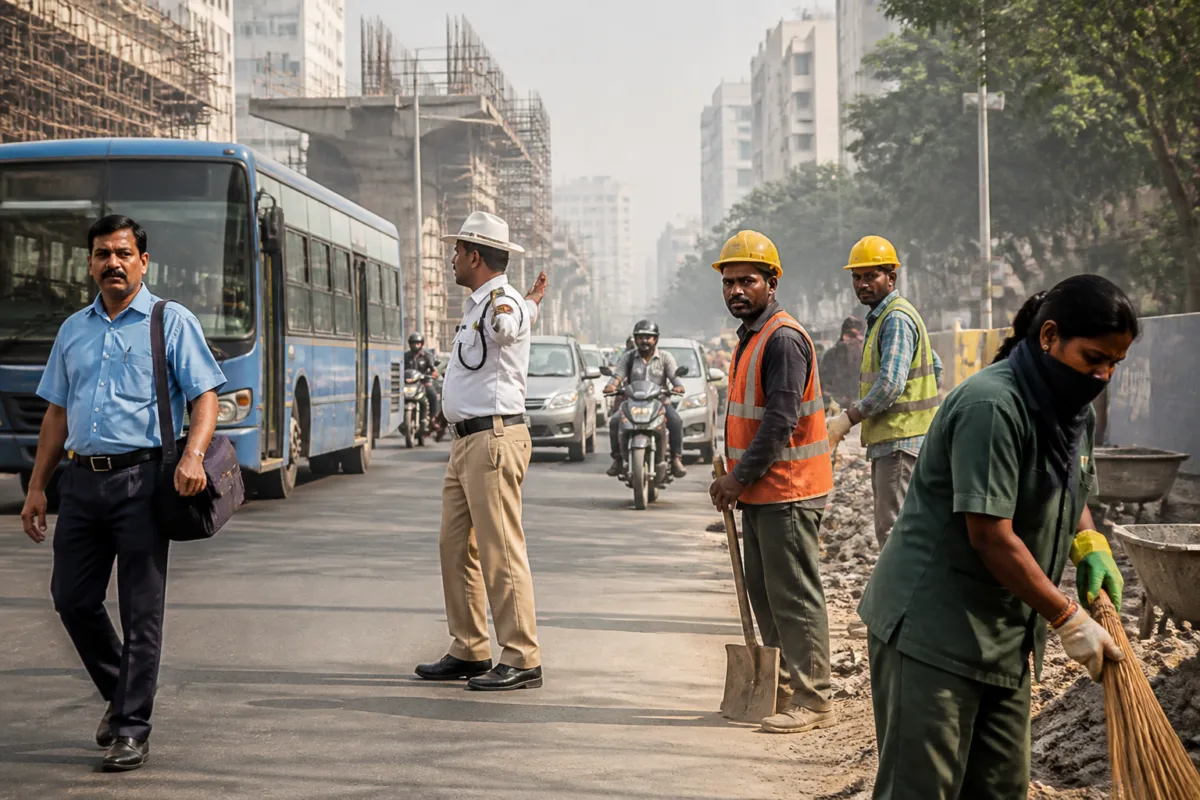
Bengaluru’s frontline workers are carrying a measurable health burden linked to the conditions in which the city operates. A three-year occupational health screening of more than 10,000 BMTC employees, traffic police personnel, construction workers and pourakarmikas found reduced lung function alongside high levels of overweight, obesity, elevated blood sugar and uncontrolled hypertension. The findings expose an urban system that depends on workers who are routinely present in traffic, on dusty roads, at construction sites and around waste, but does not yet appear to manage their health through a coordinated occupational-care framework.
The screening, conducted by the city-based Vaayu Occupational and Environmental Respiratory Illness Clinic, covered 4,517 BMTC employees, 3,287 traffic police personnel, 2,169 construction workers and 379 pourakarmikas. Most participants were men aged between 30 and 50, and all reported working for more than eight hours a day. These details matter because the findings are not about a single workplace or one isolated exposure. They describe four groups whose daily labour is essential to mobility, public order, construction and sanitation across Bengaluru.
The results also show that the risks are distributed unevenly. Among workers with available lung-function data, pourakarmikas recorded the highest proportion of reduced lung function, indicated by low forced vital capacity on spirometry, at 45%. The proportion was 29.5% among BMTC employees, 28% among traffic police personnel and 15% among construction workers.
That pattern does not establish one specific cause for each worker’s condition. The supplied findings do, however, place the results against a common occupational setting: routine exposure to traffic emissions, road dust, construction pollution and other workplace hazards. The distinction is important. A city’s air-quality problem is often discussed through ambient pollution readings, while the people who spend long working hours at street level experience exposure as part of their employment. Their risk is not simply a general public-health concern; it is also an occupational-health and administrative concern.
## Bengaluru’s frontline workers face connected risks
The cardiometabolic findings widen the picture. Overweight or obesity was recorded in 60.7% of BMTC employees, 51.3% of traffic police personnel, 29.2% of construction workers and 62% of pourakarmikas. Blood sugar levels above 200 were recorded in 63.8%, 50%, 20% and 52.9% of the respective groups. Uncontrolled hypertension affected 66.7% of BMTC employees, 25% of traffic police personnel, 76.9% of construction workers and 68.8% of pourakarmikas screened.
The figures should not be read as a citywide prevalence estimate. The screening covered specific occupational groups, and the article does not provide the total number of workers in each category, the selection method, age-wise breakdowns or a comparison group. But they do demonstrate a substantial burden among the people assessed. They also show why a narrow focus on respiratory illness would be inadequate. Workers exposed to polluted or dusty environments may simultaneously require screening and treatment for conditions that are managed through different parts of the public system.
This is where the institutional problem becomes visible. The experts who discussed the findings at the multidisciplinary roundtable, titled ‘Protecting Those Who Protect Our City’, called for a shift from awareness-building to measurable public-health interventions. Dr Arvind BA, professor of epidemiology at Nimhans, said occupational healthcare systems needed to be strengthened and the findings integrated into existing systems. Dr G Gururaj, former director of Nimhans, said existing laws and regulations needed to be translated into action through capacity-building and sustainable interventions.
The comments point to a familiar governance gap: the existence of rules or health advice does not guarantee that workers are screened regularly, referred for care, protected during exposure or followed over time. In this case, the institutional landscape includes worker welfare, public transport, environmental protection and health administration. The findings suggest that these responsibilities are not operating as one joined-up system.
## The coordination gap is an urban infrastructure issue
Bengaluru’s transport and sanitation systems are visible to residents through buses, traffic management and waste collection. Their health costs are less visible because the workers who absorb exposure are usually treated as inputs into service delivery rather than as a central part of urban infrastructure. Yet a bus network depends on drivers and other employees, traffic management depends on personnel positioned beside busy roads, construction depends on workers at sites, and sanitation depends on pourakarmikas working in public spaces and waste-handling environments.
When occupational health is separated from infrastructure planning, the city can measure service outputs without adequately tracking the health conditions under which those outputs are produced. The screening does not quantify lost workdays, treatment costs, premature exits from employment or the operational impact of illness. It does establish that the health question is large enough to require institutional attention across departments.
Swetavalli Raghavan, adviser to the health department and visiting professor at IISER Thiruvananthapuram, described the lack of coordination among departments responsible for workers’ welfare, transport and environmental protection. Her statement, as reported, was not a claim that no activity exists; it was a criticism of departments working independently and failing to bring existing laws and systems together. That distinction matters for policy. The immediate requirement identified by the experts is not another awareness campaign in isolation, but a mechanism capable of assigning responsibility, tracking interventions and measuring outcomes.
The screening also raises questions about continuity. A one-time or periodic test can identify reduced lung function, high blood sugar or uncontrolled blood pressure, but it cannot by itself show whether the worker receives treatment, whether workplace exposure changes or whether the condition worsens. Dr Ravindra Mehta, founder and medical director of VAAYU Chest & Sleep Specialists, said the organisation wanted to follow cohorts over five to 10 years. He linked that effort to the need for sustained funding, a clear agenda and institutional support.
Longitudinal follow-up would change the value of the evidence. It could show whether workers with abnormal results remain in the same exposure conditions, whether protective measures make a difference and how respiratory and cardiometabolic risks evolve. The source material does not say that such a cohort has been established. It records the desire for one and the conditions identified as necessary to sustain it.
## What the numbers reveal about worker protection
The data contains sharp differences between occupational groups. Pourakarmikas had the highest reported proportion of reduced lung function and the highest reported rate of overweight or obesity among the four groups. Construction workers had the lowest reported proportion of reduced lung function but the highest reported rate of uncontrolled hypertension. BMTC employees recorded the highest proportion of blood sugar levels above 200 in the figures provided, while traffic police personnel recorded lower reported rates of uncontrolled hypertension than the other groups but still showed reduced lung function and elevated blood sugar among those screened.
These differences argue against a single intervention for all frontline workers. The evidence supplied does not identify which specific tasks, protective practices, shift patterns, medical histories or exposure levels explain the variation. It therefore cannot support a claim that one occupation is inherently more dangerous than another. It does support a more basic conclusion: occupational healthcare needs to be sensitive to the different environments in which city workers perform their duties.
For policymakers, the central issue is not only whether masks are distributed or health camps are held. It is whether the system can connect screening with clinical care, workplace protection, environmental management and administrative accountability. Dr Mehta said immediate measures should include providing masks and educating workers about air-pollution risks, while also calling for greater authority involvement. He also referred to a pending memorandum of understanding with BMTC to screen more than 5,000 workers.
The reference to the proposed BMTC MoU is significant because it shows that institutional access remains part of the problem. The screening has already covered 4,517 BMTC employees, but the reported need for a formal arrangement to screen more than 5,000 additional workers indicates that reaching the full workforce cannot be assumed. The article does not provide the status, terms or responsible signatories of the proposed MoU, so its implementation remains an open administrative question.
## From awareness to accountable systems
The roundtable’s most important message is that information alone is insufficient. Workers may know that pollution, dust or untreated hypertension can affect their health, but awareness does not provide a medical referral, enforce protective equipment, reduce exposure or create paid time for treatment. Those functions require employers, departments and public authorities to work together.
The policy landscape described in the findings is therefore one of implementation rather than policy absence. Experts referred to existing laws and regulations, but also to gaps in capacity-building and the need to make interventions sustainable. The challenge is to convert separate responsibilities into a system that can answer basic operational questions: who screens workers, who pays for follow-up, who records results, who ensures workplace protection and which authority reviews progress?
The available evidence cannot answer whether Bengaluru currently has a unified occupational-health database for these groups, how frequently workers are screened or how many abnormal results have been connected to treatment. Those gaps should not be filled with assumptions. They are precisely the information needed to evaluate whether the city is protecting the people who keep its transport, roads, construction sites and sanitation services functioning.
Bengaluru’s screening results do not by themselves prove that traffic emissions, road dust or construction pollution caused every abnormal finding. They do establish a substantial health burden among workers exposed to demanding urban environments and identify a governance failure in how those risks are addressed collectively. The next milestones are the authorities’ response to the findings, the proposed BMTC arrangement, the provision of immediate protective measures and whether a funded five- to 10-year follow-up programme is created. Until those systems are in place, the city will continue to know more about frontline workers’ health without necessarily changing the conditions that shape it.

