


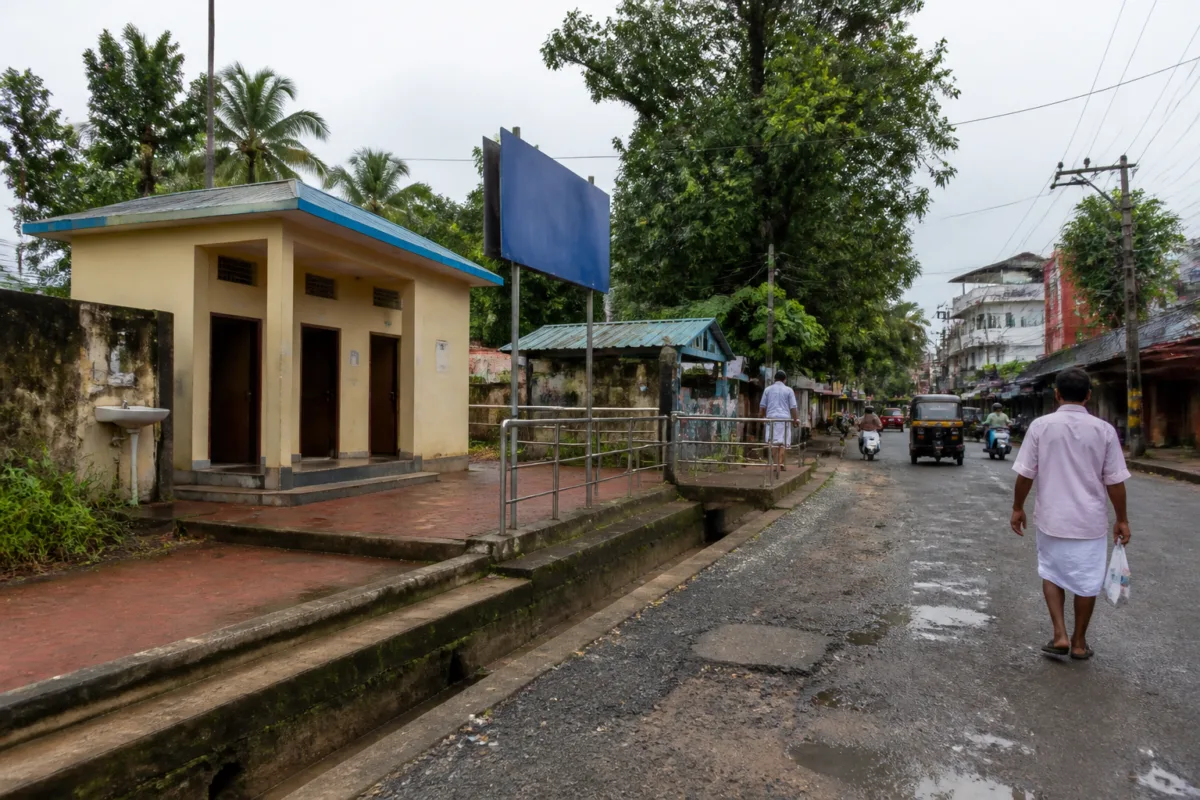
Kerala local bodies left more than Rs 3,863 crore unspent in 2023-24, according to a Comptroller and Auditor General of India report tabled in the state assembly. The figure is not simply a measure of slow spending. It exposes a wider problem in the way responsibilities, funds, staffing and implementation authority are divided between local governments and state departments.
The audit found that grama, block and district panchayats together allowed Rs 3,367.92 crore to lapse from a total allocation of Rs 9,135.94 crore. That represented 36.86% of their allocation. Municipalities and corporations left another Rs 495.83 crore unused from Rs 2,318.95 crore, or 21.38% of the amount allocated to them.
The distinction between rural and urban local bodies matters, but the broader pattern is shared. Both groups struggled to convert budgetary allocations into roads, public toilets, maintenance work, regulatory enforcement and other civic services. In a decentralised system, the effectiveness of local government depends not only on the size of the grant but also on whether the institution has the authority and administrative capacity to spend it.
The CAG report indicates that this chain is fractured. Local bodies continued to face uncertainty over their responsibilities, while government departments implemented schemes in areas already assigned to them. The audit said this overlap weakened the autonomy envisaged for local governments and created risks involving accountability and duplicate beneficiaries.
Although 28 of the 29 functions listed for panchayats had been transferred fully or partially, panchayats had full responsibility for only five. They had a limited or no role in 14 functions. Agriculture, animal husbandry, education, health and sanitation were among the areas where local bodies and government departments were implementing schemes in parallel.
This arrangement creates a basic administrative difficulty: an institution may be held responsible for a service without controlling the full set of decisions needed to deliver it. The report also pointed to staff shortages and the continued administrative control of government departments over institutions whose functions had been transferred to local governments. The result is a system in which formal devolution and practical control do not fully match.
The release of funds was another constraint. The audit recorded delays of up to 117 days in releasing development funds, 114 days for maintenance funds and 89 days for general-purpose funds. Such delays compress the period available for tendering, execution and payment, particularly for projects that must be completed within a financial year.
The spending pattern was especially weak in maintenance. Panchayats left 71.07% of road-maintenance funds and 49.76% of non-road maintenance funds unspent in 2023-24. Urban local bodies left 67.68% of road-maintenance funds and 56.42% of non-road maintenance allocations unused.
These figures point to a civic system that may be more capable of announcing or allocating projects than of maintaining existing assets. Roads, public toilets and other facilities require recurring expenditure, timely procurement and clear responsibility. When maintenance money remains unused, deterioration can continue even when budgets technically provide for repairs.
The audit also found low spending on productive sectors. Panchayats allocated between 10.28% and 12.67% of their expenditure to agriculture, animal husbandry, fisheries and industries during the period from 2019-20 to 2023-24. For urban local bodies, the corresponding share ranged from 4.61% to 8.04%.
The report does not establish that low spending in these sectors was caused by a single factor. However, the figures show that local-government expenditure was not consistently translating into investment in sectors identified as productive. The limited role of urban local bodies in these areas also reflects the wider question of what local governments are expected to plan and deliver in an increasingly complex urban economy.
Building regulation provides another example of the gap between formal responsibility and service delivery. The CAG found that building permits were delayed by between 44 and 474 days. In three local bodies, an additional fee of Rs 54.37 lakh due on excess floor area was not collected.
A building-permit system is both a regulatory mechanism and a gateway for construction activity. Delays affect applicants and can make enforcement less predictable, while failure to collect assessed fees weakens municipal revenue and the credibility of development controls. The audit findings connect these operational failures to the larger capacity problem facing urban local bodies.
Public sanitation facilities also revealed the consequences of weak planning and maintenance. The report found that several public toilets, including Take a Break facilities, remained incomplete or non-functional despite substantial allocations. The reasons included unsuitable site selection, lack of water and electricity, and inadequate maintenance arrangements.
Even operational toilets in busy public areas and tourist destinations lacked basic amenities or were maintained in unhygienic conditions. This is significant because the construction of a facility does not by itself create a functioning public service. Site selection, utility connections, cleaning contracts, inspections and recurrent funding are all part of the service chain.
The audit identified similar gaps in slaughterhouse and meat-stall regulation. It found 61 unauthorised meat stalls in 19 selected panchayats. In four urban local bodies, 24 unauthorised meat stalls continued to operate without effective action to close them. Routine inspections by local bodies, food-safety authorities and pollution-control authorities were inadequate.
The report also found that statutory veterinary inspections were not being carried out as required and that some slaughterhouses lacked essential waste-management facilities. These findings demonstrate how overlapping institutional responsibilities can become a public-health risk when no agency consistently performs inspection, enforcement and waste-management functions.
The issue, therefore, is not only that money was left unspent. The CAG findings show that local government performance is shaped by the interaction of four conditions: when funds are released, who controls the relevant function, whether the local body has adequate staff and whether projects are planned for long-term operation rather than one-time construction.
Kerala’s local-government framework appears formally decentralised but operationally divided. Local institutions have been assigned or partially assigned a large number of functions, yet the audit found that they exercise full responsibility over only a small portion of them. Government departments continue to implement schemes in overlapping areas, while administrative control and staffing constraints remain.
This division complicates accountability. Residents generally experience a road, toilet, permit office or sanitation service as a single civic function. They do not experience the separate budget heads, departmental jurisdictions or transfer orders that determine which agency is responsible. When several institutions share a function, failures can be attributed across the system without any one institution being fully answerable.
The numbers also show that the problem is not confined to one category of local government. Panchayats had a larger absolute amount of unspent funds, but municipalities and corporations recorded substantial unused allocations as well. Urban local bodies additionally faced building-permit delays, failures in meat-stall enforcement and poor maintenance of public facilities.
The report does not provide, in the supplied material, a single estimate of the service deficit caused by the unspent funds. Nor does it establish that every unspent amount represented avoidable waste; some projects may have faced legitimate administrative or execution constraints. But the scale of the lapse, combined with the documented failures in maintenance, regulation and facility operation, shows that utilisation is a central governance concern.
The next question is whether the findings lead to clearer functional separation and faster fund release, or remain an audit record of recurring implementation weakness. The CAG has identified delays, overlaps, staff shortages and service-level failures. The effectiveness of Kerala’s decentralised governance will depend on how the state and local bodies respond to those specific administrative gaps.

