


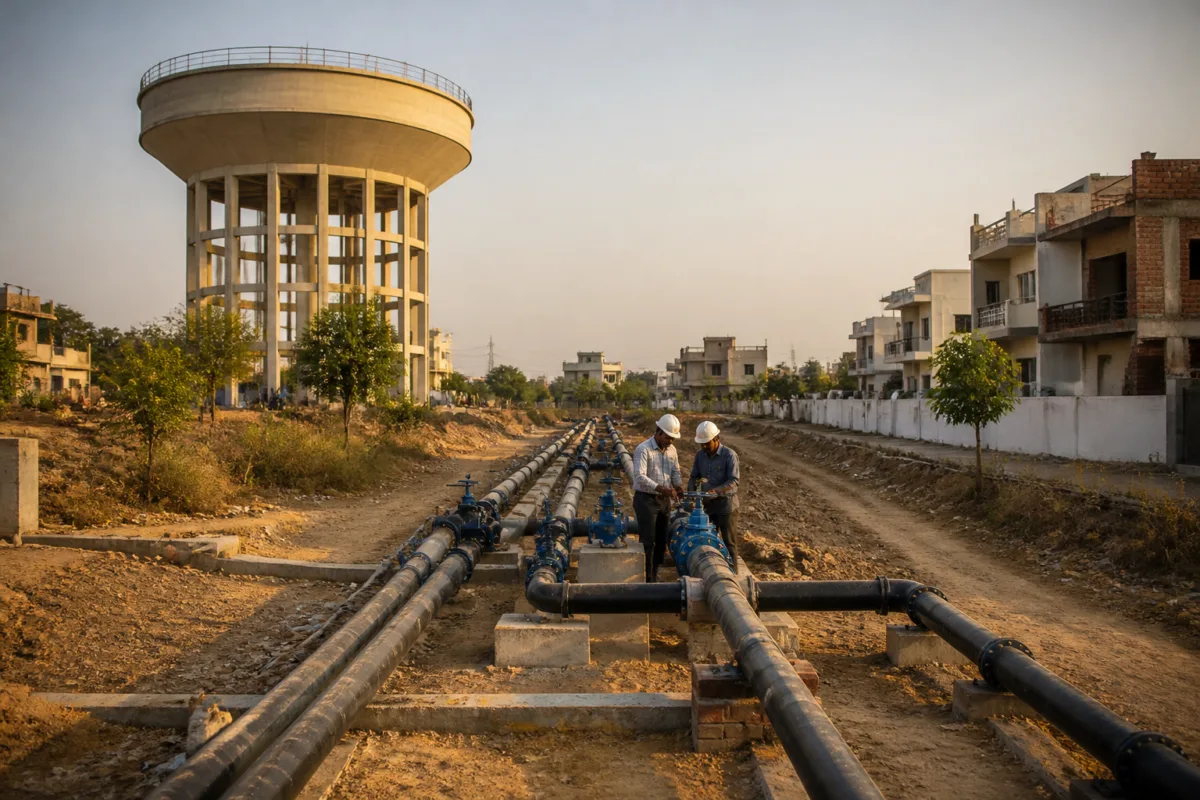
Jaipur’s water supply network is set to reach more than 3,000 additional residents in newly incorporated areas of the city, but the expansion also exposes the difficult balance between extending formal access and managing limited supplies during the approaching summer. The Public Health Engineering Department’s Bisalpur 2.0 programme is being rolled out in villages now included within Jaipur Municipal Corporation, including Niwaru, Hathoj, Beer Hathoj, Boytawala and Peethawas.
The immediate change is administrative as much as physical. These settlements, located in the rapidly urbanising southwest of Jaipur, have been brought under PHED’s Prithviraj Nagar division. The department has started accepting applications in some areas and plans to begin household supply after applications are processed and approved. A PHED engineer told the Times of India that the official completion deadline is December 31, although the department expects all household connections to be completed by February 2027.
That gap between the formal deadline and the expected completion date is important because the project is not simply a matter of laying a few final pipes. It is an attempt to bring a large, expanding urban fringe into a network that has historically relied on tubewells, tankers and private water sources. The change from informal or fragmented supply to a municipal network can improve predictability for households, but it also brings new demand into the city’s central water system.
The scale of that transition is visible in the numbers provided by PHED. The Prithviraj Nagar division currently supplies Bisalpur water to nearly 1.5 lakh people. Once the project is completed, the department expects the number of people served to rise to about 4.5 lakh, effectively bringing the entire division under the Bisalpur supply network. That represents a threefold increase in the population identified as being served by the division.
The expansion is being undertaken through the Prithviraj Nagar water supply scheme, which has a budget of ₹747.08 crore and was formalised on July 4, 2023. Its physical system includes 46 elevated service reservoirs and an extensive distribution network. PHED has completed 45 reservoirs and laid more than 2,342 kilometres of pipelines, according to the report. The final reservoir, at Pawanpuri West, is expected to be completed by the end of October.
These figures show why the programme is more consequential than a routine announcement of new household connections. Elevated service reservoirs and long distribution lines are the visible infrastructure of supply, but their usefulness depends on the availability and management of source water. A network can be technically complete and still face pressure if demand grows faster than the water available to fill it.
PHED officials have acknowledged that concern. A senior engineer said the additional connections were a significant issue during peak consumption periods and that contingency planning had begun several months in advance. The department is examining the possibility of blending groundwater with Bisalpur water. The supplied report does not specify the quantities involved, the treatment arrangements or the locations where this blended supply would be used.
The proposed groundwater blending also reveals the institutional complexity of urban water expansion. Bisalpur water provides the backbone of the scheme, while groundwater is being considered as a supplementary source during periods of higher demand. That may help the department manage short-term pressure, but the report does not establish how long such a strategy would be used or how groundwater extraction would be monitored. Those details will matter as the newly incorporated areas continue to urbanise.
For now, PHED has drawn one clear line around the rollout: new connections will not be provided to high-rise buildings at this stage. The restriction indicates that the department is differentiating between household expansion in designated colonies and larger developments that could create concentrated demand. It also suggests that connection policy is being used as a supply-management tool while the network is brought into operation.
The distinction is particularly relevant in Jaipur’s outskirts, where urban growth has often preceded the full arrival of civic infrastructure. Areas that were once villages or semi-urban settlements are being absorbed into the municipal boundary, while residential colonies and larger developments spread across former peripheral land. The water system must therefore serve two processes at once: the formal incorporation of existing communities and the continuing physical expansion of the city.
The Prithviraj Nagar scheme’s history reflects that challenge. Its ₹747.08-crore allocation, 46 reservoirs and more than 2,342 kilometres of pipelines represent a major public investment in extending networked supply. Yet the final service outcome will be measured at the household level: whether applications are approved, connections are installed, water reaches properties with reasonable regularity and supply remains dependable during the hottest months.
The timeline is also layered. PHED has an official completion deadline of December 31, while an engineer expects complete household connections by February 2027. The report does not explain the reason for the difference, whether it reflects administrative processing, pending construction or a phased commissioning plan. That uncertainty does not invalidate the project, but it makes implementation milestones important for residents waiting to move from tanker or private supply to a public connection.
The scheme also raises a broader question about how Jaipur plans water infrastructure for areas that are already urban in practice but still developing institutionally. Bringing a locality into a municipal boundary does not automatically create a fully functioning service system. It requires source allocation, treatment and transmission capacity, storage, local distribution, household applications, billing and ongoing maintenance. Each part of that chain has to work for the expansion to translate into reliable access.
In the current plan, the elevated service reservoirs provide storage and pressure-management infrastructure, while the pipeline network creates the physical reach. The Bisalpur system provides the principal source identified in the report. Groundwater blending is being considered as a contingency. The decision to defer high-rise connections limits one category of demand. Together, these measures show a phased approach rather than an unrestricted opening of the network.
But the supplied evidence also leaves several operational questions unanswered. It does not state the daily quantity of water available to the division, the projected demand from the 3 lakh additional people expected to be brought under the network, or the frequency of existing Bisalpur supply. It also does not provide groundwater quality, extraction or recharge data. Without those figures, the long-term balance between network expansion and source sustainability cannot be established.
That limitation is central to understanding the project. The immediate public benefit is clear: residents in Niwaru, Hathoj, Beer Hathoj, Boytawala, Peethawas and other designated colonies are being offered a route into formal water infrastructure. The long-term outcome depends on whether the source system can support the larger service population and whether the department can maintain supply through seasonal peaks.
Jaipur’s water expansion is therefore both an access project and a capacity test. It demonstrates the pressure created when municipal boundaries, housing growth and infrastructure provision move at different speeds. PHED is extending the network, completing reservoirs and preparing contingencies, while also restricting some connections because the department is not treating additional demand as cost-free.
The evidence currently confirms substantial physical progress: 45 of 46 reservoirs are complete, more than 2,342 kilometres of pipelines have been laid and the division’s planned service population is expected to rise from nearly 1.5 lakh to 4.5 lakh. What remains to be established is how the system will perform once all household connections are active. The next milestones are the completion of the Pawanpuri West reservoir, the processing of applications, the December project deadline and the department’s expected February 2027 completion of household connections.

