


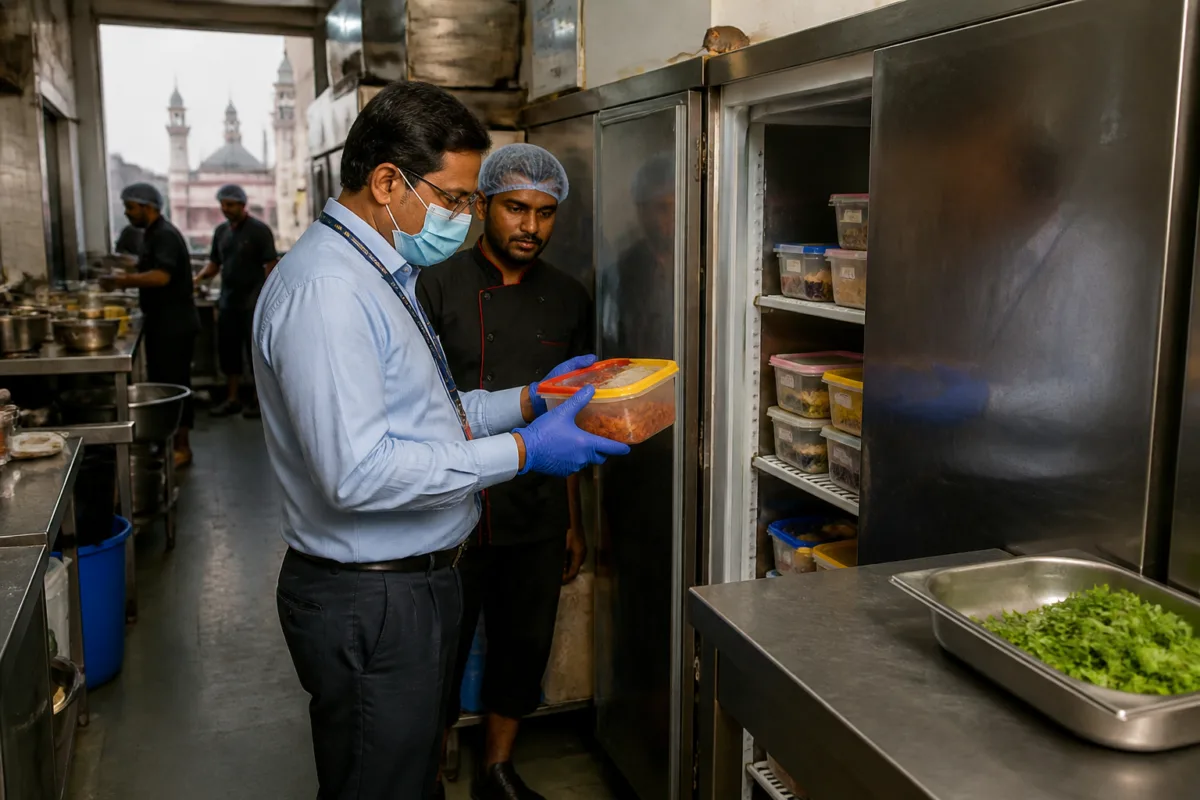
Hyderabad’s latest food-safety drive is revealing a problem that cannot be solved by sending inspectors into restaurant kitchens alone. Several popular eateries have been flagged repeatedly for poor storage, expired food, pest infestations and missing medical records, while authorities are now suspending licences and preventing establishments from reopening until violations are addressed.
The pattern matters because it shifts the question from whether restaurants are being inspected to whether the city’s enforcement system can make compliance last between inspections. The report shows that violations have recurred at establishments including Hotel Shadab, Shah Ghouse, The Rameshwaram Cafe, Pista House, Mehfil, Absolute Barbeque, 4 Seasons, Hotel Alpha and Chutneys. The reported lapses include inadequate storage, expired items, pest infestations and failures linked to staff and medical records.
Hotel Shadab, which had been flagged in 2024, had its Food Safety and Standards Authority of India licence suspended in September 2026. Shah Ghouse and The Rameshwaram Cafe were flagged in May 2024 for poor storage, expired items and missing medical records, and were reported again in September 2026. Pista House faced reported violations in 2024, 2025 and August 2026, while Mehfil was flagged in June and September 2026.
These cases indicate the limits of treating an inspection as a complete measure of kitchen safety. Former Telangana food safety commissioner Sangeetha Satyanarayana said most restaurants know the rules, but poor storage, inadequate infrastructure and staff shortages undermine compliance. She said some owners may find it cheaper to pay fines than invest in cold storage, pest control and staff training.
Her central observation is administrative as much as operational: an inspection captures the condition of a kitchen on the day an officer visits, not on the other 364 days. That makes food safety a continuous-management problem rather than a one-time compliance exercise. The quality of storage, pest control, staff training and procurement practices can change after an inspection, particularly when the cost of maintaining standards is higher than the expected penalty for violating them.
The enforcement response described in the report marks a shift from identifying violations to applying consequences that affect a business’s ability to operate. A Telangana food safety official associated with TG SAFE said earlier inspection drives in areas including Kukatpally, Gachibowli and Banjara Hills were treated lightly, whereas authorities were now suspending licences and refusing to allow restaurants to reopen until they were satisfied with corrective action.
Police are ensuring that restaurants with suspended licences remain closed while the suspensions are in force. The significance of that step lies in coordination. A licence suspension is only effective if the establishment cannot continue operating during the suspension and if the authority has a defined process for checking whether the underlying violations have been corrected.
The report, however, also shows why enforcement cannot rest only on closure. Restaurant owners acknowledged gaps while describing steps taken after inspections. Mohd Faraz Rabbani of Shah Ghouse said pests could enter through beverage crates, gas cylinders and egg trays. The chain, which operates seven outlets, had strengthened pest control and cleaned kitchens two to three times daily, he said. Mehfil owner Mohd Mubeen Pasha said the chain had moved to branded products with proper labelling and reduced bulk purchases after inspections exposed stock and storage issues.
Those responses point to the physical and logistical conditions behind compliance. Food safety depends not only on written rules but also on whether kitchens have adequate cold storage, controlled movement of supplies, pest-proof access points, traceable products and enough trained staff. If those systems are weak, repeated inspection findings are likely to reflect an operational pattern rather than an isolated lapse.
The report also presents public exposure as another enforcement mechanism. Food safety expert Anirudh Gupta recalled that a restaurant branch began providing drinking water after a social media video about its refusal went viral. He also said a video about a food outlet in Hyderabad’s Old City was shared about 15,000 times, led to boycott calls and was followed by the installation of glass counters at the outlet’s Attapur branch.
Public complaints and social-media scrutiny can therefore produce quick behavioural changes, but they are uneven tools. They depend on a customer noticing a problem, documenting it, gaining an audience and creating reputational pressure. They cannot replace a citywide system that records violations, tracks corrective action and distinguishes a first lapse from repeated non-compliance.
That tracking gap is one of the clearest institutional issues raised by the report. National Restaurant Association of India city chapter head Sandeep Balasubramanian called for a mechanism to distinguish repeat violations from new lapses. Such a system would allow enforcement agencies to identify establishments where earlier action did not produce lasting improvement, rather than treating every inspection as a separate event.
The absence of a visible repeat-offender framework can weaken the credibility of penalties. A fine imposed for an isolated lapse and the same fine imposed after several earlier violations do not carry the same regulatory meaning. Satyanarayana called for fines proportionate to the size of an establishment and the severity of the violation, along with escalating penalties for repeat offenders. She also supported swift action, including stock seizure and licence suspension, in serious cases involving expired food or unsafe storage.
Other states cited in the report are also tightening enforcement. Karnataka has directed food businesses to rectify hygiene and safety violations within 15 days or face legal action. West Bengal has launched special inspections of restaurants, sweet shops and eateries. Maharashtra has introduced restrictions on junk-food sales within 50 metres of schools, prohibited serving food on newspapers and mandated licences for organisers of community and religious feasts.
These examples suggest that food safety is increasingly being treated as a broader urban governance issue involving restaurants, vendors, public institutions and consumer spaces. The specific rules differ, but the common challenge is implementation: standards have to be translated into routine practices, documented inspections, predictable penalties and follow-up checks.
For Hyderabad, the immediate enforcement drive will be judged not by the number of inspections conducted but by whether repeat violations decline and whether suspended establishments meet clearly recorded conditions before reopening. Recognition for restaurants that consistently maintain hygiene standards, as proposed by Balasubramanian, could complement penalties by making good practice visible rather than focusing only on failure.
The evidence supplied in the report confirms that inspections are identifying real and recurring problems, and that authorities have begun using stronger measures such as licence suspension and closure enforcement. It does not establish how many establishments have been inspected overall, how many licences have been suspended, how quickly corrective action is verified or whether repeat violations have declined after the current drive. Those are the measures that will determine whether Hyderabad’s food-safety response has moved from episodic inspection to continuous accountability.

