


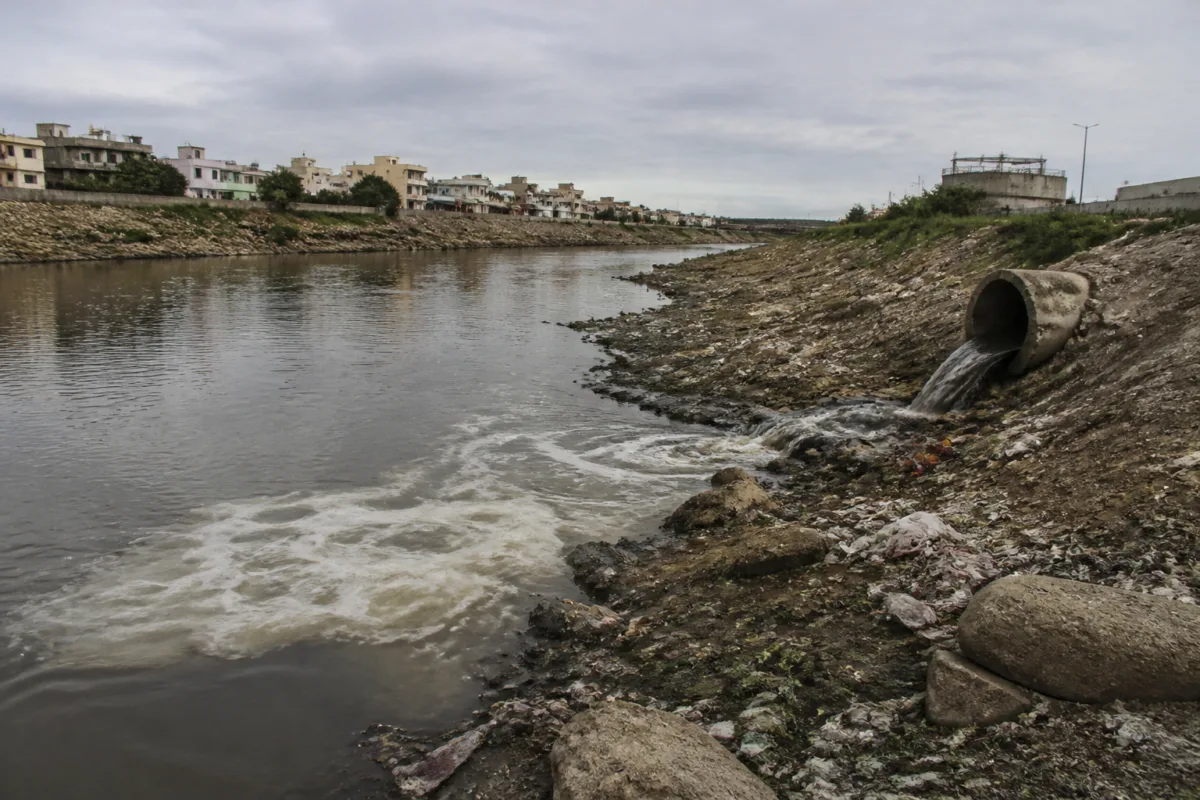
Faecal contamination in the Godavari and Krishna rivers has risen to levels that expose a deeper weakness in Telangana’s urban water system: the state’s cities and towns are still allowing untreated or inadequately treated sewage to enter river basins that support drinking water, irrigation and power generation. Central Water Commission data for August, cited in a Times of India report, recorded faecal coliform levels of 1,60,000 most probable number (MPN) per 100 ml in the Krishna at Suryapet and in the Godavari at Mulugu and Nizamabad. That is 320 times the reference benchmark of 500 MPN per 100 ml.
The immediate significance of the readings is clear. The Godavari and Krishna are not peripheral water bodies for Telangana. They are part of the state’s drinking-water and water-management infrastructure, while the Godavari and Krishna systems also support irrigation and power generation. Hyderabad’s drinking-water supply draws more than 90% of its requirement from these river systems, according to the report. Treatment before distribution reduces the risk to consumers, but the safety of that chain depends on treatment performance, monitoring and the prevention of contamination after treatment.
The latest readings also show that the problem is worsening rather than remaining static. In June, faecal coliform levels in the rivers were reported at around 9,200 MPN per 100 ml, already nearly 20 times the reference benchmark. By August, the level had reached 1.6 lakh MPN per 100 ml, an increase of more than 1,600%. The numbers are not merely a measure of river quality; they are an indicator of how urban sewage, inadequate sanitation and weak enforcement are interacting across the basin.
The evidence points to multiple sources rather than a single discharge point. The report identifies untreated or inadequately treated sewage, leaking sewer lines, septic tanks, drains and runoff carrying human and animal waste as key contributors. A 2024 study by the National Institute of Technology, Warangal, commissioned by the Union ministry to prepare a condition assessment and management plan for the Krishna river basin, found that most urban settlements along the Krishna release untreated sewage directly into the river. In parts of Suryapet, several houses reportedly lack even septic tanks, allowing human waste to flow into the river.
This is a governance problem because sewage pollution is generated locally but travels through a connected river system. A town’s sanitation deficit does not remain confined to its municipal boundary. Wastewater discharged into a drain, stream or river can affect downstream settlements, reservoirs and treatment systems. The NIT report also identifies pollution from pharmaceutical and synthetic chemical industries in the Telangana stretch of the Krishna basin, adding industrial risk to the existing burden of domestic sewage.
Low rainfall has made the contamination more concentrated. Experts cited in the report linked below-normal rainfall partly to the El Niño effect and said reduced river flows limit the dilution of pollutants. The relationship between rainfall and pollution is not straightforward. Heavy flows can carry pollutants downstream, while low flows can allow contaminants to remain concentrated. The report also cites water-resources expert B Venkateshwar Rao, who said sewage discharged from residential settlements can accumulate in riverbed sediments during summer and be resuspended with the arrival of the monsoon, pushing up coliform readings at monitoring stations.
That seasonal pattern matters for how water quality is understood. A single reading captures conditions at a monitoring point and a particular time, but the wider evidence suggests a recurring system of accumulation, discharge and resuspension. It also means that river pollution cannot be addressed only through occasional clean-up drives or downstream treatment. The source of the contamination lies in the everyday operation of urban sanitation networks: whether sewage is collected, whether treatment plants function, whether sewer lines leak and whether households and large residential developments comply with wastewater rules.
The Musi tributary provides a more detailed picture of the same failure. At Valigonda in Yadadri Bhuvanagiri district, dissolved oxygen was recorded at 1.28 milligrams per litre against a reference value of at least 5 milligrams per litre. Biochemical oxygen demand stood at 10.94 milligrams per litre, more than three times the reference limit of 3 milligrams per litre. Low dissolved oxygen can threaten aquatic organisms, while high biochemical oxygen demand indicates that the decomposition of biodegradable organic matter is consuming oxygen in the water.
The Musi’s condition is particularly relevant to Hyderabad because the river is connected to the metropolitan region’s sewage and drainage geography. The report states that Greater Hyderabad currently has 42 sewage treatment plants, with another 36 in the pipeline. Yet only around 600 high-rise buildings and gated communities are reported to have functional sewage-treatment facilities, despite the city’s rapid growth in such developments. The contrast raises a basic infrastructure question: capacity at municipal treatment plants is not enough if wastewater is not reliably collected or if private and group housing systems do not operate as required.
This distinction between installed capacity and functioning compliance is central to the river-quality problem. A sewage-treatment plant exists on paper only as capacity; its public-health value depends on connections, regular operations, maintenance, power supply, monitoring and enforcement. The same applies to on-site treatment systems in large residential complexes. If untreated wastewater bypasses these systems and enters the Musi or other water bodies, additional municipal treatment capacity alone may not resolve the contamination.
The institutional challenge extends across several levels. The Central Water Commission provides the monitoring data cited in the report. The Union ministry of Jal Shakti commissioned the Krishna-basin assessment. Municipal authorities are responsible for urban sewage collection and treatment, while pollution-control enforcement must address industrial discharge and compliance with wastewater standards. Residential complexes and industries also have direct responsibilities. The river basin therefore has no single point of failure and no single agency capable of solving the problem alone.
The recommendations cited in the report reflect this multi-layered challenge. For the Krishna and Musi, they include stricter enforcement of industrial wastewater-discharge standards, adequate sewage treatment before wastewater enters rivers and other water bodies, and stronger compliance by residential complexes. At the basin level, the proposed interventions include monitoring groundwater levels, promoting micro-irrigation, improving soil health through green manure and riverbank buffer zones in the Upper Krishna sub-basin, and using watershed management, soil conservation and agroforestry to reduce runoff and erosion in the middle basin.
The lower Krishna sub-basin requires advanced wastewater treatment, better management of industrial discharges and improved urban solid-waste management, according to the report. These measures show that river quality is tied not only to sewage plants but also to land use, agriculture, industrial regulation and waste collection. Pollution-control policy becomes ineffective when each issue is handled as a separate departmental file while the river receives the combined load.
The available numbers show the scale of the pressure. Faecal coliform readings of 1,60,000 MPN per 100 ml at three monitoring locations are 320 times the stated benchmark. At Bhadrachalam and Mancherial, readings of 92,000 MPN per 100 ml were recorded, or 184 times the benchmark. Other monitoring points in Mulugu and Bhadradri Kothagudem, as well as the Musi at Valigonda, also reported levels far above prescribed benchmarks. The pattern is therefore geographically wider than one polluted stretch or one municipal boundary.
At the same time, the supplied evidence does not establish how much of the contamination comes from each source, whether the August readings were sustained in subsequent months, or how treatment performance varied across the drinking-water supply chain. Those questions matter for public-health assessment and for assigning administrative responsibility. The data confirms a severe water-quality warning, but a complete response would require source-wise pollution mapping, consistent monitoring and transparent information on treatment and compliance.
The larger urban question is whether Telangana’s infrastructure is expanding faster than its sanitation governance. Hyderabad has a growing number of high-rise buildings and gated communities, while towns along the Krishna basin continue to face gaps in basic sanitation. The resulting pollution is not an isolated environmental issue. It is a direct consequence of how cities collect waste, regulate construction, operate treatment systems and protect shared water resources.
The CWC readings make the immediate risk visible, but the underlying problem is institutional. River-basin health depends on the least protected settlement, the weakest sewer connection and the treatment system that is not monitored or enforced. What the evidence confirms is a sharp deterioration in faecal contamination across important Telangana river stretches. What remains to be established is whether the state’s agencies can convert monitoring data into source-level enforcement, functioning sewage systems and sustained protection for the rivers on which its cities depend.

