


Tamil Nadu wind manufacturing is entering a new phase in which the state’s industrial future may depend not only on how many turbines it can produce, but also on whether it can supply more of the high-value components and export them efficiently. Industry representatives cited by The Times of India say India’s expanding free-trade agreement network, global decarbonisation demand and the state’s established manufacturing and port infrastructure could give Tamil Nadu a larger role in international wind equipment markets.
The opportunity is significant because wind energy is no longer only a power-generation story. It is also a question of industrial geography: where blades, towers, nacelles, hubs, gearboxes and specialised components are made; how they move from factories to ports; and whether states can retain the investment needed to build increasingly sophisticated supply chains. Tamil Nadu already has many of these links, but the next stage will require the state to move beyond assembly and strengthen its position in high-value manufacturing.
According to figures cited in the report, India’s annual wind turbine manufacturing capacity has grown to 24GW from 12GW in 2020-21. Wind equipment exports reportedly reached Rs 12,800 crore in FY26, an increase of nearly 50%. Domestic value addition is estimated at more than 70%, indicating that the sector has developed a relatively deep local ecosystem compared with clean-tech industries that remain more dependent on imported materials and technologies.
Girish Tanti, chairman of the Indian Wind Turbine Manufacturers Association and co-founder of the Suzlon Group, told The Times of India that the domestic wind industry had developed indigenous technology, intellectual property and global competitiveness without relying on direct incentives. He said this could allow India to use its expanding FTA network to take wind manufacturing capabilities to international markets.
The distinction between wind and other clean-energy sectors is important for industrial policy. The report quotes Tanti as saying that India remains dependent on imports and overseas supply chains for critical materials and technologies in sectors such as solar and batteries, while wind has developed a more localised manufacturing base. That does not mean the wind sector is fully self-sufficient. It does mean that a larger share of the value chain is already available for expansion inside the country.
The global market provides the demand rationale. Wind power has been deployed in 133 countries, according to the report, creating a sizeable potential market for Indian manufacturers, technology providers and project developers. Ben Backwell, chief executive officer of the Global Wind Energy Council, has said India could account for around 10% of the global wind supply-chain market. Tanti has set a broader ambition of increasing India’s share of global wind turbine exports from about 2% currently to 10% by 2030.
Those targets expose the gap between existing capability and global scale. India’s wind manufacturing base may already be competitive in several areas, but the remaining gaps are concentrated in components that carry greater technological and economic value. Saravanan Manickam, vice-chairman-cum-secretary of the Indian Wind Turbine Manufacturers Association, said strengthening production of gearboxes, specialised bearings and advanced materials would be critical.
This challenge is becoming more urgent as turbine technology changes. The report says the industry is moving towards higher-rated turbines, which will require manufacturers to accelerate indigenisation while adding production capacity. Larger and more powerful turbines can alter factory requirements, transport dimensions, port handling needs and the technical capabilities expected from suppliers. The industrial system must therefore expand in parallel with the machines it produces.
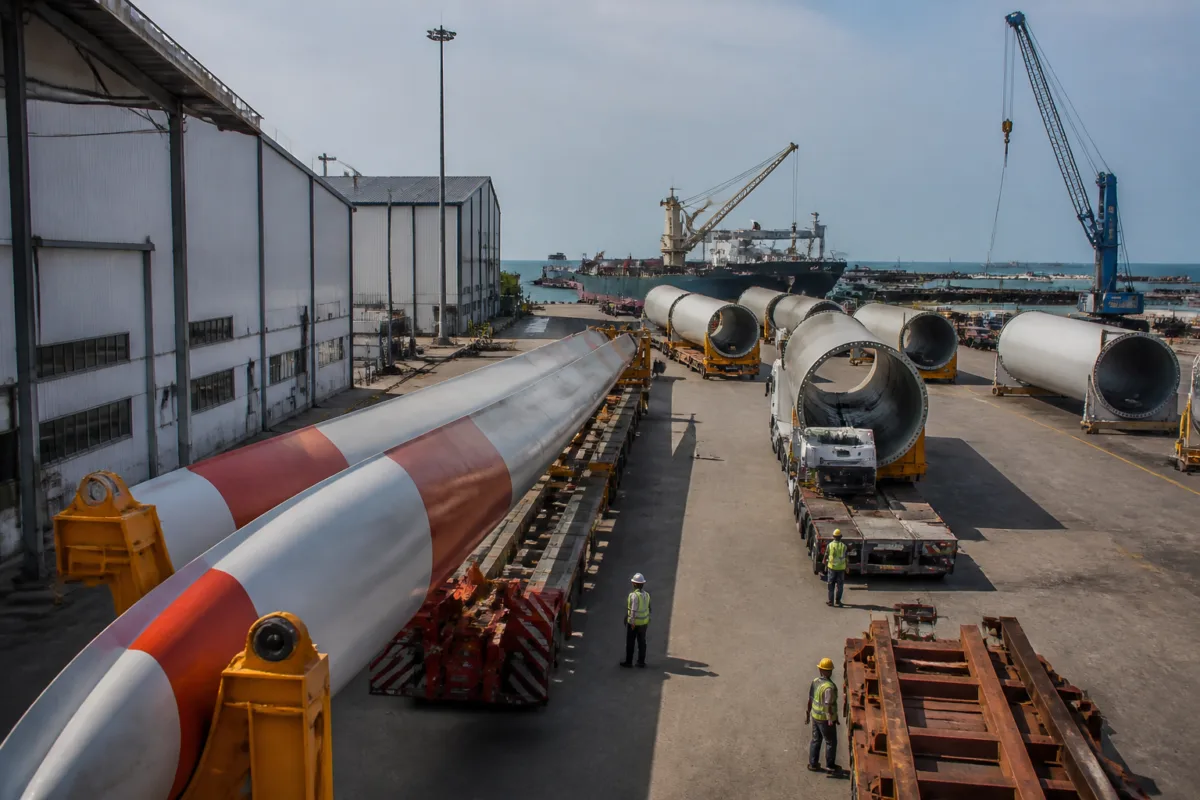
Tamil Nadu’s advantage is that its manufacturing geography already connects several parts of the wind value chain. Blade and tower production is concentrated in Tiruchi and Viralimalai, while nacelle and hub assembly facilities are located in Chennai and Oragadam. Export logistics are supported by V O Chidambaranar Port in Tuticorin. This distribution gives the state a combination of production clusters and maritime access that many industries spend years trying to build.
The value of this network lies in reducing the distance between production and export. Wind equipment is large, heavy and difficult to move through ordinary logistics systems. A state that combines component factories, assembly facilities, industrial land, transport links and port capacity can potentially lower handling complexity and delivered costs. The report says Tamil Nadu could use this base to strengthen its position as a hub for wind equipment manufacturing and exports.
The presence of major original equipment manufacturers is another part of the state’s industrial platform. Suzlon, Vestas, Siemens Gamesa and ZF have established manufacturing operations in Tamil Nadu, while Envision Energy, Senvion India and Flender are strengthening the local supply chain. Suzlon and other manufacturers have also announced fresh investments to expand production capacity in the state, according to the report.
However, an industrial cluster is not secured merely by the presence of large companies. It depends on whether suppliers, workers, ports, utilities, land and public incentives remain aligned with the needs of the sector. Industry representatives are seeking to raise localisation levels in Tamil Nadu to around 85%. That goal would increase the role of domestic suppliers, but it would also require more investment in precision manufacturing, testing, engineering and component development.
The policy question is therefore shifting from attracting any manufacturing investment to retaining and upgrading a specific industrial ecosystem. Tamil Nadu faces competition from other states seeking investment in high-value wind components. Industry sources cited by The Times of India said targeted, port-linked and manufacturing-specific incentives would be essential for keeping the state a preferred destination for next-generation megawatt-scale wind platforms and their components.
The industry has sought a targeted wind and offshore manufacturing package from the state government. Its proposals include capital expenditure subsidies of 10% for large plants and 20% for micro, small and medium enterprises, in line with benchmarks in Gujarat. Such demands place the state’s industrial policy at the intersection of public expenditure, regional competition and the long-term economics of clean-energy supply chains.
A subsidy can help a company establish capacity, but the report does not establish whether the proposed package will be accepted, how much it would cost the state, or what performance conditions would accompany it. Those details matter because manufacturing incentives are not only about announcing investment. They also determine whether public support produces durable local value addition, supplier development and export capacity.
The port connection adds another layer to the policy debate. Tuticorin’s role in the reported manufacturing network is not incidental: large wind equipment needs specialised handling and reliable routes to overseas markets. If Tamil Nadu wants to compete for higher-value components and offshore manufacturing, port-linked industrial planning will have to remain connected to factory expansion. The evidence supplied in the report identifies the infrastructure base, but it does not provide data on current port capacity, turnaround times or the specific upgrades required.
The same limitation applies to the state’s cost competitiveness. Industry representatives have argued that competitive incentives and lower delivered-energy costs can support Tamil Nadu’s position. Yet the supplied material does not quantify delivered-energy costs, compare them with competing states or identify the precise tariff and infrastructure measures involved. These are areas that will determine whether the state’s existing advantages translate into new investment.
What the available numbers do show is a sector expanding faster than its earlier production base. Manufacturing capacity has doubled from 12GW in 2020-21 to 24GW annually, while reported exports have reached Rs 12,800 crore and increased by nearly 50% in FY26. Domestic value addition above 70% also indicates that the sector is not simply importing finished equipment for re-export. At the same time, the push towards 85% localisation in Tamil Nadu and the identified gaps in gearboxes, bearings and advanced materials show that the supply chain remains incomplete.
This combination of progress and unfinished capacity is the central issue for the state. Tamil Nadu has an established industrial geography, recognised manufacturers and an export-supporting port. But global competitiveness in wind equipment will depend on whether the state can add the less visible capabilities behind a turbine: specialised materials, precision parts, engineering knowledge, testing facilities and suppliers able to meet international requirements.
For cities such as Chennai, Oragadam and Tiruchi, the consequences extend beyond factory gates. Manufacturing expansion affects industrial land, freight movement, worker housing, utilities and the infrastructure connecting production clusters to ports. The supplied report does not quantify these urban pressures, but its description of a geographically distributed ecosystem makes clear that wind manufacturing is supported by a network of cities and industrial corridors rather than a single site.
The larger question is whether Tamil Nadu can turn an existing clean-energy manufacturing base into a durable export platform. The evidence supports the conclusion that the state has a strong starting position and that India’s FTAs and global decarbonisation demand are creating an opening. It does not yet establish how much additional capacity will be built, whether the proposed incentives will be approved, or whether India can reach a 10% share of global wind turbine exports by 2030. The next milestones will be investment decisions, localisation progress, policy responses and the ability of the manufacturing and port network to handle higher-value, larger-scale wind equipment.

