


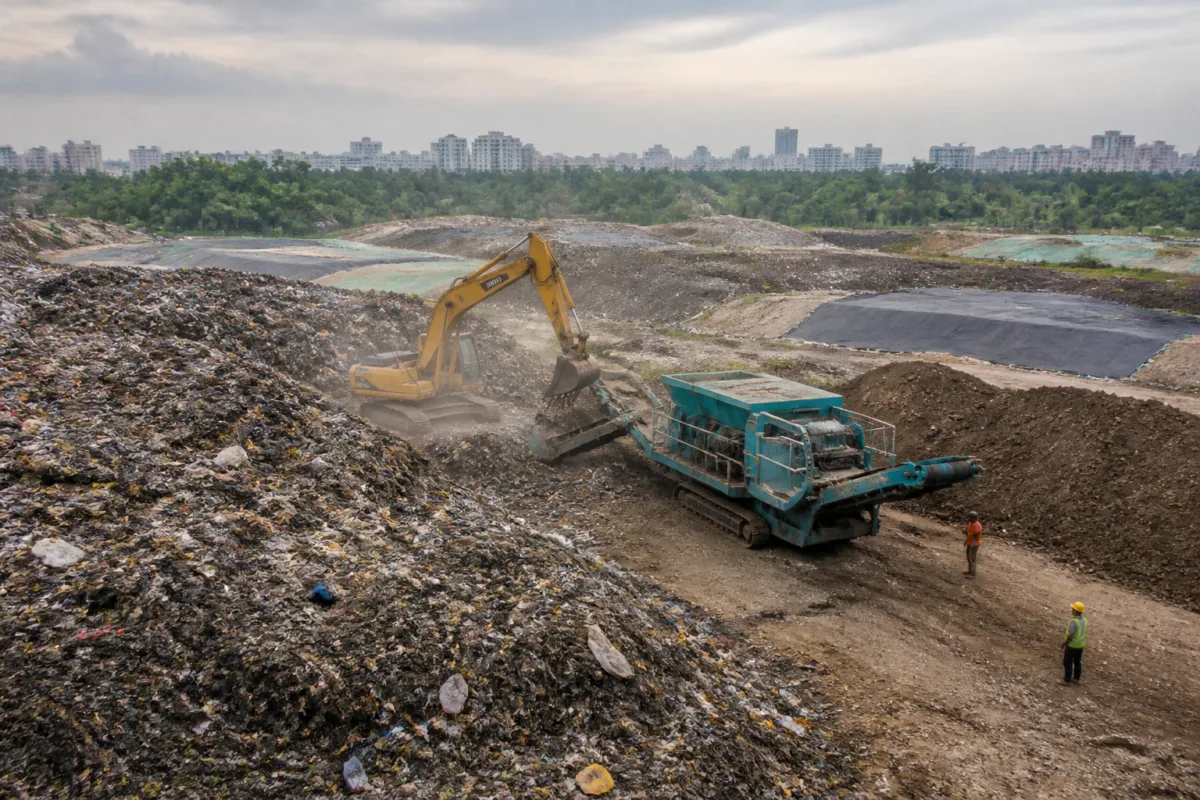
Chandigarh’s waste data has become a governance problem, not merely a record-keeping dispute. Affidavits submitted by the municipal corporation to the Punjab and Haryana high court and the National Green Tribunal contain conflicting figures on how much garbage the city generates, how much is processed, what remains after processing and whether the legacy waste at Dadumajra landfill has actually been cleared.
The contradictions matter because waste management depends on an auditable chain. A city must be able to account for the waste it generates, identify where it is segregated and processed, record the residues left behind and show where those residues are finally disposed of. When those links do not reconcile, it becomes difficult to establish whether waste is being treated, stored, dumped or simply omitted from official accounting.
The latest affidavit, submitted in 2026, states that legacy waste at the Dadumajra landfill had been “totally bio-mined”. But the same filing also refers to “mixed waste lying at the dumping ground” and says the corporation will attempt to clear it by November 15. The filing therefore raises a central operational question: whether the claim of completed biomining refers only to a defined portion of legacy waste, while other material remains at the site, or whether the records describe the same waste differently.
That question is sharpened by the corporation’s earlier statements. In December 2025, the municipal body assured the high court that no freshly generated waste was being deposited at Dadumajra. The latest affidavit, however, still records mixed waste at the dumping ground. The documents supplied in the report do not establish whether this material is old legacy waste, recently accumulated waste or a combination of both. They do show that the landfill’s status is not presented consistently across filings.
The most consequential discrepancy concerns the volume of waste generated each day. In July 2022, the corporation told the high court that Chandigarh generated about 550 tonnes of garbage daily. That estimate consisted of 200 tonnes of dry waste and 350 tonnes of wet waste. The latest affidavit instead records 110 tonnes of dry waste and 200 tonnes of wet waste being processed daily, along with 70 to 80 tonnes of mixed waste sent to a segregation plant.
The 2026 filing does not provide a total daily generation figure or explain how its processing numbers relate to the 2022 estimate. The figures may represent different stages of the waste chain: generation, processing and movement to segregation. But the affidavit does not make that relationship clear. If the mixed-waste figure overlaps with the dry- and wet-waste figures, the totals cannot simply be added. If it does not overlap, the combined figures still do not reconcile with the earlier estimate of 550 tonnes per day. In either case, the absence of an explained methodology leaves a substantial portion of the city’s waste difficult to trace.
The capacity figures add another layer to the problem. According to the corporation’s records, the wet-waste processing plant is operating at less than half its capacity, while the dry-waste facility is operating at just over half capacity. The report does not supply the installed capacity figures, so the exact unused tonnage cannot be calculated from the available material. Even so, the stated utilisation levels raise a basic administrative issue: a city reporting significant daily waste generation is not using its processing infrastructure fully, while its landfill records remain inconsistent.
The discrepancy is not limited to the latest affidavit. The corporation’s own 2022 material contains an internal mismatch. The affidavit stated that 120 tonnes of wet waste were processed daily, while attached logs showed a daily average of 79 tonnes for June 2022. That difference is significant because processing claims determine how much waste should have moved into composting, refuse-derived fuel or residual disposal. Without a clear explanation, the higher figure cannot be treated as interchangeable with the operational logs.
The processing outputs recorded in those logs also show why input figures alone are insufficient. For every 100 tonnes processed, the logs recorded five tonnes of compost and 44 tonnes of inert material, described as primarily non-biodegradable residue. The two outputs together account for 49 tonnes, leaving the available record without a complete explanation of the remaining material. The report does not establish whether that balance represented fuel, recovered material, moisture loss, rejects or another category. That limitation makes it impossible to construct a complete material-flow account from the supplied records.
Residue disposal is the least visible part of the system, but it is central to whether waste processing has actually reduced landfill pressure. In 2022, the corporation stated that 15% to 20% of processed waste was sent to the dumping ground. The latest affidavit lists compost and fuel as processing by-products but does not explain where the remaining residue is being disposed of. If residues continue to move to a dumping ground, then biomining or processing may reduce the volume of legacy waste without eliminating the need for controlled final disposal. If they are being handled elsewhere, the filing needs to identify those destinations and quantities.
This is the institutional gap exposed by the conflicting affidavits. Waste-management documents often use different measures for generation, collection, processing, recovery and disposal. Those measures can all be valid when their definitions are stated. They become misleading when a processing number is compared with a generation number without clarification, or when a by-product is listed without recording its final destination. The Chandigarh filings, as described in the report, do not provide the definitions or reconciliation needed to make the figures comparable.
The issue also affects the interpretation of the Dadumajra biomining claim. Biomining is not the same as making all material at a landfill disappear. It involves processing legacy waste to recover usable fractions and separate inert or residual material. The final environmental and administrative outcome depends on what happens to each fraction after separation. A declaration that legacy waste has been totally bio-mined therefore needs to be read alongside records showing the quantity processed, the recovered products, the residue generated, the residue’s disposal location and the condition of the site afterwards.
The changing number of dumping sites further complicates that assessment. In 2022, the corporation reported two dumping sites at Dadumajra. The 2026 affidavit lists three sites and introduces a third mound. The available report does not say whether the third mound was newly identified, previously counted as part of another site or created by subsequent dumping. That distinction is essential. A change in site count can reflect improved mapping, a change in terminology or a real increase in waste accumulation, but the filing needs to explain which one occurred.
For residents, the concern is not confined to the accuracy of court paperwork. Dadumajra’s waste burden affects the management of land, air and public-health risks around a long-running landfill site. Yet the supplied material does not establish specific current health or pollution impacts, and those claims should not be inferred from the data discrepancies alone. The confirmed public-interest concern is more basic: the city’s official records do not yet present a consistent account of the waste moving through its system.
The court filings also show how judicial oversight can expose gaps that routine municipal reporting may leave unresolved. The high court and the National Green Tribunal have received affidavits over several years, creating a documentary trail against which newer claims can be compared. But oversight is effective only when the underlying measures remain consistent or changes are clearly explained. A new affidavit that changes the number of sites, omits total generation and leaves residue disposal unspecified makes longitudinal monitoring harder.
The immediate administrative requirement indicated by the report is reconciliation. Chandigarh needs a single account that distinguishes daily generation from daily processing, separates dry, wet and mixed waste, identifies overlaps, records plant capacity and utilisation, and tracks every output through final disposal. It also needs to clarify whether the material due to be cleared by November 15 is legacy waste, fresh waste or mixed material, and how that statement relates to the earlier assurance that fresh waste was no longer being deposited at Dadumajra.
What the evidence confirms is that Chandigarh’s waste system is being described through figures that do not presently fit together. What remains unresolved is the actual quantity of waste generated and unaccounted for, the status of the third dumping mound, the destination of processing residues and the precise meaning of the claim that legacy waste has been totally bio-mined. Those are not secondary details. They determine whether the city can demonstrate that its landfill problem is being solved or merely being reported in different ways.

