


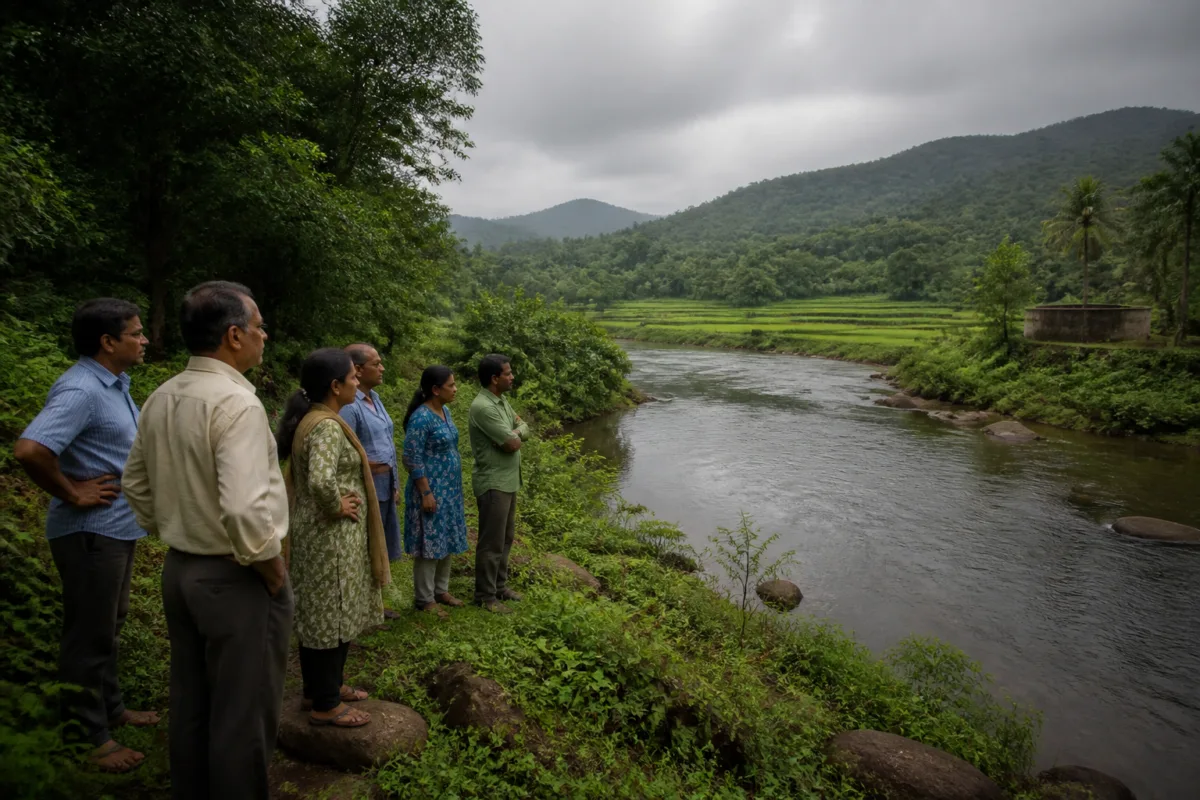
A two-day consultation in Dharwad on the Malaprabha–Mhadei water dispute has brought the conflict into sharper focus: the same river system is being presented as a drinking-water necessity, an agricultural lifeline and an ecological reserve by communities in Goa, Karnataka and Maharashtra. The meeting did not announce a settlement, but it exposed the competing needs that have kept the dispute unresolved for decades.
The consultation, held at Devalaya in Dharwad over the weekend, brought together affected communities, environmentalists and representatives from the three states. It focused on Karnataka’s proposed damming and diversion schemes and was organised by the National Alliance of People’s Movements, SPARK Karnataka, Eco Watch, Sarvodaya Samaj, People First Foundation, Gandhi Shanti Pratishthan and the Hubballi–Dharwad Citizens Environment Committee.
NAPM’s Nirmala Gowda said the consultation was intended to create a common platform where stakeholders could share concerns, expectations and perspectives. That format matters because the dispute is not simply a contest between state governments. The positions described at the meeting also reflect differences between communities dependent on water for drinking and farming, environmental groups concerned about river ecology, and campaigners seeking to protect the Western Ghats.
The consultation therefore offers a useful view of the dispute at ground level. It shows how a proposal described in administrative or engineering terms as a diversion or damming project is experienced locally as a question of water security, agricultural survival, salinity, fish habitats and the future of forested landscapes.
## A water allocation dispute with competing public needs
Farmers from north Karnataka, including Shankar Ambali, argued that Karnataka should be allowed to use 4 tmcft of water because it is primarily required for drinking-water needs. They also said that livelihoods in the region depend on sustainable agriculture and rejected the suggestion that the water demand is being driven by irrigation for sugarcane cultivation.
That position places drinking water at the centre of Karnataka’s claim. It also demonstrates why the dispute is difficult to resolve through broad political statements alone. The volume sought, the purpose for which it would be used and the communities that would receive it are all central to the argument. The account of the consultation does not provide an independent assessment of Karnataka’s 4 tmcft claim or details of the proposed project design, storage capacity, command area or implementation schedule. Those limits mean the meeting can clarify the competing positions, but cannot by itself establish the technical or legal merits of each demand.
From Goa, Mhadei Bachao Abhiyan’s Nirmala Sawant described the state as water-deficient and the Mhadei as a lifeline for drinking water, irrigation and daily needs. Other Goa speakers—Dasharth Morajkar, Abhijit Prabhudesai and Eric Pinto—emphasised the river’s importance for drinking and agriculture and warned that diversion could increase salinity, damage fish habitats and affect the wider ecology.
These concerns broaden the definition of water security. A river is not only a quantity that can be transferred from one basin or region to another. It also supports the conditions that allow freshwater ecosystems, farming communities and local livelihoods to function. The supplied report does not quantify the possible increase in salinity or identify the specific fish habitats at risk. However, the concerns raised at the consultation show that ecological effects are part of the public dispute, not a separate environmental issue.
## Maharashtra’s position links water security to landscape protection
Maharashtra’s Prasad Gawade opposed damming and diversion projects as well as mining in ecologically sensitive areas of the Western Ghats. He argued that protecting forested regions would help the Konkan secure water for drinking and irrigation through springs, tanks and traditional community-managed water-harvesting systems.
This position introduces a third dimension to the dispute. Karnataka’s representatives, as described in the report, framed the issue around access to a specified quantity of water for drinking and agriculture. Goa’s representatives emphasised the river’s role in sustaining communities and ecosystems. Maharashtra’s intervention connected water availability to the condition of forests, springs, tanks and local water-harvesting systems.
The significance of that argument is institutional as much as environmental. It suggests that decisions about a river cannot be separated from decisions about land use in its catchment and surrounding Western Ghats areas. Mining, forest protection, storage structures, local harvesting systems and inter-state transfers may be discussed by different departments and authorities, but they are experienced by communities as connected parts of one water system.
The consultation did not produce a common technical framework for weighing those claims. There was no reported agreement on water accounting, ecological-flow requirements, project safeguards or a joint monitoring mechanism. That absence is important. Dialogue can create a shared platform, but a durable settlement would require the competing claims to be translated into transparent evidence that all three states and affected communities can examine.
## The institutional gap behind the public dispute
The organisations that convened the meeting are civil-society and citizens’ groups rather than the official water authorities of the three states. Their role was to bring affected communities, environmentalists and state-based stakeholders into the same discussion. This gives the meeting a participatory character, but it also underlines the distance between public consultation and formal decision-making.
The report does not identify a government notification, court order, inter-state agreement or official project approval emerging from the consultation. It also does not say that the three states accepted a shared position. The event should therefore be understood as a forum for presenting and comparing concerns, not as a formal resolution of the dispute.
That distinction is essential in inter-state water conflicts. A consultation may reveal the distributional consequences of a project—who expects to receive water, who fears losing it and which ecological systems may be affected—but it cannot substitute for the legal, technical and administrative processes through which a project is assessed and implemented. The supplied material does not provide details of those processes for the current proposals.
The meeting nevertheless performs a valuable institutional function by making the dispute less abstract. The discussion included farmers from north Karnataka, campaigners from Goa and a Maharashtra representative concerned about the Western Ghats. Their participation places the consequences of water decisions alongside the claims of states and project proponents. It also indicates that any settlement judged legitimate by affected communities would need to address more than the allocation of water at the state level.
## What the consultation establishes—and what it does not
The clearest evidence from the meeting is that the three-state dispute involves multiple and sometimes conflicting definitions of public interest. Karnataka participants described a need for 4 tmcft of water, primarily for drinking purposes, while also linking the demand to sustainable agriculture. Goa participants described the Mhadei as essential to drinking water, irrigation and daily needs and warned about salinity and damage to fish habitats. Maharashtra’s representative opposed diversion and mining and promoted forest protection and community-managed water systems as part of regional water security.
The report establishes that these positions were voiced at a two-day consultation. It does not establish that the proposed diversion will cause a particular level of ecological damage, that Karnataka’s claimed quantity has been officially approved, or that alternative water systems can meet the full needs of affected communities. Those questions remain outside the evidence supplied for this story.
The absence of such information is not a minor technical gap. Water disputes are often reduced to competing claims over quantities, but the public consequences depend on where water is stored, how it is released, which users receive priority and what happens to downstream ecosystems. Without a shared assessment, each side can present a genuine local need while the wider river system remains poorly understood in public debate.
The consultation’s emphasis on drinking water and daily needs also raises a question about priority-setting. If all three states frame their claims around basic needs, the dispute cannot be resolved simply by treating one state’s demand as development and another’s objection as conservation. The available account instead points to a need to examine the full chain: source, diversion, users, downstream effects, agricultural practices and the condition of the landscapes that sustain flows.
## The larger urban and regional water question
Although the consultation took place in Dharwad and the dispute concerns river systems and rural communities, its implications extend to the wider built environment. Drinking-water security for towns and cities depends on sources outside municipal boundaries. Irrigation, food production, forest protection and the health of rivers all shape the resilience of settlements that may not be located beside the contested project.
The meeting also shows why infrastructure decisions cannot be evaluated only through the physical structure being proposed. A dam or diversion channel may be the visible component, but the underlying system includes catchments, farms, fish habitats, springs, tanks, forests and community institutions. Damage or stress in one part of that system can alter the choices available to people elsewhere.
The three-state consultation does not resolve those questions. Its value lies in showing that the Mhadei dispute remains a live contest over how water security should be defined and who should bear the costs of securing it. The next meaningful stage would require the positions aired in Dharwad to be matched by publicly available technical evidence, formal responses from the concerned authorities and a process that gives affected communities a continuing role rather than a one-time platform.

