


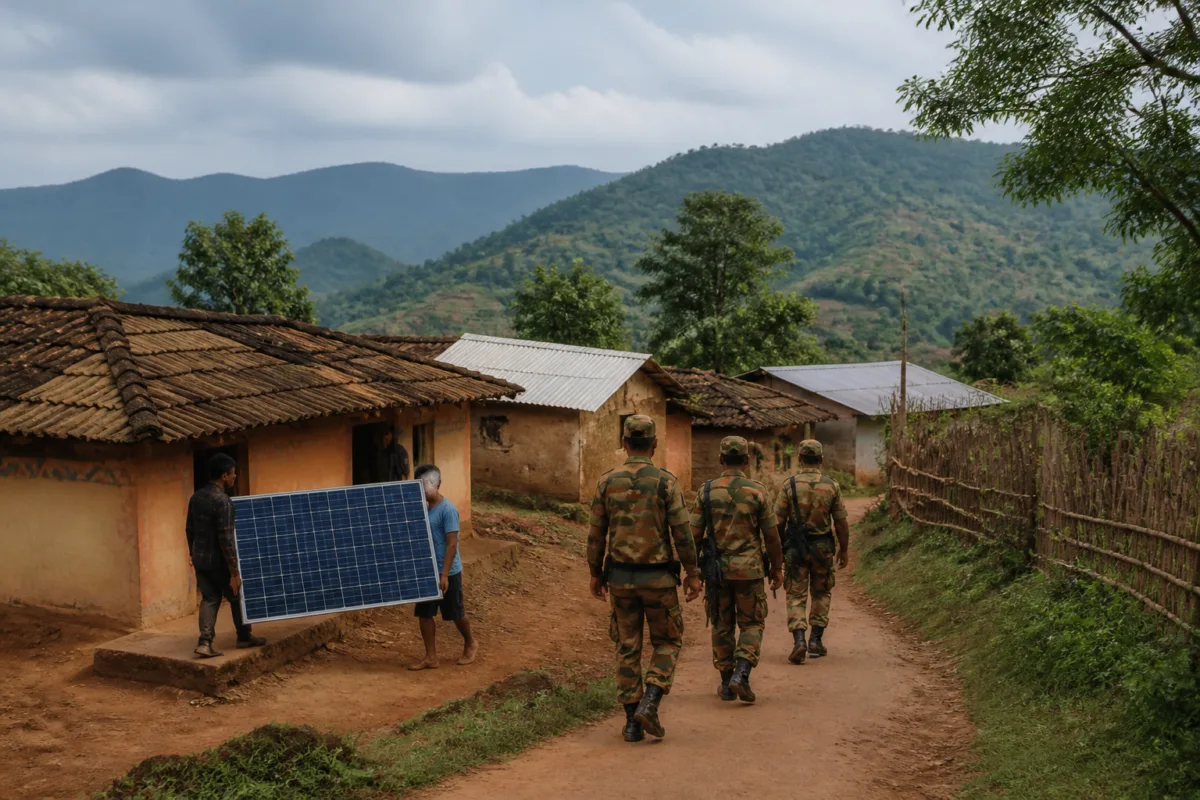
The latest confrontation in the Kotia border dispute is not only about an election. It is also about who can deliver public services, conduct political activity and exercise administrative authority in villages claimed by both Odisha and Andhra Pradesh. Odisha officials stopped an Andhra Pradesh team from installing solar panels in 36 houses at Upper Sembi, while police from Odisha prevented Andhra officials and personnel from mobilising voters ahead of the November 3 panchayat election.
The incidents, reported by the Times of India, came a day after the Odisha government moved the Supreme Court against Andhra Pradesh’s decision to hold elections in the disputed panchayat. They show how a long-running territorial disagreement has moved into the everyday functioning of the border villages: the dispute is being expressed through welfare delivery, election activity, policing and visible government presence.
That makes Kotia more than a boundary question. It is an administrative contest experienced by residents through the officials who visit their homes, the services brought to their villages, the election processes they are asked to participate in and the security presence deployed around them.
## A dispute sustained through competing state presence
Odisha and Andhra Pradesh have competing claims over 21 of the 28 villages in Kotia panchayat. The matter has been pending before the Supreme Court since 1968, according to the report. The dispute has therefore continued across multiple political and administrative periods, without a final resolution described in the supplied material.
The persistence of the case has allowed the territorial disagreement to become a recurring governance problem. Rather than remaining confined to court filings or official maps, it appears in the form of development initiatives and election-related activity. Andhra Pradesh has continued with election-related activities and development initiatives despite Odisha’s objections, the report said. Odisha, in turn, has responded through administrative intervention, police deployment and intensified surveillance.
This pattern creates a situation in which public works can acquire a political and territorial meaning. A solar panel is normally a household-level infrastructure asset. In a disputed area, however, the government team delivering it can also be seen as demonstrating administrative reach. The reported stoppage at Upper Sembi illustrates how basic infrastructure delivery becomes entangled with the question of which state is entitled to act in the village.
The available report does not establish who financed the solar panels, which agency sanctioned them, whether residents had requested the installations or whether the work was part of a wider programme. Those details matter because they would help distinguish a routine service-delivery exercise from a targeted political or administrative intervention. What is established is that the installation team was stopped by Odisha officials and that the intended work involved 36 houses.
## Elections have raised the stakes
The proposed election has added a new institutional dimension to the dispute. Odisha police stopped an attempt by Andhra government officials and police to mobilise voters ahead of the election to the Mandal Parishad Territorial Constituency, or MPTC. The report describes the activity as election-related mobilisation and says Odisha police objected to it, preventing the team from campaigning.
The immediate issue is therefore not only which state claims the territory, but also how electoral participation is to be managed while that claim remains unresolved. Election activity gives the dispute a deadline and a direct connection to residents’ political representation. It also increases the likelihood that administrative actions by either state will be interpreted through the lens of territorial authority.
The report does not provide the legal details of the election decision, the precise jurisdictional arrangements for the MPTC poll or the Supreme Court’s response to Odisha’s challenge. Those questions remain important to understanding how the election can proceed amid competing claims. The supplied account establishes only that Andhra Pradesh decided to hold elections, Odisha challenged that decision in the Supreme Court and tensions increased in the run-up to the November 3 poll.
This limited information is significant in itself. When the legal status of a disputed area and the operational conduct of an election overlap, routine administrative actions can become potential flashpoints. The presence of officials and police from two states around the same villages introduces a layer of institutional competition that is different from ordinary campaign activity.
## Security has become part of local administration
Odisha has deployed at least two platoons of security personnel in Kotia to prevent any untoward incident, Koraput sub-collector Fabi Rasheed told the Times of India. The official said additional forces would be deployed depending on the situation.
Odisha police have also intensified surveillance across the 21 disputed villages. Senior officers, including the additional superintendent of police and the sub-divisional police officer, have conducted patrolling and door-to-door visits, according to the report. Pottangi tehsildar Debandra Dharua said police personnel were visiting villages regularly to maintain law and order and prevent disturbance to peace.
These measures show the extent to which security management has become linked to civic administration in Kotia. Patrolling and door-to-door visits are being presented as ways to reassure residents and maintain peace, but they also indicate that the election period is being treated as a sensitive administrative phase rather than a routine local poll.
The number of security personnel deployed is not provided beyond the reference to two platoons. The report also does not specify the size of the police force involved in the earlier voter-mobilisation incident or whether any arrests, complaints or formal cases followed. It records intervention and heightened surveillance, but not a wider breakdown of law and order.
That distinction is important. The evidence describes heightened tension and preventive deployment, not violence. The institutional response so far, as reported, has focused on stopping disputed activities and preventing escalation. The next stage will depend on how the authorities manage election-related activity, public works and movement across the villages without allowing competing claims to turn into confrontation.
## The service-delivery problem behind the territorial dispute
The solar-panel episode brings the resident’s perspective into a dispute often reported through the language of territory and litigation. For households in Upper Sembi, the immediate issue was a proposed installation in their homes. Whether the panels would have improved electricity access, reduced dependence on other sources or formed part of a larger scheme is not established in the report. But the incident demonstrates how residents can become the point at which competing administrative claims meet.
In a conventional service-delivery system, responsibility is expected to be clear: a department identifies a need, approves a project, sends personnel and completes the work. In a disputed border area, each of those steps can be contested. The identity of the implementing authority may matter as much as the service itself. An infrastructure project can therefore be delayed or stopped not because its technical purpose is disputed, but because its delivery is connected to jurisdiction.
The same problem can affect election administration. Voters are not only recipients of public services; they are also participants in institutions that determine local representation. If the conduct of an election is contested by two states, residents may face uncertainty over which authority is organising the process, which officials are legitimate and what administrative consequences follow from participation.
The report does not provide residents’ statements, turnout data, details of previous elections or information on how public services are divided between the two states. It would be premature to claim that the latest incidents have changed voting behaviour or service access. What can be said is that the dispute has placed residents at the centre of overlapping administrative actions, while the final legal position remains pending.
## What the numbers reveal—and what they do not
The reported figures outline the scale of the immediate administrative challenge. Twenty-one of the 28 villages in Kotia panchayat are subject to competing claims. Solar panels were intended for 36 houses in Upper Sembi. At least two platoons of security personnel were deployed, and police surveillance covered the 21 disputed villages. The election to the MPTC was scheduled for November 3.
These numbers do not measure the full social or economic impact of the dispute. There is no information in the supplied material on the population of the villages, household electricity access, the number of voters, previous election turnout, public spending, road connectivity or the availability of health and education services. Nor does the report establish how frequently development projects from either state have been delivered in the area.
That absence points to a broader information problem. Territorial disputes are often documented through legal claims, official statements and security deployments, while the service conditions of affected residents receive less systematic attention. Without comparable information on electricity, roads, welfare access, schools, health facilities and local government functioning, it is difficult to assess whether competing state presence is improving daily life or mainly intensifying institutional rivalry.
The immediate report provides a snapshot rather than a complete administrative audit. It records a proposed household infrastructure intervention, disputed election activity, police action and preventive security deployment. The evidence supports an account of rising tension before the poll, but not a conclusion about which state has delivered better services or how residents view the competing claims.
## The larger governance question
Kotia demonstrates how unresolved boundaries can turn ordinary functions of urban and rural governance into instruments of state presence. The issue is rural in location, but it belongs to the wider built-environment and governance debate because roads, electricity, elections, policing and public administration all depend on clear institutional responsibility.
The central question is not simply whether Odisha or Andhra Pradesh has a stronger claim. It is how residents receive essential services and exercise democratic rights while the legal dispute continues. The latest incidents suggest that, in the absence of a final settlement, every new project or election-related activity can be assessed as both a public service and a territorial assertion.
The available evidence confirms that the November 3 election has intensified activity in the 21 disputed villages, with competing state interventions now visible through solar-panel installation, voter mobilisation and security deployment. It does not establish the legal outcome of Odisha’s Supreme Court challenge, the final arrangements for the poll or the longer-term effect on residents. Those are the developments that will determine whether the current tension remains a managed administrative contest or becomes a deeper disruption to local governance.

