


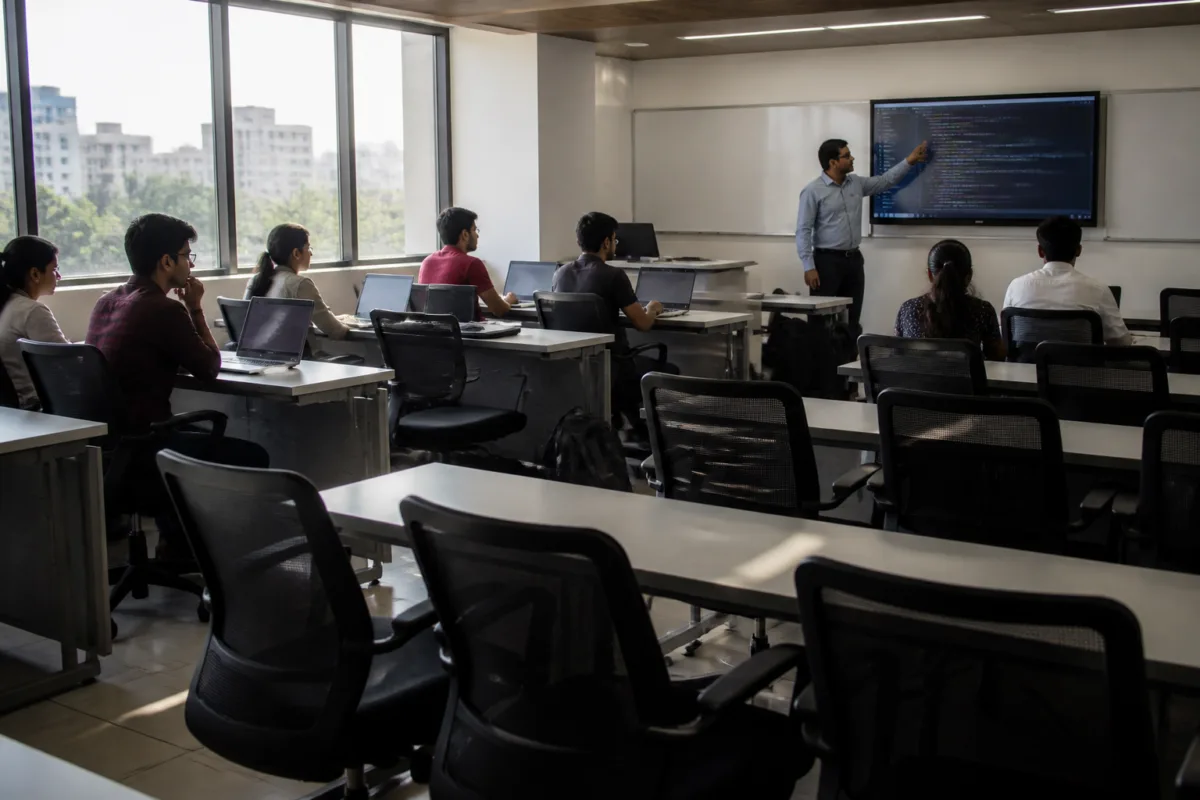
Gujarat’s computer engineering system has reached a point where expanding capacity is no longer translating into expanding demand. In 2026, institutions offered 45,620 seats across computer engineering and allied courses, but only 22,847 were filled. The resulting 22,773 vacancies represent a fill rate of 50.1%, the highest level of unfilled capacity in five years.
The numbers mark a significant reversal for the state’s most sought-after engineering stream. Computer engineering remained Gujarat’s largest discipline by total admissions, but enrolment fell for a second consecutive year, from 27,302 students in 2024 to 24,507 in 2025 and 22,847 in 2026. At the same time, institutional intake rose from 26,630 seats in 2021 to 45,620 this year.
That divergence is the central institutional fact in the current downturn. Colleges added nearly 19,000 seats over five years, while actual enrolment declined from its recent peak. The result is not simply a temporary shortage of applicants or a weak admission cycle. It indicates that the education system expanded its supply of computer engineering places faster than student demand and the entry-level technology labour market could absorb.
Nilay Bhuptani, principal of LD College of Engineering and member secretary of the Admission Committee for Professional Courses, said demand for computer engineering had begun to soften after dominating student preferences for nearly a decade. He said the discipline had retained the top position for 10 years, but demand was now declining.
Bhuptani linked the change to three pressures: continuous seat expansion, the disruption caused by artificial intelligence and longer campus placement cycles. Placements that earlier concluded by July or August are now extending into October, making the transition from engineering education to employment less predictable for students and families.
This is important because the value of an engineering seat is increasingly being judged through the employment pathway attached to it. When campus recruitment was strong, expanding computer engineering capacity could appear to be a straightforward response to student demand and industry growth. The present figures show the limits of that assumption. A larger intake does not by itself create more technology jobs, improve the quality of training or guarantee that employers will continue recruiting at the same level.
The industry evidence cited in the report points to a change in the composition of demand as much as a decline in overall opportunity. Nirav Shah, former president of the GESIA IT Association, said outsourcing orders had reduced even though the domestic market was performing well. He said companies were seeking different skill sets and that artificial intelligence was reducing manpower requirements for certain functions, leading to lower new hiring.
The distinction between a growing technology sector and a growing market for fresh graduates is therefore crucial. A company can increase its use of technology while hiring fewer entry-level employees if software tools perform a larger share of junior work or if employers prefer workers who can manage artificial-intelligence systems. That is the change being described by the industry sources in the report, although the available evidence does not establish how widespread the effect is across Gujarat’s entire technology economy.
Chandresh Patel, chief executive of Bacancy Technology, said the company hired about 100 fresh graduates in 2024 and 56 in 2025, but had not planned new campus hiring in 2026. The company was instead hiring experienced professionals with artificial-intelligence skills. His account provides a concrete example of how the entry-level pipeline is narrowing: the issue is not that technology firms have stopped hiring altogether, but that the qualifications and experience they want are shifting.
The same shift is visible in campus recruitment behaviour. Placement coordinators at premier institutes in Gandhinagar, speaking anonymously, said regular recruiters were either skipping campus drives or taking substantially fewer graduates. The report does not provide a statewide count of participating recruiters or a consolidated placement rate, so these accounts cannot be treated as a complete measure of the market. They do, however, help explain why students may be reassessing the value of a computer engineering seat.
The consequences are uneven across the education system. Institutions with stronger reputations, established employer networks and the capacity to conduct active outreach may be better placed to protect placements during a lean hiring cycle. Prof RN Patel, director general of Nirma University, said more than 300 students had been placed and that teams of professors had approached companies in Pune, Hyderabad and Bengaluru with information about student profiles and institutional initiatives. He attributed progress in internships and placements partly to this outreach.
That response highlights an institutional divide. When employers reduce routine campus recruitment, colleges cannot rely only on a centralised placement event. They need access to broader employer networks and a way to demonstrate skills that match changing technology requirements. The supplied evidence does not show whether all institutions have comparable resources, which leaves open the question of how vacancies and placements are distributed between established colleges and less-connected campuses.
The changing admissions pattern also complicates the usual narrative that students are abandoning engineering. Enrolment in several traditional branches increased in 2025. Mechanical engineering admissions rose from 3,036 in 2024 to 3,503 in 2025; civil engineering increased from 2,654 to 2,939; electrical engineering from 2,056 to 2,164; chemical engineering from 1,786 to 1,811; and biotechnology from 530 to 676. Specialised courses recorded smaller numbers, including 105 admissions in textile engineering, 37 in dairy engineering and 19 in agriculture engineering.
These figures do not prove that traditional engineering has fully recovered, because the report provides only one year of comparative growth for those disciplines and does not supply their total available capacity. They do show, however, that the decline in computer engineering admissions is occurring alongside renewed interest in some other branches. Students may be responding to a perceived change in employment prospects, or colleges may be seeing the effects of a broader diversification in career choices. The available data cannot distinguish between these explanations.
For Gujarat’s urban education and employment system, the capacity mismatch has implications beyond college administration. Engineering institutes are part of the state’s talent pipeline and are closely linked to cities such as Ahmedabad, Gandhinagar and Vadodara, where education, services and technology employment are concentrated. When seats remain vacant, institutions face a potential financial and planning problem; when graduates face weaker campus hiring, households face a higher risk that a professional degree will require additional training, relocation or a longer search for work.
The policy question is not simply whether colleges should add or remove seats. It is whether technical education planning is responding quickly enough to changes in employer demand. The figures show that intake expanded substantially between 2021 and 2026 even as enrolment peaked in 2024 and then declined. A system that measures demand mainly through past student preferences may continue approving capacity after the labour market has changed.
The evidence also suggests that artificial intelligence is affecting the education-to-work transition before its full effects on the wider sector are known. Industry representatives describe reduced junior hiring and stronger demand for experienced professionals with AI-related capabilities. At the same time, college leaders are trying to maintain placements through direct employer outreach. What remains uncertain is whether this is a temporary hiring cycle, a lasting reduction in entry-level technology work, or a transition towards new roles that current curricula and recruitment systems have yet to capture.
Gujarat’s computer engineering vacancy figures therefore represent more than a fall in one year’s admissions. They expose a widening gap between institutional capacity, student expectations and the changing structure of technology employment. The state still has the largest pool of computer engineering admissions among its disciplines, but the five-year vacancy peak shows that past popularity can no longer be treated as a reliable guide to future demand. The next admission cycle, campus hiring numbers and the distribution of placements across institutions will indicate whether the current reversal deepens or begins to stabilise.

