


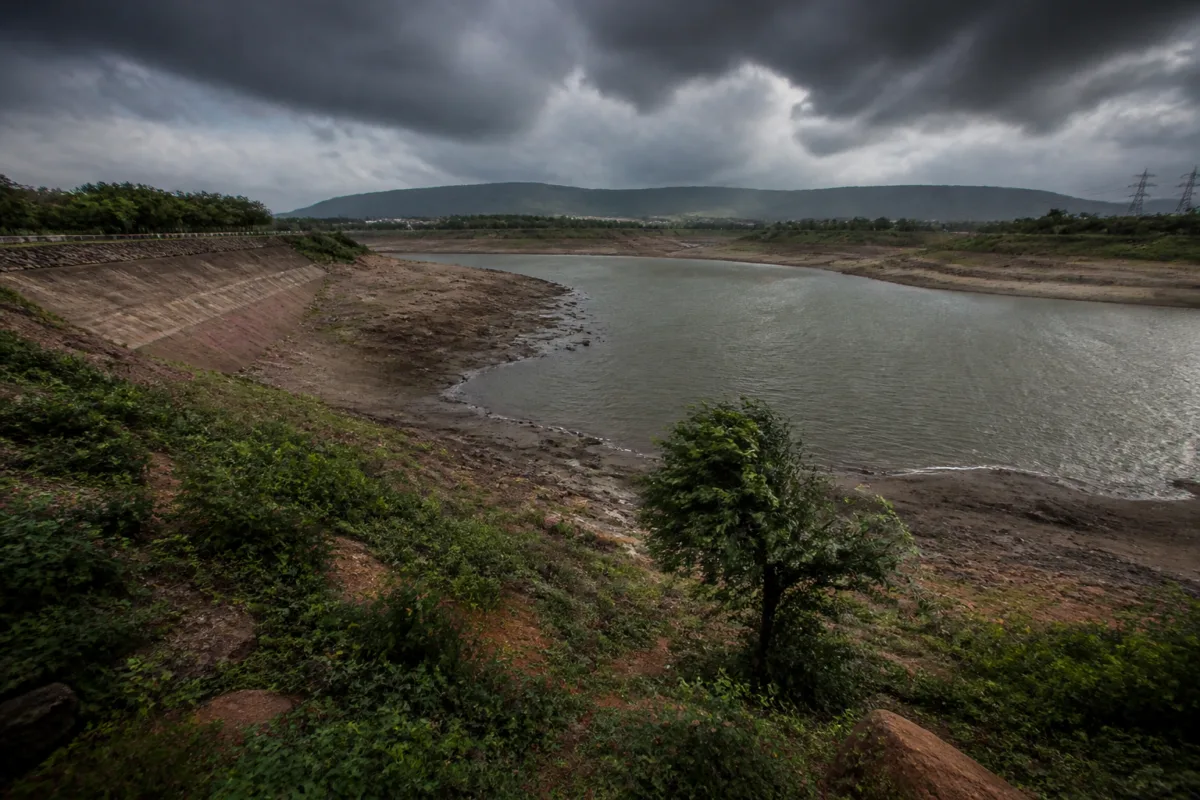
Cyclone Arnab is expected to bring heavy but passing rain to parts of Telangana after crossing the Andhra Pradesh coast, but the weather event is unlikely to repair the state’s wider water deficit. The central issue is not whether rain will fall, but whether it will fall for long enough, and across a wide enough area, to replenish the river basins and reservoirs on which drinking-water systems depend.
According to a Deccan Chronicle report quoting India Meteorological Department authorities, the cyclone is expected to move north through Wednesday and Thursday. Eastern districts including Bhadradri-Kothagudem, Mahbubabad, Mulugu and Khammam were placed under a red alert for Wednesday, while orange alerts were issued for Jayashankar Bhupalpally, Warangal, Suryapet, Nalgonda and Nagarkurnool. Several other districts were placed under yellow alert, while Hyderabad and the remaining areas were expected to receive light to moderate rainfall.
The immediate concern is severe weather. IMD officials told the newspaper that wind speeds could exceed 50 to 60 km/h, with a maximum of about 70 km/h. Andhra Pradesh is expected to bear the stronger impact after landfall, while Telangana may experience heavy storms that pass through the state. The forecast also identified moderate rainfall in Komuram Bheem Asifabad, Mancherial, Peddapalli, Jayashankar Bhupalpally and Mulugu on Thursday.
But the water-security question extends beyond the forecast period. Telangana’s rivers, reservoirs and drinking-water sources have been weakened by a deficient monsoon, according to the report, with the state also facing the looming impact of El Niño. A few days of intense rain may provide temporary relief to parched areas, recharge some local water bodies and improve soil moisture. That does not necessarily amount to a sustained recovery in water availability.
This distinction is important for cities because urban water supply is tied to infrastructure that operates across administrative boundaries. A reservoir supplying a city does not depend only on rainfall within that city or even within the state. Its storage is affected by rainfall in upstream catchments, inflows through rivers and streams, the condition of local water bodies and the timing and intensity of precipitation. A storm concentrated in one part of Telangana can therefore produce flooding or swollen streams without generating enough inflow into the reservoirs supporting drinking-water schemes.
The reported forecast illustrates this geographic mismatch. The districts expected to receive the heaviest rain are concentrated largely in eastern and northern parts of the state. Telangana’s water security, however, depends on rainfall across the wider Krishna and Godavari basins. Those catchments extend beyond the state into Maharashtra and Karnataka. Rainfall inside Telangana is therefore only one part of the hydrological system that determines how much water eventually reaches major reservoirs and river channels.
Short, intense rainfall also behaves differently from steady rainfall spread across several days. When rain falls faster than the ground can absorb it, a larger share can run off into drains, streams and low-lying areas. Some of that runoff may enter rivers and reservoirs, but the actual quantity depends on where the rain falls, how intense it is, how long it continues and whether the affected land lies within the relevant upstream catchment.
The result is that a weather warning and a water-replenishment forecast answer different questions. An alert indicates the risk of strong winds and heavy rain in specified districts over a defined period. Water managers need to know how much of that rain will become usable storage, where the inflows will occur and whether they will be sustained. The first is a public-safety decision; the second is a basin-scale resource-management question.
The Deccan Chronicle report does not provide reservoir-level figures or quantify the state’s water deficit. It also does not establish how much inflow the cyclone may generate in specific projects. Those gaps matter because rainfall totals alone cannot show whether drinking-water security has improved. Storage levels, inflow measurements, release decisions and the location of rainfall would be needed to assess the effect on individual reservoirs and supply systems.
That absence of data does not make the forecast irrelevant. It defines the limits of what can responsibly be concluded from it. The cyclone may reduce local stress in areas that receive rain. It may restore moisture in soil and add water to smaller tanks and streams. It may also create operational risks through high winds and sudden runoff. But the available information does not support the conclusion that the state’s broader river and reservoir systems will be replenished during the following week.
For urban administrations, the distinction has practical consequences. Drinking-water planning cannot be based solely on whether a forecast shows heavy rain. Municipal agencies and water utilities must track the sources that actually feed supply networks, including reservoirs and river systems outside city boundaries. The relevant administrative task is to connect weather information with catchment conditions, storage levels and expected demand rather than treat rainfall as an automatic increase in available supply.
The report also highlights the institutional complexity of water security. IMD is responsible for weather forecasts and district alerts. Reservoir and river agencies must assess inflows and storage. Urban and rural water-supply authorities must translate available water into distribution plans. Because the Krishna and Godavari basins cross state borders, the hydrological conditions in Maharashtra and Karnataka also become relevant to Telangana’s water position. No single district forecast can capture that entire chain.
This is why a cyclone can be simultaneously significant for public safety and insufficient as a solution to a water crisis. Emergency agencies may need to prepare for strong winds, intense rain and localised runoff even when water managers remain cautious about long-term replenishment. The same rainfall that helps a dry local water body can create short-term drainage or flooding pressures without materially changing the storage position of a major drinking-water source.
The episode points to a broader weakness in how urban water stress is often communicated. Rain is visible and immediate; recharge and storage are delayed and harder to observe. A city may receive a dramatic downpour while its principal source remains vulnerable because the wider catchment has not received comparable rainfall. Conversely, moderate rain spread across the right upstream areas may be more valuable for reservoirs than a much heavier storm concentrated elsewhere.
For Telangana, the evidence currently supports a limited conclusion. Cyclone Arnab may bring temporary relief to some districts and improve local moisture conditions, but the available report does not show that it will restore the state’s major river systems or drinking-water reserves. Sustained improvement will depend on adequate rainfall across the wider Krishna and Godavari catchments, including areas outside Telangana.
The next evidence to watch is not only the rainfall recorded in the alerted districts, but also the resulting inflows and storage levels in the reservoirs and river systems that support drinking-water schemes. Until those measurements become available, the cyclone should be treated as a short-term weather event with possible local benefits, not as a resolution to Telangana’s water crisis.

