


Himachal Pradesh’s plan to invest Rs 10,000 crore to Rs 15,000 crore in tourism over the next five years is also an infrastructure programme, with the state government placing airport expansion, flight support and heliport connectivity at the centre of its growth strategy. Announced by Chief Minister Sukhvinder Singh Sukhu at a golf tournament in Naldehra, the proposal links the expansion of tourism with the ability to move visitors into and across a geographically difficult hill state.
The headline figure is large, but the announcement is not yet a detailed investment plan. The report does not specify how the proposed Rs 10,000-15,000 crore will be divided between public and private investment, which projects will receive priority, or what implementation milestones will govern the five-year period. What it does establish is the direction of policy: Himachal wants to promote high-end tourism, strengthen infrastructure and improve air access, while presenting eco-tourism as another source of state revenue.
That combination makes the announcement significant for more than the tourism industry. In a hill state, visitor growth is inseparable from transport capacity, land availability, airport planning, local access and the management of environmentally sensitive sites. The proposed investment therefore raises a practical question for urban and regional planning: can tourism infrastructure be expanded in a way that improves access without making connectivity dependent on a small number of large projects?
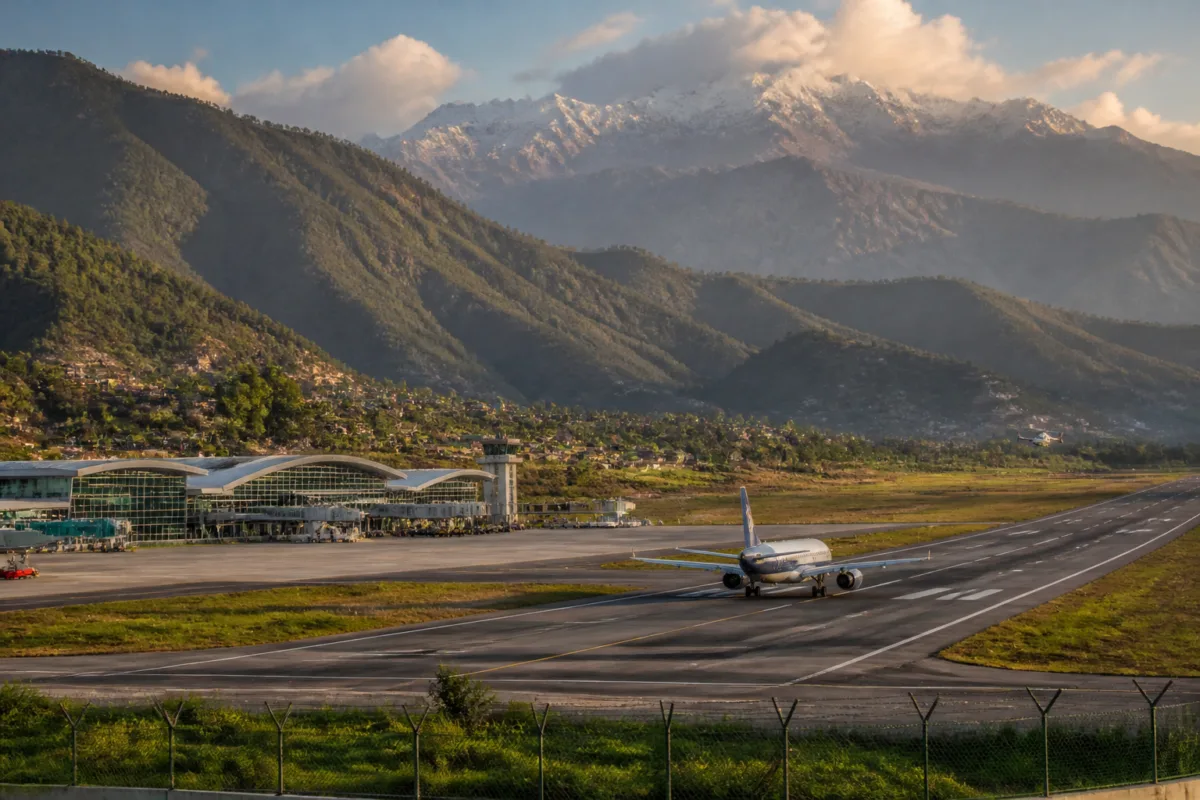
The most specific infrastructure commitment identified in the report is the expansion of Kangra airport. Sukhu said Rs 3,000 crore was being spent on land acquisition for the project. The state expects the expansion to allow larger aircraft to operate, increase tourist arrivals and boost tourism activity across Himachal Pradesh.
Land acquisition is a crucial part of that proposition. It is not an operational upgrade that can be measured only by the eventual size of the terminal or the number of aircraft it can handle. It involves the purchase of land, the creation of conditions for construction and the coordination of public spending with a long-term transport objective. The amount cited for land acquisition represents a substantial component of the broader tourism investment ambition, although the supplied report does not provide the total estimated cost of the airport expansion or its construction timeline.
The airport proposal also illustrates the difference between physical capacity and usable connectivity. Larger aircraft may improve the movement of passengers, but the benefits will depend on whether airlines operate the routes, whether flights are commercially viable and whether visitors can reach destinations beyond the airport. The state government is addressing part of that problem through a Rs 35 crore Viability Gap Funding mechanism to support flight operations.
Viability Gap Funding is significant because it shows that air connectivity is being treated as a service that may require public financial support. The chief minister said the funding would support flights in the state, but the report does not identify the routes, duration, airline agreements or performance conditions attached to the allocation. Those details will determine whether the mechanism creates durable connectivity or serves as a temporary bridge until routes become commercially sustainable.
The government is also working towards connecting all district headquarters through heliport facilities. This expands the transport strategy beyond one airport. District-level heliports could, in principle, provide another layer of access between administrative centres and tourism destinations, although the announcement does not state how many heliports are planned, where they will be located, what they will cost or when they will become operational.
The proposed heliport network is therefore best understood as an administrative connectivity objective rather than a fully defined infrastructure programme at this stage. Connecting district headquarters is different from connecting tourist sites, villages or remote communities. The practical value of the plan will depend on the relationship between those facilities, scheduled flights, road access and the places where visitors actually stay and spend money. The supplied material does not establish whether the heliports are intended primarily for tourism, public services or both.
The state has separately been seeking to improve air access from Shimla. Sukhu said efforts were underway to introduce connecting flights from Shimla, making travel more convenient for tourists. This suggests an attempt to develop a network rather than rely only on a single enlarged gateway. However, the report provides no information on proposed destinations, operating frequency or the infrastructure required at Shimla airport.
That absence of detail matters because tourism infrastructure works as a system. An airport expansion can increase arrival capacity, but it cannot by itself resolve the movement of people across a dispersed hill region. Connecting flights may reduce travel time for some visitors, while heliports may serve selected district headquarters. The full effect will depend on how these modes are integrated with the rest of the state’s transport network, a subject not addressed in the announcement.
The government’s emphasis on high-end tourism also has an infrastructure dimension. Higher-value tourism generally requires accommodation, reliable access, utilities, public spaces and supporting services capable of meeting visitor expectations. The report does not specify whether the planned investment will include hotels, resorts, roads, water systems, waste management, public transport or other urban services. Without that breakdown, it is not possible to determine how much of the proposed sum is intended for transport infrastructure and how much for tourism facilities.
The distinction is important for local administrations. Tourism investment can produce demand for land and services in places that may have limited capacity to absorb rapid growth. It can also concentrate development around airports, golf destinations and selected tourism sites. The announcement identifies Naldehra as the venue for the chief minister’s statement and refers to Kangra, Shimla and district headquarters, but it does not provide a spatial plan showing how investment would be distributed across the state.
The government’s eco-tourism initiative provides one concrete indicator of the state’s current approach. Sukhu said 60 eco-tourism sites had been leased out, generating Rs 22 crore for the state exchequer. This establishes both an administrative action and a reported revenue outcome. It does not, however, provide information on the size of the sites, the terms of the leases, the number of visitors, the environmental safeguards or how the revenue is being used.
Those missing details are central to evaluating eco-tourism as an urban and regional development tool. Leasing sites can create a revenue stream and bring private operators into tourism development. At the same time, the quality of the outcome depends on how carrying capacity, construction, waste, water use and access are regulated. The supplied report does not make claims about these impacts, so the environmental performance of the 60 sites remains undetermined.
The state’s proposed investment also brings different institutions into the same policy frame. The government will need to coordinate tourism planning with land acquisition, airport development, flight operations and district-level administration. The use of Viability Gap Funding indicates a public role in enabling connectivity, while the leasing of eco-tourism sites indicates a model involving external operators. The announcement does not clarify which department or agency will lead the overall investment programme, nor does it identify a public monitoring mechanism.
This institutional question is as important as the investment figure. A five-year programme spanning airports, heliports, flights and tourism sites requires a clear division of responsibility. Land acquisition may move on a different timetable from airport construction. Airline support may be reviewed against different criteria from eco-tourism leases. Without a published project list, budget structure and timeline, the programme cannot yet be assessed as a single coordinated plan.
The available numbers show the scale of the ambition but not its full financial architecture. The state has announced a five-year tourism investment range of Rs 10,000 crore to Rs 15,000 crore, cited Rs 3,000 crore for Kangra airport land acquisition, committed Rs 35 crore in Viability Gap Funding for flight operations and reported Rs 22 crore in revenue from 60 leased eco-tourism sites. These figures relate to different parts of the tourism system and should not be treated as interchangeable.
In particular, the Rs 3,000 crore land acquisition figure cannot be compared directly with the broader investment range without knowing whether it is included within that range. Similarly, the Rs 22 crore revenue from eco-tourism leases is an outcome already reported by the government, while the Rs 35 crore allocation is a support mechanism. The announcement does not state whether either figure will expand under the proposed five-year programme.
The plan’s success will therefore be measured less by the headline investment range than by the information that follows. A credible implementation framework would need to identify projects, funding sources, land requirements, timelines, operating responsibilities and indicators for connectivity and revenue. It would also need to explain how high-end tourism and eco-tourism will coexist with the physical limits of hill infrastructure.
For cities and district headquarters in Himachal Pradesh, the central issue is how tourism growth will translate into everyday infrastructure. Better air access may reduce travel time for visitors, but it will also increase the importance of local roads, accommodation, water supply, waste systems and public administration. The current announcement confirms the state’s intention to expand the tourism economy through transport-led investment. It does not yet establish the detailed safeguards, delivery structure or project sequencing needed to judge how that expansion will affect individual places.
The evidence currently supports a clear conclusion: Himachal Pradesh is positioning tourism as a major investment sector and is using airport expansion, subsidised air operations, heliports and eco-tourism sites as the main instruments identified so far. What remains uncertain is the composition and implementation of the Rs 10,000-15,000 crore programme. The next developments to monitor are the publication of project-level details, the progress of Kangra airport land acquisition, the routes supported by Viability Gap Funding, the proposed heliport locations and the operating framework for the 60 leased eco-tourism sites.

