


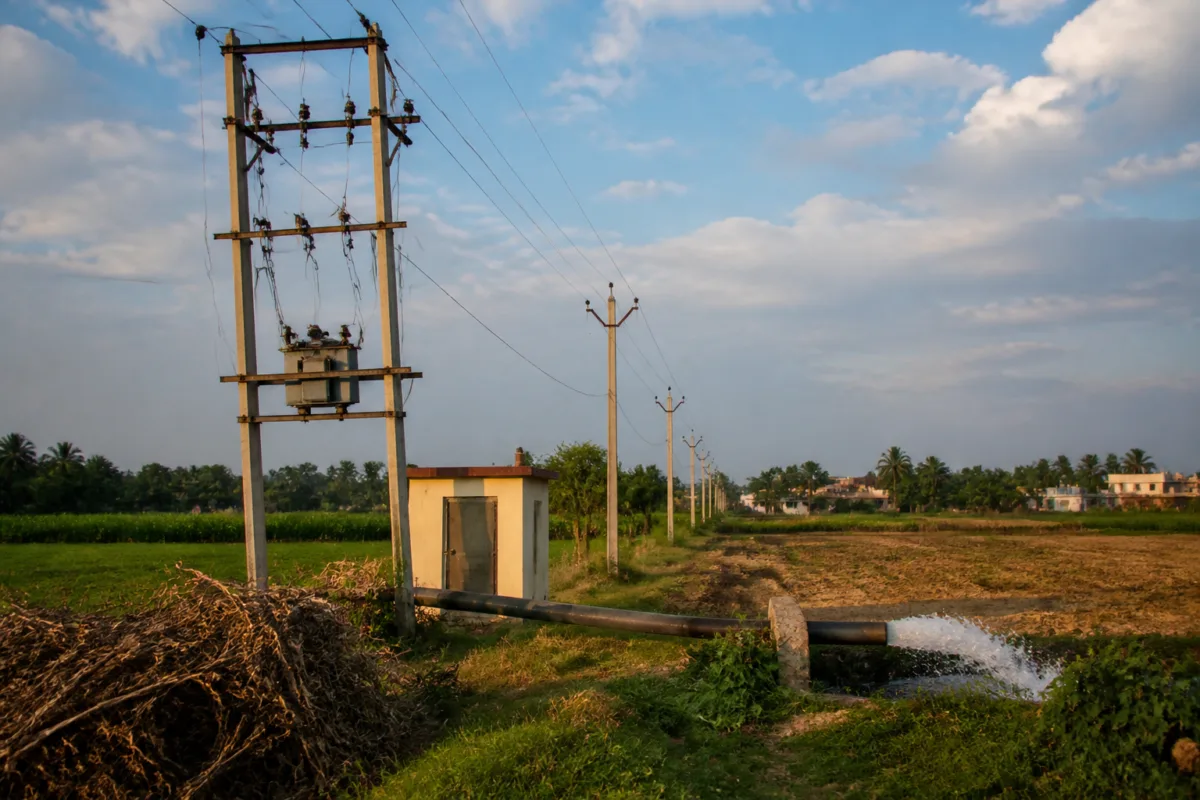
Tamil Nadu’s decision to provide 50,000 free agricultural electricity connections in 2025-26 expands a long-running public utility commitment, but the government order also exposes the administrative and financial pressure behind that policy. Alongside sanctioning new connections, the state has asked the Tamil Nadu Power Distribution Corporation (TNPDCL) to verify whether existing agricultural connections are being used for their intended purpose and remove ineligible claims.
The order follows a proposal from TNPDCL after electricity minister C T R Nirmal Kumar announced the plan during the budget session of the Assembly in August. The government will bear the recurring consumption subsidy for the newly approved connections, estimated at ₹127.56 crore, while TNPDCL will absorb an installation cost of about ₹750 crore.
The decision therefore has two parallel parts. The first is an access programme for farmers who are waiting for agricultural power connections. The second is a review of the existing beneficiary base at a time when the distribution corporation faces high power-purchase costs and a difficult financial position. Together, they show how a subsidised utility service must manage both expansion and control.
Of the 50,000 connections, 20,000 will be issued under the normal category, with the government bearing the entire cost. A further 3,372 will be provided through the self-financing scheme, under which farmers deposit the cost of the required load. The Tatkal fastrack scheme, which offers a shorter waiting period, will account for 25,282 connections. Another 1,346 connections will be covered through various government schemes.
The categories matter because the programme is not a single uniform distribution of free connections. The state is combining fully subsidised connections with arrangements in which farmers contribute installation-related costs or access a faster service route. The government order does not state how the 50,000 beneficiaries will be distributed geographically, or how the selection process will prioritise farmers who have been waiting the longest.
The target also includes connections that have already been issued. According to the order, TNPDCL provided 7,313 agricultural connections since April, and these will count towards the annual total. That leaves 42,687 connections to be delivered under the 50,000-connection target, based on the figures in the order.
The scale of the waiting list is considerably larger than the current annual allocation. More than three lakh farmers are still awaiting an agricultural electricity connection, while the previous DMK government provided 1.70 lakh free agricultural connections between 2021 and 2026. The figures indicate that new annual approvals, although significant, do not by themselves eliminate the backlog.
Tamil Nadu already has about 24 lakh agricultural connections receiving free power. The state released more than ₹7,000 crore as a free-power subsidy for farmers in 2025-26. Against that background, the additional ₹127.56 crore recurring expenditure for the new connections is not an isolated commitment. It adds to an established subsidy architecture in which the government compensates the distribution utility for electricity supplied to agricultural consumers.
The distinction between recurring and installation costs is important for understanding the financial mechanics. The ₹127.56 crore estimate relates to consumption charges for the new connections, while the approximately ₹750 crore installation cost will be borne by TNPDCL. The order therefore places a direct budgetary obligation on the state for electricity consumption and a substantial infrastructure-related burden on the utility.
For TNPDCL, the installation component involves extending the physical network to new agricultural consumers. The supplied material does not specify the length of lines, number of transformers, feeder capacity, location of works or implementation schedule. It also does not provide a connection-wise estimate of the average installation cost. Those details would be necessary to assess how the ₹750 crore requirement will affect the corporation’s capital spending and network operations.
The order’s direction to verify existing connections adds another layer to the programme. TNPDCL has been asked to examine whether agricultural connections are misclassified, whether they are being used for their intended purpose and whether ineligible claims should be removed. The government has cited the high cost of power purchase and the corporation’s critical financial position while issuing this direction.
This is a governance question as much as a financial one. A free-power programme depends on an accurate beneficiary register, reliable classification of connections and a clear process for correcting misuse. If the records are outdated or connections are used for purposes other than those approved, the subsidy may not be reaching the intended agricultural activity. At the same time, any removal of eligibility would require a transparent verification process because the connection affects access to a public utility and the operating costs of a farm.
The available information does not specify the number of connections suspected to be misclassified, the criteria that will be used in the review, or the procedure through which consumers can respond to an adverse finding. It also does not state whether the verification will be carried out through field inspections, billing records, land records or another administrative database. These are material implementation details because the accuracy and fairness of the exercise will shape the value of the savings it is intended to create.
The programme also illustrates the tension between universal policy commitments and limited utility capacity. About 24 lakh existing agricultural connections already receive free power, and the state’s subsidy has crossed ₹7,000 crore in the current financial year. New connections increase access for farmers on the waiting list, but they also increase the recurring volume of electricity that must be supplied and compensated. The same utility must finance network expansion while managing power-purchase expenses and its reported financial stress.
The 50,000-connection announcement should therefore not be read only as a number of beneficiaries. It is also a decision about the future size of a subsidised electricity system. The state has chosen to expand the network while simultaneously asking the utility to examine the existing base. The success of that approach will depend on whether the two processes are managed together: new applicants must be assessed consistently, and existing connections must be verified without weakening legitimate access.
The waiting-list figure provides the clearest measure of the unresolved demand. More than three lakh farmers are awaiting connections, while the approved annual target is 50,000 and includes 7,313 connections already supplied since April. Even if the full target is achieved, the order’s figures indicate that a substantial number of applicants will remain outside the programme. The supplied material does not establish how long applicants have been waiting or whether the backlog is concentrated in particular districts.
Those missing details matter for infrastructure planning. Agricultural electricity access is not only a question of subsidy eligibility; it requires network capacity, installation funding and administrative processing. A connection can be approved on paper but still face delays if lines, transformers or other distribution assets are not available. The government order’s allocation across normal, self-financing, Tatkal and other schemes suggests an attempt to process demand through multiple channels, but the evidence supplied does not show how quickly each category will be completed.
The institutional arrangement remains clear. The state government sets the policy and provides the recurring subsidy, while TNPDCL processes connections, undertakes installation and operates the distribution network. TNPDCL’s proposal formed the basis of the government order, and the utility has been directed to carry out both the connection programme and the verification of existing agricultural consumers.
This division places a continuing burden on coordination. The government must fund the consumption subsidy and oversee eligibility policy. TNPDCL must install infrastructure, supply electricity and maintain records, even as it absorbs the stated installation cost and faces high power-purchase expenses. The order thus links budgetary policy to the everyday administration of a distribution network.
The central evidence confirms three simultaneous realities: Tamil Nadu is adding 50,000 free agricultural connections; the state already supports about 24 lakh such connections through a large subsidy; and more than three lakh farmers remain on the waiting list. It also confirms that the government is concerned about possible misclassification and ineligible use within the existing network.
What remains unclear is how the new connections will be prioritised, when the remaining 42,687 connections will be installed, how the verification will be conducted and what financial impact the review will have on TNPDCL. The next significant developments will be the implementation of the connection categories and the results of the utility’s examination of existing agricultural connections. Those steps will show whether the order can expand access while improving control over the cost of the subsidy system.

