


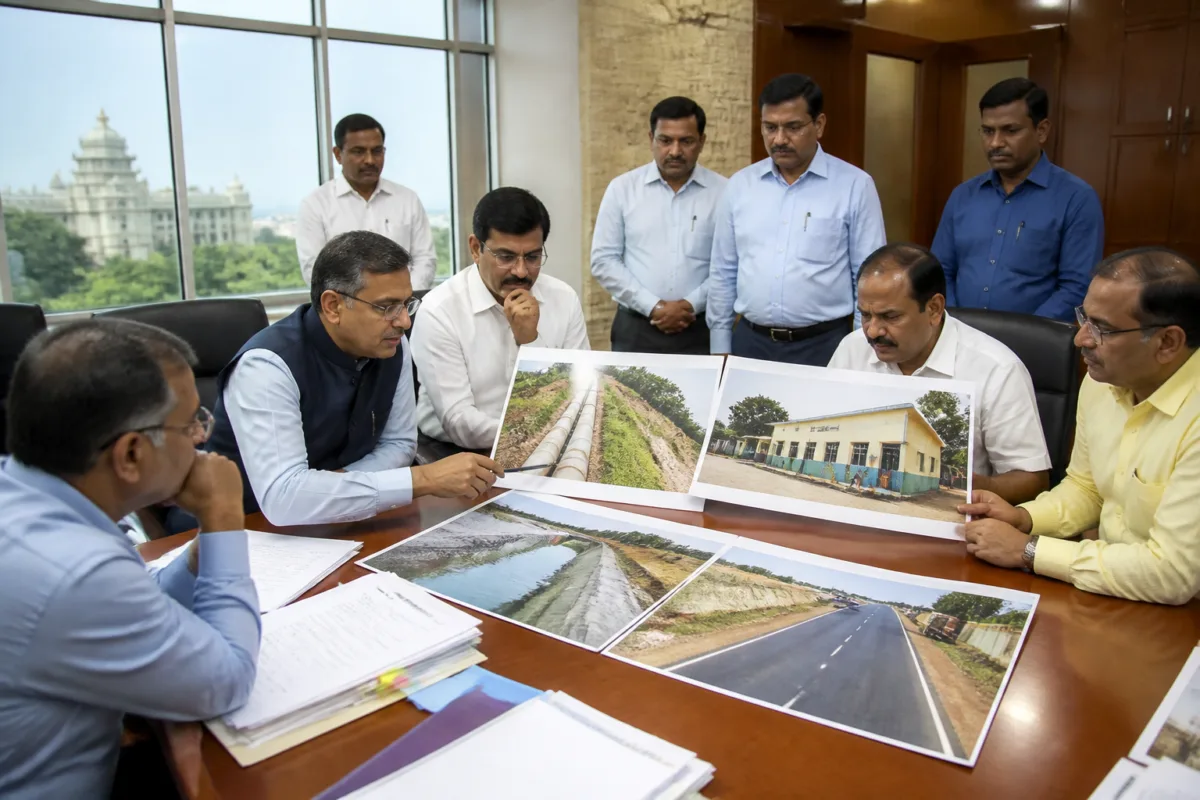
Karnataka has left ₹8,937 crore of funds released under central and centrally sponsored schemes unused, with transport, revenue, water resources, primary education and minor irrigation among the departments recording the weakest spending, according to a report by Prajavani. The figures were reviewed at a meeting chaired by Chief Minister’s Additional Chief Secretary Tushar Girinath on the progress of central sector and centrally sponsored schemes.
A total of ₹31,917 crore had been allocated to Karnataka for 118 schemes, of which ₹15,350 crore had been released to the state. Departments had spent ₹6,413 crore, taking overall utilisation to 41.8% of the released amount. The remaining ₹8,937 crore has yet to be used.
The unspent funds are concentrated in 10 schemes, which together account for ₹6,615 crore of the unused amount. These include the Jal Jeevan Mission, the Viksit Bharat Guarantee for Rozgar and Ajeevika Mission, and the Samagra Shiksha programme. The spending levels in several of these schemes remain low despite their direct links to drinking water, employment and school education.
Under the Jal Jeevan Mission, only 10.2% of the released funds had been spent, while expenditure under the Viksit Bharat Guarantee for Rozgar and Ajeevika Mission stood at 26.1%. The Pradhan Mantri Poshan Shakti Nirman scheme recorded utilisation of just 0.5% of its released allocation, according to the report.
Department-level figures show an even sharper gap in some areas. The transport department received ₹11 crore but had not spent any of it. The revenue department also recorded no expenditure against the ₹189 crore released to it. Water resources had utilised only 1.3% of its funds, leaving ₹52 crore unspent. Primary education had spent 1.8% of its allocation, with ₹912 crore still unused. The minor irrigation department had not yet used ₹19 crore released under its schemes.
The figures point to a gap not between budgetary allocation and release alone, but between the release of funds and the state’s ability to convert them into projects, services or benefits. In centrally sponsored programmes, delays can arise at multiple stages, including the preparation of project proposals, matching contributions, tendering, administrative approvals, land or technical clearances, and the submission of utilisation certificates. The report, however, does not specify which of these factors was responsible for the delays in each department.
The review meeting focused on identifying and removing obstacles to implementation. Officials resolved that the departments should address the barriers affecting the schemes and use the available funds immediately. The decision places the next step with the departments responsible for implementation, while the scale of the unspent balance makes monitoring across individual schemes essential.
The issue is particularly significant for programmes connected to household water supply, primary education, nutrition, employment and irrigation. Until the funds are spent in accordance with scheme guidelines, the allocations cannot translate into completed infrastructure or public services. The state’s implementation progress and the removal of the identified bottlenecks will determine how much of the released ₹15,350 crore is ultimately converted into outcomes for residents.

