


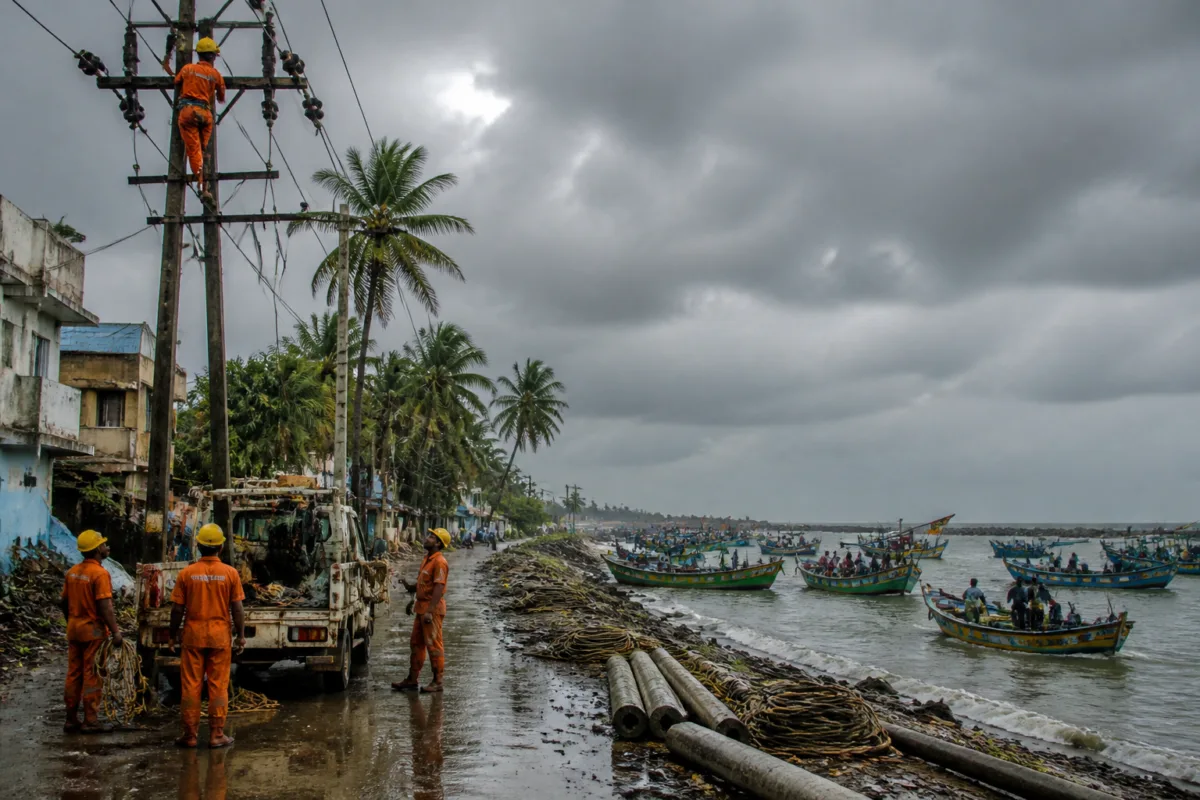
Andhra Pradesh’s response to the developing cyclone reveals a difficult two-sided task for coastal states: protect people and infrastructure from extreme weather while ensuring that the rainfall itself is not wasted. Chief Minister N. Chandrababu Naidu has directed officials to remain on high alert, prepare for heavy rain and use the expected inflows to fill reservoirs and irrigation tanks across coastal Andhra and Rayalaseema. At the same time, power officials are preparing for damaged poles and lines, while the fisheries department is tracking boats still returning from the sea.
The measures show that cyclone preparedness is not limited to evacuation or emergency relief. It is also a test of how different public systems work together before a weather event becomes a crisis. Water storage, electricity restoration, fisheries safety and public communication are being handled by separate departments, but the consequences of failure will be felt by the same communities, particularly in coastal and rural areas.
The immediate trigger was a warning from the Andhra Pradesh State Disaster Management Authority about possible strong winds and heavy rainfall linked to a low-pressure area over the east-central and south-eastern Bay of Bengal. The India Meteorological Department had issued a cyclone alert on October 22, after which fishermen were advised not to venture into the sea until October 29. Boats already at sea were instructed to return to the coast immediately.
The state’s response therefore combines advance preparation with active monitoring. Naidu asked officials to conserve the expected rainwater, fill reservoirs and irrigation tanks, and manage available water resources efficiently for farmers. The instruction is significant because rainfall during a cyclone can be both a hazard and a resource. If drainage, storage and irrigation systems are not coordinated, heavy rain can produce localised disruption without improving water availability after the event.
The source report does not provide the current storage levels of reservoirs or irrigation tanks, nor does it identify which specific facilities are expected to receive the rainfall. It does, however, establish the administrative priority: departments are being asked to prevent avoidable water wastage and direct the expected inflows towards agricultural use. The effectiveness of that approach will depend on the condition and available capacity of individual water bodies, information that has not been provided in the supplied material.
Electricity preparedness is the second major part of the state’s plan. Andhra Pradesh Central Power Distribution Corporation Limited is preparing for possible interruptions and damage to power infrastructure. Its chairman and managing director, P. Pullareddy, held a review meeting with superintending engineers from districts under the corporation after the disaster management warning.
Officials were directed to ensure that field staff, vehicles and repair equipment were available in advance. The instructions specifically anticipate damage to electrical poles and power lines, indicating that the electricity response is being planned around restoration as well as prevention. Control rooms have been established at all circle and division offices to coordinate emergency response and repair work.
This arrangement places local electricity offices at the centre of cyclone resilience. A damaged line can affect households, communications, water pumping and other essential services at the same time. The decision to position staff and equipment before the weather deteriorates is intended to reduce the time between an outage and restoration. The supplied report does not state how many personnel or vehicles have been mobilised, or whether any outages have already occurred.
Public safety communication is another part of the electricity plan. Officials have been asked to warn consumers not to touch fallen electrical wires. The instruction addresses a specific risk that can emerge after storms, when damaged lines may be difficult to identify and residents may attempt to clear obstructions themselves. The power corporation has also directed that reports of electrical hazards and interruptions be addressed promptly.
The fisheries response highlights the scale of the coastal exposure. Andhra Pradesh has a coastline of 1,053 kilometres across 12 coastal districts, with 555 marine villages, 350 fish landing centres and 30,043 fishing boats, according to the report. These numbers describe a dispersed coastal operating system in which safety depends not only on a warning but also on the ability to locate boats, communicate with crews and bring them back to landing centres.
By the time of the report, 29,952 of the 30,043 boats had returned safely to their respective landing centres. The remaining 91 boats were reported to be heading towards the coast. They included 37 boats from Visakhapatnam, 32 from Bapatla, 20 from Krishna and one from Anakapalli. The figures provide a snapshot of the monitoring task, but they also show that a small number of boats can remain a critical operational concern even after the overwhelming majority have returned.
The fisheries department has established control rooms at its head office and district offices to track the remaining boats and monitor conditions. Officials were working to ensure that all 91 boats reached the coast safely by Saturday night. The report does not provide information on the communication systems being used to contact the boats, their exact locations or the weather conditions along their routes. Those details would determine how much operational risk remained at the time of publication.
The geography of the response matters. The coastal districts are exposed to wind and rain, while the instruction to use rainfall for reservoirs and irrigation tanks extends the administrative focus into Rayalaseema. This connects coastal weather preparedness to the state’s wider agricultural water system. Rainfall management is therefore not only an emergency function; it is also part of the state’s effort to protect irrigation resources and support farmers after the weather event.
At the institutional level, the response involves the chief minister’s office, the state disaster management authority, the power distribution corporation, the fisheries department, district administrations and field-level officials. Each agency has a distinct role, but the arrangements described in the report also show why coordination is essential. A cyclone can simultaneously create risks for boats, transmission and distribution infrastructure, roads, homes and water systems. Separate control rooms can improve departmental response, but they must still operate with a shared understanding of the situation.
The state’s preparedness model is built around three forms of advance action. The first is prevention: keeping fishermen off the sea and warning residents about electrical hazards. The second is readiness: positioning staff, vehicles, repair equipment and control rooms before damage occurs. The third is resource management: directing officials to capture and use rainfall for reservoirs and irrigation tanks. Together, these measures cover immediate safety, service continuity and post-rainfall water availability.
The available evidence also shows the limits of what can yet be concluded. There is no reported assessment of damage, no confirmed account of power interruptions and no indication that reservoirs or irrigation tanks have already received cyclone-related inflows. The source does not establish whether the remaining fishing boats have reached shore, beyond the stated target of getting them back by Saturday night. The preparedness plan is documented, but its final performance remains dependent on the weather and on implementation at district and field level.
That distinction is important in assessing urban and regional resilience. Preparedness announcements can identify responsibilities and resources, but resilience is ultimately measured by whether people remain safe, essential services are restored quickly and public infrastructure can absorb or retain the water that arrives. In Andhra Pradesh, the same cyclone system is being treated as a threat to electricity and fisheries and as a possible opportunity to replenish irrigation assets.
The larger question is whether these functions can be managed as one connected water, power and safety system rather than as separate departmental responses. The information supplied confirms that the state has activated multiple layers of preparation and assigned specific tasks to power and fisheries officials. It does not yet show the outcome. The next milestones are the safe return of the remaining boats, the state of electricity infrastructure after the weather event and the extent to which reservoirs and irrigation tanks are able to conserve the expected rainfall.

