


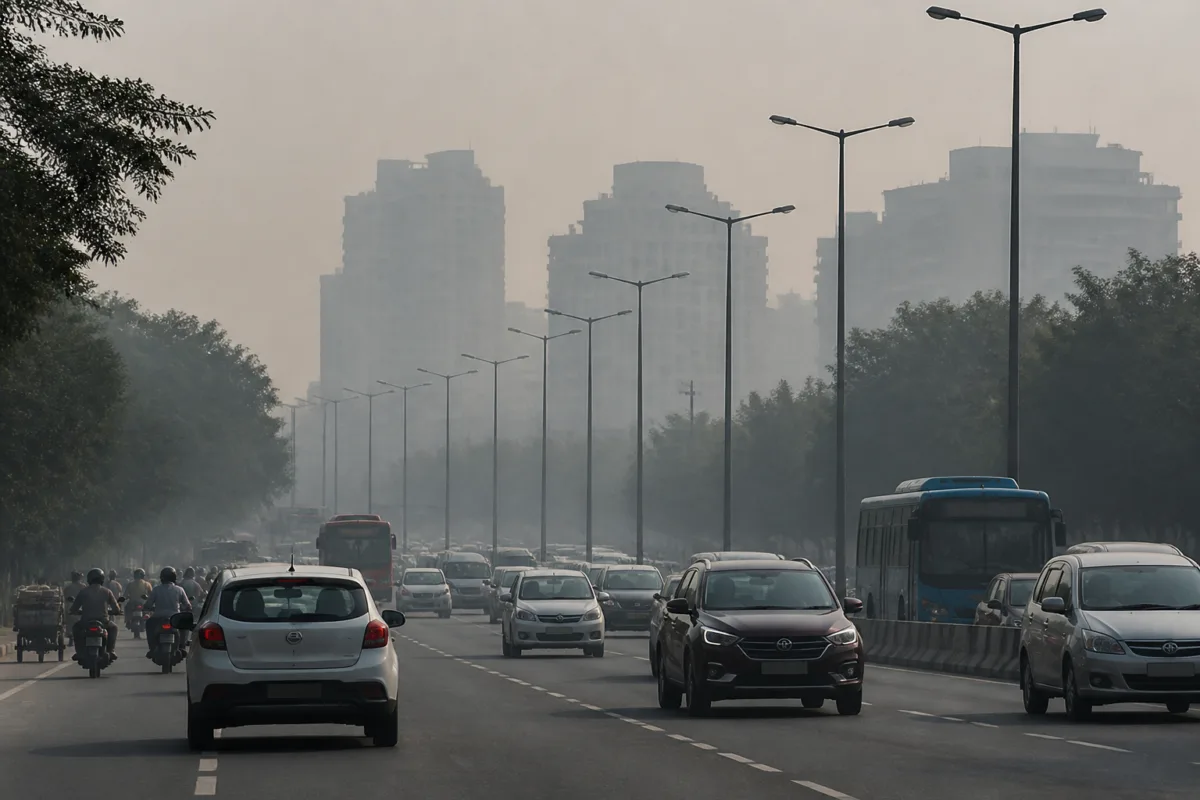
Delhi’s air-quality improvement to an AQI of 191 on Saturday offered residents only a brief reprieve. The city is expected to return to the ‘poor’ category from Sunday through Tuesday, showing how quickly weather conditions can alter pollution levels even when no major change in emissions has been reported. The episode also underlines a recurring urban problem: Delhi’s air is influenced not only by what is emitted within the city, but by how the wider airshed transports, traps and disperses pollution.
The three-day spell of poor air quality ended when the AQI moved into the upper end of the ‘moderate’ category. According to the Central Pollution Control Board’s 24-hour average bulletin cited in the report, Delhi’s AQI stood at 185 at 9 am and rose to 191 by 4 pm. It was 188 at 8 pm. The improvement followed a shift in wind direction from north-westerly to easterly, along with an increase in wind speed.
A government official attributed the change to reduced transport of pollution from outside Delhi and better dispersion of pollutants. That explanation is important because it places the city’s air-quality fluctuations within a regional atmospheric system. When winds arrive from areas carrying a heavier pollution load, Delhi can receive additional pollutants. When wind speeds increase, the atmosphere can disperse those pollutants more effectively. A change in direction can therefore improve readings without necessarily indicating a lasting reduction in emissions.
The AQI had entered the poor category for the first time this season on October 21, when it reached 245. The Commission for Air Quality Management responded by imposing Stage I of the Graded Response Action Plan. The city recorded an AQI of 223 on Thursday and 230 on Friday before the Saturday improvement.
That sequence illustrates the limits of reading air quality through a single day’s number. The AQI is a public-facing indicator of pollution conditions, but the underlying exposure environment changes throughout the day and across neighbourhoods. The shift from 185 in the morning to 191 in the afternoon, followed by a reading of 188 at night, shows that conditions can move within the same 24-hour period. A moderate classification does not erase the conditions that produced the preceding poor days, nor does it guarantee that the next day will remain moderate.
The wider seasonal pattern is equally significant. Dipankar Saha, former head of the CPCB’s air laboratory, said air quality typically deteriorates during the post-monsoon period because stagnant conditions and changes in wind direction reduce the atmosphere’s ability to disperse and dilute pollutants. He also said emissions transported from upwind regions add to Delhi’s pollution load, with air quality tending to worsen during the winter period.
This is the central institutional challenge in Delhi’s pollution management. The city administration can act on local sources, but atmospheric conditions and emissions across the wider region also affect the final concentration recorded within the capital. The report does not quantify the contribution of each source or identify a single cause for the latest deterioration. It does, however, establish that regional transport and meteorology are material parts of the pollution problem.
The October data cited in the report reinforces the difference between a short-term improvement and a sustained trend. So far this October, Delhi has recorded three poor-air days, 19 moderate days and two satisfactory days. In October last year, the city recorded 11 poor days and seven very poor days. The comparison suggests that the current month has not yet matched the severity of the previous October, but it also shows that poor days have already appeared before the winter period has fully set in.
The available numbers should be read carefully. They describe the number of days falling within AQI categories, not the exposure of every resident or the concentration of every pollutant at every location. They also do not establish that this October will follow the same path as last year. What they show is that Delhi’s air has already crossed into the poor category and that the city remains vulnerable to deterioration as seasonal atmospheric conditions change.
The maximum temperature on Saturday was 32.9 degrees Celsius, one degree above normal, while the minimum temperature was 18.3 degrees Celsius, also one degree above normal. These readings provide weather context but do not, on their own, explain the full pollution picture. The official and expert explanations cited in the report point more directly to wind direction, wind speed, atmospheric stagnation and the movement of emissions from upwind areas.
The Graded Response Action Plan provides a framework for escalating measures as air quality worsens. In this episode, CAQM imposed Stage I after Delhi’s AQI entered the poor category. The supplied report does not list the specific measures activated under that stage or assess their implementation. That absence is itself relevant to understanding the policy landscape: an emergency response framework can trigger administrative action, but the effectiveness of those actions depends on enforcement, coordination and whether the underlying regional emissions and weather conditions change.
Delhi’s pollution governance therefore operates across several layers. The CPCB measures and publishes the AQI, CAQM determines the response stage, and local and regional authorities are expected to act on pollution sources under the wider response framework. Atmospheric conditions, however, are not governed by municipal boundaries. This creates a coordination problem in which Delhi’s daily air reading reflects decisions and emissions beyond the city as well as conditions within it.
For residents, the consequence is an uncertain exposure environment. A day classified as moderate can be followed rapidly by a poor day, and the improvement may be caused mainly by temporary meteorological assistance rather than by a durable decline in pollution generation. The report’s forecast of poor air from Sunday through Tuesday makes that distinction especially clear. The near-term outlook depends on whether the conditions that helped disperse pollutants persist.
The episode also raises a measurement and communication question. Public attention often focuses on whether the AQI has improved or worsened compared with the previous day. That is necessary information, but it can obscure the difference between a cleaner atmosphere and a more favourable weather pattern. Saturday’s AQI of 191 was an improvement from 230 on Friday, yet the forecast deterioration suggests that the change may be temporary. For policy evaluation, the more important question is whether poor and very poor days are being reduced over time, not simply whether a particular day records a lower number.
The evidence supplied in the report confirms three points. First, Delhi’s air moved from poor to moderate as wind direction changed and wind speed increased. Second, the improvement is expected to reverse from Sunday through Tuesday. Third, the post-monsoon and winter transition creates conditions in which atmospheric dispersion weakens and pollution transported from outside the city can add to local emissions.
What remains unestablished in the supplied material is the precise contribution of individual pollution sources, the pollutant responsible for the latest AQI movement and the effectiveness of the Stage I measures imposed by CAQM. Those are essential questions for judging whether the city is reducing pollution or merely receiving intermittent relief from the weather. The next milestones are the AQI readings through Tuesday and the authorities’ response if Delhi returns to the poor category as forecast.

