


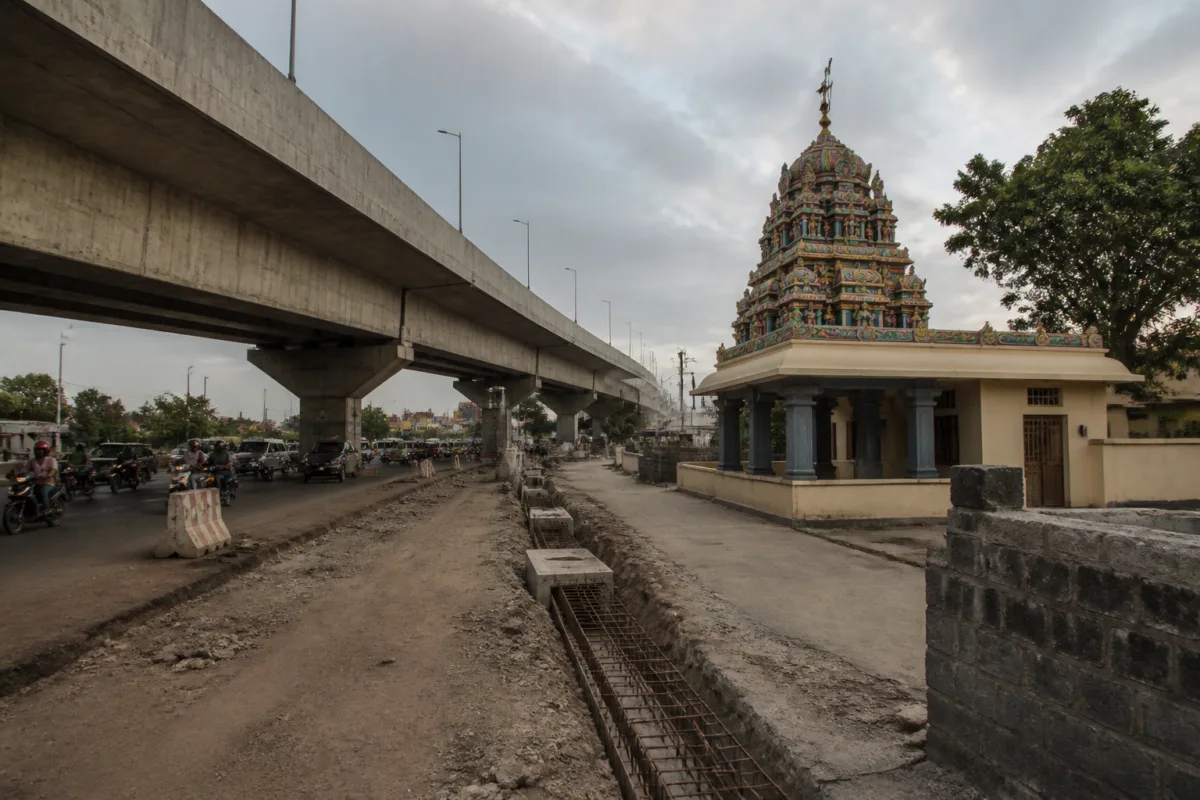
The stalled service road at the Periyanaickenpalayam flyover in Coimbatore shows how a small obstruction can hold up a larger road-widening project even after land acquisition, a court decision and repeated coordination between government departments. The Mariamman temple at the northern end of the flyover’s descending ramp remains in place, while the state highways department says law-and-order concerns have prevented its removal.
The project concerns the Mettupalayam-side approach of the Periyanaickenpalayam flyover on the Coimbatore-Mettupalayam-Ooty-Gundlupet Road, also identified as NH-181. Its immediate purpose is to widen the service road near Jothipuram. The department has said that the land required for the project has already been acquired and that the approved alignment has not been changed. Yet construction remains incomplete because the temple stands at the zero point of the descending ramp, directly obstructing the alignment.
This is not simply a case of a delayed construction activity. It is an example of how urban infrastructure projects move through several institutional layers before work can begin on the ground. Land acquisition, alignment approval, religious-structure removal, police coordination, revenue administration and judicial review have all become part of the same project sequence. The road can be technically ready for construction, but implementation remains dependent on resolving the administrative and law-and-order questions surrounding the structure.
The latest development came through a letter dated October 9 from the national highways wing of the state highways department to Coimbatore resident Velumani. He had filed a grievance through the Centralised Public Grievance Redress and Monitoring System, or CPGRAMS, regarding the stalled work. In its response, the department said the Mariamman temple had not been removed because of law-and-order concerns.
The department also said it had coordinated with police and revenue officials several times to clear the temple and was taking further steps towards its removal. The response indicates that the delay is not being attributed to a change in the project design or a failure to secure the required land. Instead, the unresolved issue is the physical removal of a structure located on the approved road alignment and the conditions under which that action can be carried out.
The legal position has also become clearer. On October 6, the Madras High Court dismissed a writ petition challenging the national highways wing’s action to remove the temple encroachment obstructing the service road. The court declined to interfere with the NH wing’s action. The dismissal removed the immediate judicial challenge to the department’s stated course of action, but it did not itself remove the structure or complete the roadwork.
That distinction is important for understanding why a court order has not automatically translated into construction progress. A judicial decision may settle whether an authority can proceed with an action, but the physical implementation still depends on the responsible departments. In this case, the highways wing has referred to coordination with the police and revenue officials, suggesting that execution requires an operational plan involving more than the road agency alone.
The project history described by the department also shows that the obstruction is specific rather than general. A Vinayagar temple along the approved alignment was dismantled to facilitate construction. The Mariamman temple, however, continues to remain near the northern end of the flyover’s descending ramp. The two structures therefore occupy different stages in the same infrastructure process: one has already been removed, while the other remains the unresolved point preventing completion.
The department’s position that the approved alignment has not been altered has another administrative implication. It indicates that officials are continuing with the original project plan rather than redesigning the service road around the temple. That approach preserves the sanctioned alignment but leaves the project dependent on removing the obstruction. The available information does not establish whether an alternative alignment was formally assessed or what additional cost or delay such a change would involve.
The road’s location gives the dispute a direct mobility dimension. The service road is linked to the approach of a flyover on a major route between Coimbatore and Mettupalayam, with onward connections towards Ooty and Gundlupet. The stalled section is near Jothipuram and lies at the descending-ramp end of the flyover. The supplied report does not provide traffic volumes, accident data or a revised completion date, but it establishes that the widening project remains incomplete at a point designed to support movement around the flyover.
For residents, the practical consequence is that a project intended to improve road movement remains constrained by a single unresolved site. The precise daily effect on congestion, access or safety is not quantified in the available material. However, the continued obstruction means that the service-road work cannot be completed according to the approved alignment, despite the department’s statement that the necessary land has been acquired.
The CPGRAMS route also illustrates how citizens can seek an administrative response when local infrastructure work remains stalled. The grievance did not produce a new project approval or a new alignment. It produced a written explanation from the department identifying the reason for the delay and outlining the steps it said were under way. This makes the grievance mechanism a source of project-status information, while the actual resolution remains with the departments responsible for enforcement and implementation.
The institutional chain behind the delay is therefore central to the story. The highways wing is responsible for the road project and has maintained that the temple obstructs the sanctioned alignment. The police are relevant because the department has cited law-and-order concerns. Revenue officials are involved in the process of clearing the structure and dealing with the site. The High Court has already considered and dismissed a challenge to the proposed removal. Progress now depends on how these responsibilities are coordinated in practice.
The episode also raises a broader planning question about the treatment of religious structures located within or alongside infrastructure corridors. The report refers to the Mariamman temple as an encroachment obstructing the service road and records that another temple on the alignment was dismantled. But it does not provide the dates of the original construction, details of ownership or legal status, compensation arrangements, relocation proposals or the precise procedure proposed for the remaining structure. Those omissions matter because they determine how quickly an authority can move from a legal decision to physical implementation.
At the same time, the evidence does not support claims that the project has been abandoned or that the alignment has been permanently revised. The department has said that it is taking further steps to remove the temple and complete the project at the earliest. It has also said that the approved alignment remains unchanged. These statements establish the authority’s declared position, but they do not provide a confirmed removal date or a construction completion schedule.
The Periyanaickenpalayam case demonstrates the difference between project approval and project delivery. Land acquisition can be completed, an alignment can be approved, a related structure can be removed and a legal challenge can be dismissed, yet the road can remain unfinished if the final implementation step is unresolved. In infrastructure delivery, the last obstruction can have an outsized effect because adjoining works may not become fully usable until the entire planned section is completed.
The next measurable developments are consequently administrative and physical: whether the highways wing, police and revenue officials complete the planned coordination; whether the Mariamman temple is removed; and whether service-road construction resumes along the approved alignment. Until those steps occur, the flyover approach project remains legally supported but operationally incomplete.

