


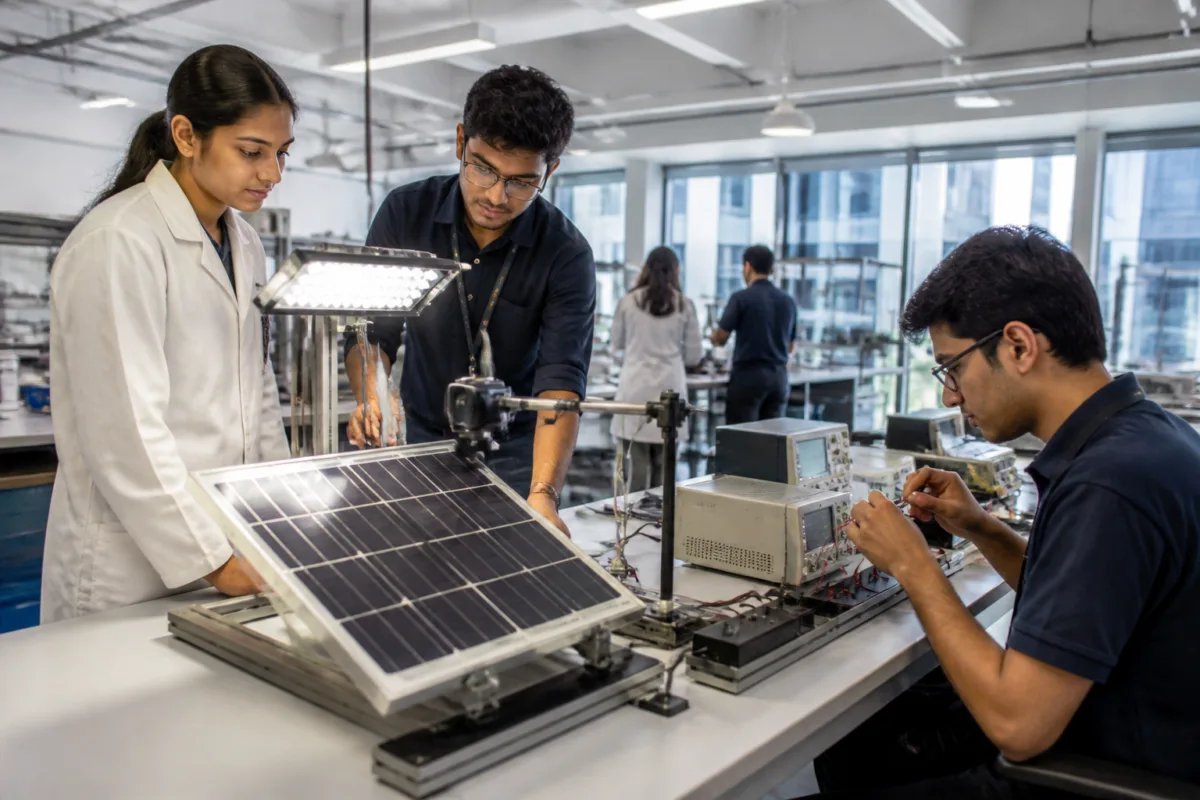
IIIT-Delhi researchers are examining whether light, alongside radio waves, can expand the capacity and reach of future wireless networks. Their work brings together visible light communication, LiFi and WiFi, while also testing whether solar panels can receive optical data and whether intelligent reflecting surfaces can carry signals around obstacles. The research points to a broader infrastructure question: how will increasingly connected buildings, hospitals, offices, industrial sites and vehicles obtain enough reliable wireless capacity without depending entirely on conventional radio-frequency networks?
The research is being led by Professor Vivek Ashok Bohra, and the institute has been working in this area since 2020, according to the report. Its focus is not on replacing WiFi with LiFi, but on exploring a hybrid communication arrangement that could use different transmission methods for different settings. That distinction is important because the research described is still concerned with possibilities, experiments and system development rather than a ready-to-deploy public network.
WiFi transmits data through radio waves. LiFi, by contrast, uses extremely rapid changes in the intensity of LED light to carry information. A receiver converts those changes into digital data. The variations occur so quickly that they are not visible to the human eye. In practical terms, this allows lighting infrastructure to become part of a communications system without changing the way people ordinarily perceive the light.
For cities, the significance lies in the possibility of using existing indoor environments more efficiently. Hospitals, offices and industrial campuses are identified as locations where LiFi could provide additional wireless capacity, particularly where controlling radio-frequency interference is important. These are spaces where connectivity is increasingly tied to daily operations, but where different equipment and safety requirements can constrain the use of radio-based systems. The supplied research account does not establish that LiFi has already solved these constraints; it shows that the team is studying how optical communication could help address them.
The proposed hybrid model also reflects a basic limitation of urban connectivity: no single transmission method works equally well in every physical environment. WiFi can pass through many ordinary indoor spaces using radio waves, while LiFi depends on light reaching a receiver. A wall or another obstruction can interrupt the direct path between the transmitter and receiver. That makes the physical design of rooms, buildings and campuses relevant to the performance of an optical network.
IIIT-Delhi researchers are therefore working on optical intelligent reflecting surfaces. These surfaces are intended to reflect light towards locations where a direct connection between the transmitter and receiver is unavailable. The approach is an attempt to address LiFi’s line-of-sight limitation through the built environment itself. Instead of treating walls, rooms and other surfaces only as barriers, the research explores whether engineered reflecting surfaces can help redirect the signal.
This is where the research intersects with the design of future buildings and infrastructure. A conventional wireless network can often be added to an existing structure with limited changes to the physical environment. An optical system may require greater attention to the position of lights, receivers, reflective surfaces and obstructions. The report does not specify the design, cost or installation requirements of the proposed reflecting surfaces, so their eventual practicality remains to be established through further testing.
Another major strand of the work involves using ordinary solar panels as optical data receivers. Solar panels generally convert light into electricity. The researchers are examining whether they can also receive data contained in light signals. The team has conducted experimental tests of solar-panel-based systems, according to the report. If such systems prove affordable and reliable, the need for separate optical detectors could be reduced.
That possibility is especially relevant to locations where solar infrastructure already exists. The research account raises the prospect of using existing solar-energy installations to support communication in remote areas. It does not claim that current solar panels can immediately function as dependable communications equipment across such locations. Rather, it describes an effort to determine whether the same physical infrastructure can perform an additional role and under what technical and economic conditions.
The idea connects two infrastructure challenges that are often planned separately: energy access and digital connectivity. Solar installations are usually considered part of the electricity system, while wireless networks are planned as communications infrastructure. A solar panel that can both generate power and receive optical data could, if the technology becomes reliable and cost-effective, create a link between the two. The source material does not provide performance figures, deployment costs or details of the experimental setup, so the scale of this potential remains uncertain.
The researchers are also examining solar-panel-based receivers for communication between vehicles. Vehicle-to-vehicle communication is a demanding use case because the transmitter and receiver can move, their alignment can change, and the surrounding environment can contain obstacles. The report only states that the usefulness of solar-panel receivers is being investigated in this context. It does not establish that the system is ready for road deployment or that it can meet the reliability requirements of traffic management and road safety systems.
The research nevertheless illustrates why future connectivity is likely to involve a combination of technologies rather than one universal network. Radio-based systems, visible light communication, LiFi, optical receivers and reflecting surfaces each respond to different physical conditions. A hybrid system could potentially assign different communication tasks to different channels, but the research described by IIIT-Delhi is still assessing how those components can work together.
The reference to 6G should also be read in that context. The work is presented as research that could contribute to the capacity of future 6G networks, not as evidence that a 6G service has been deployed through LiFi. The central question is whether optical communication can become one component of a larger wireless architecture. That architecture would need to handle indoor coverage, obstacles, receiver availability, cost, reliability and integration with existing WiFi and other network systems.
For urban institutions, these questions have practical implications. Hospitals may require communication systems that operate alongside sensitive equipment. Offices may need greater capacity as devices and digital services multiply. Industrial campuses may seek connectivity in environments where radio-frequency interference must be controlled. In each case, the usefulness of LiFi would depend not only on transmission speed but also on the availability of suitable LED lighting, compatible receivers and network management systems.
The source material does not provide numerical comparisons between LiFi and WiFi, a tested data rate, a range estimate, the number of experiments completed or a timetable for commercialisation. It also does not identify a specific pilot building, municipal project or industry partner. Those gaps prevent a conclusion about when the technology could enter everyday urban use. What the evidence does establish is that the work has been underway at IIIT-Delhi since 2020 and that its current research areas include hybrid LiFi-WiFi-VLC communication, solar-panel receivers, optical reflecting surfaces and vehicle communication.
The larger urban question is how cities can expand digital capacity while using infrastructure more intelligently. As buildings and transport systems become increasingly dependent on connected devices, communications networks are becoming part of the built environment rather than a service added after construction. Research into light-based communication brings attention to ceilings, lighting systems, walls, reflective surfaces and solar panels as possible elements of that network.
For now, the evidence supports a measured conclusion. IIIT-Delhi’s research is exploring how light and radio waves might work together, how solar panels might receive data, and how optical signals could reach beyond direct lines of sight. Whether these ideas become affordable and dependable urban infrastructure will depend on the results of continued testing. The next important milestones are the technical performance, reliability and integration findings from the team’s experimental systems.

