


Bhopal’s draft 2047 master plan has moved from a planning document to a street-level dispute, with traders protesting restrictions on commercial activity while resident groups oppose the spread of shops into residential neighbourhoods. The conflict is centred on a basic but unresolved urban question: how should a growing city regulate the economic activity that supports livelihoods without transferring its costs to homes, roads and public services?
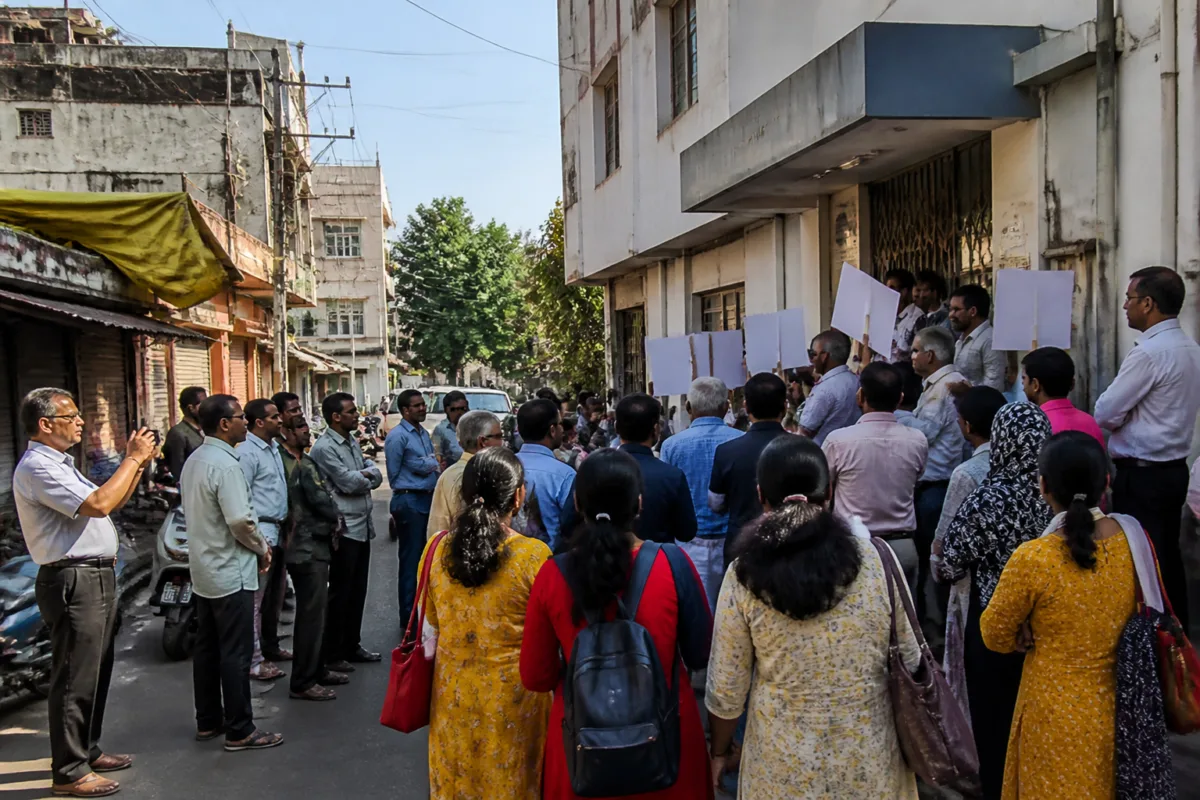
The latest protest followed a march by farmers and resident groups to the office of the town and country planning department, or T&CP, to submit objections to the proposed plan. On Friday, traders affiliated with organisations including the Bhopal Vyapari Mahasangh went to the same office with posters, banners and a memorandum. They asked the administration to protect existing commercial activity, stop the ongoing shutdown drive by the Bhopal Municipal Corporation and include their objections before the plan is finalised.
The immediate dispute concerns the draft Bhopal 2047 development plan’s proposed regulation of commercial activity in residential areas. The rules would link the extent of permissible commercial use to the width of the road serving a property. Full-scale commercial activity would not be permitted on roads narrower than 12 metres. Only limited professional use, restricted to a single floor, is proposed on such roads.
That road-width rule is important because it turns the street network into the main filter for deciding where economic activity can continue. Traders argue that a blanket restriction on roads below 12 metres could threaten established shops and affect what they described as lakhs of people. Their demand is that roads narrower than 12 metres should be designated as “market streets”, allowing existing traders to continue operating rather than face closure.
The proposal reflects a familiar planning concern: narrow residential roads may not have the capacity to handle the traffic, parking, loading, waste and pedestrian movement generated by intensive commercial activity. But the traders’ objections show the other side of the same rule. Shops in established neighbourhoods are often connected to existing customers, homes, supply networks and local employment. Closing them can disrupt livelihoods even when the plan does not provide an immediate alternative location.
The report does not establish how many establishments would be affected, how many roads fall below the 12-metre threshold or whether the proposed regulation distinguishes between different types and scales of commerce. Those details matter because a small professional office, a neighbourhood grocery shop, a high-footfall retail outlet and a storage or loading operation can place very different demands on a street. The absence of such distinctions in the reported objections has become part of the wider uncertainty surrounding the draft plan.
Traders have also challenged the proposed zoning treatment of Arera Colony. The draft development plan divides residential areas into five categories: RG-1 for existing residential areas, RG-2 for proposed residential areas, RG-3 for VIP and environmentally sensitive areas with limited density, RG-4 for new expansion areas intended for future population and RG-5 for extremely environmentally sensitive areas with the lowest density.
Traders say Arera Colony has been proposed for the RG-3 category and are seeking its inclusion in RG-1, arguing that commercial activity should continue there. Resident groups have taken the opposite position. They have opposed the commercialisation of Arera Colony, saying that it brings pollution, traffic problems and disorder into residential areas. The disagreement therefore is not simply about whether a neighbourhood should have shops. It is also about who bears the consequences of commercialisation and how those consequences should be measured.
The Arera Colony dispute highlights the institutional challenge facing the master plan. Land-use categories are expected to provide certainty, but a category can affect different groups in sharply different ways. Traders view a more permissive classification as protection for existing economic activity. Residents view tighter controls as protection for living conditions. The planning authority must reconcile these claims through rules that are clear enough to enforce and specific enough to recognise different neighbourhood conditions.
The sequence of objections indicates that the draft plan is being contested by multiple urban constituencies rather than by a single interest group. Resident groups submitted more than 2,000 objections on Thursday, according to the report. Traders’ association president Anand Soni told the Times of India that the association had submitted 2,500 suggestions and objections and had asked the administration to include residents and traders in the committee preparing the final draft of the 2047 development plan.
The reported figures refer to submissions by different groups and should not be treated as a single consolidated count. They nevertheless indicate the scale of engagement around the plan. Public objections are not merely procedural in this case. They concern the location of work, the use of homes and streets, the cost of conversion, municipal enforcement and the future structure of neighbourhoods.
The traders’ memorandum also seeks a fixed conversion rate and a one-time fee of 5% instead of a recurring charge. They have asked for permission to conduct commercial activity on vacant land. These demands point to a second layer of the dispute: even where commercial use may be permitted, the cost and administrative process of obtaining permission could determine whether businesses can remain compliant.
A recurring fee and an uncertain conversion process can make regulation difficult for small establishments, while a fixed one-time charge may create a more predictable framework for property owners and traders. The supplied report does not provide the proposed conversion rate, the basis for the 5% demand or the administration’s response. It therefore remains unclear how the financial provisions would operate, which properties would qualify and whether the fee would apply uniformly across neighbourhoods and categories.
The Bhopal Municipal Corporation’s shutdown drive has added urgency to the debate. The traders have asked that the drive be halted, although the report says its speed and extent have already slowed. This suggests that planning provisions and enforcement activity are now interacting before the final master plan has been settled. For affected businesses, the distinction between a draft rule and an active municipal action may be difficult to experience on the ground: both can create uncertainty about whether a shop can continue operating.
That overlap raises a governance question about sequencing. If enforcement begins while the land-use framework is still under objection, affected stakeholders may see the process as premature. If enforcement is delayed indefinitely, existing violations or incompatible uses may continue to expand. The source material does not state the legal basis or current status of the shutdown drive, so its relationship with the proposed master plan cannot be established beyond the traders’ demand for it to stop.
The draft’s 12-metre threshold also shows how a simple planning metric can carry wider consequences. Road width is measurable and can be applied across a city, but it does not by itself capture footfall, public transport access, parking demand, building design, emergency access, delivery timings or the nature of the business. Nor does it establish whether a narrow road is already functioning as a commercial street or whether a wider road has sufficient capacity for additional activity.
At the same time, the objections from resident groups indicate that commercial activity can affect more than the property where a shop operates. Traffic, pollution, parking and disorder are neighbourhood-level impacts. These concerns are especially significant in areas that the draft plan classifies as environmentally sensitive or subject to limited density. The challenge for the planning process is to address these impacts without treating all commercial activity as identical or all residential areas as interchangeable.
The Bhopal master plan is therefore being asked to perform two tasks at once. It must establish a long-term spatial framework for a city looking towards 2047, and it must resolve disputes involving businesses and residents already occupying the city. Those tasks require different kinds of evidence. Long-term planning needs population and expansion assumptions, infrastructure capacity and environmental safeguards. Immediate regulation needs property-level information, business categories, street conditions and a workable transition process. The report confirms that these issues are being raised, but does not provide the underlying technical assessments.
The institutional process will determine whether the objections produce changes or remain submissions on record. The T&CP department is receiving the objections, while the BMC is associated with the enforcement drive that traders want stopped. The traders have also sought representation on the committee preparing the final draft. This division of responsibilities makes the final decision-making structure important: stakeholders need to know which authority will evaluate objections, which body will amend the plan and how the final provisions will be implemented.
For residents, the key issue is whether the plan can protect residential environments from unmanaged commercialisation. For traders, it is whether regulation recognises the economic role of existing markets and avoids sudden livelihood losses. For the administration, the test is whether it can create a rule that is legally clear, financially predictable and enforceable across different parts of the city.
The available evidence confirms a broad conflict over the future relationship between homes, shops and streets in Bhopal. It also shows that the draft plan’s most contested elements are the 12-metre road threshold, Arera Colony’s proposed zoning category, conversion charges, vacant-land permissions and the timing of municipal enforcement. What remains unclear is how many properties and businesses would be affected, what technical studies support the classifications and how the administration will respond to the objections.
The next significant step is the consideration of the suggestions and objections before the Bhopal 2047 development plan is finalised. Whether traders and resident groups receive a formal role in that process, and whether the draft provisions are modified, will determine if the plan becomes a negotiated framework for urban growth or remains a source of conflict between land-use control and existing livelihoods.

