


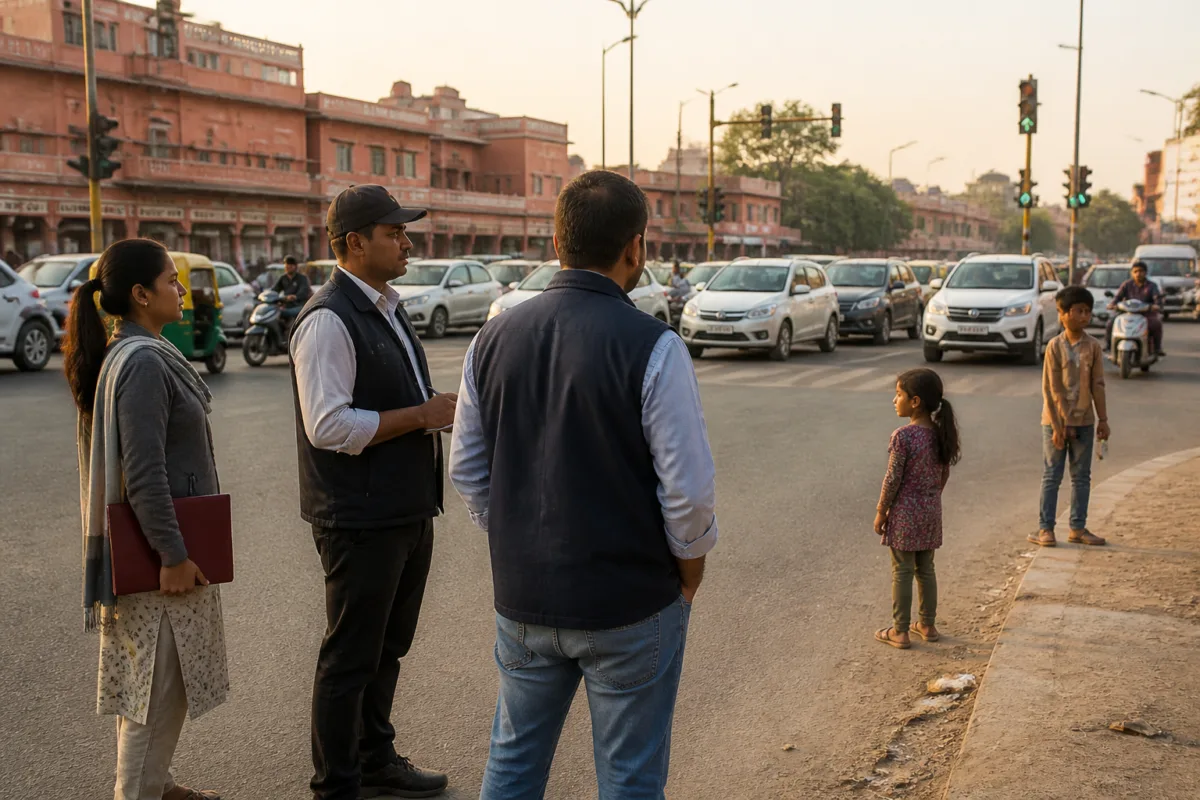
Jaipur’s anti-begging drive has rescued 117 people and rehabilitated 48, but children continue selling roses, pens and tissue paper at major traffic intersections. The gap between those numbers and the activity still visible at Rambagh Circle, JDA Circle and OTS Circle exposes a difficult urban governance problem: removing people from public spaces is easier than creating conditions in which they can sustainably leave street-based livelihoods.
The drive, launched by the Jaipur district administration on October 9, was intended to rehabilitate children and others engaged in begging. It is scheduled to continue until October 30, although an official from the Social Justice and Empowerment Department told the Times of India that the administration is considering extending it after what officials described as positive results.
Yet the continuing presence of children at intersections shows that rescue and rehabilitation are not the same administrative outcome. On Friday, a 12-year-old girl was seen selling roses at Rambagh Circle, while a teenage boy was selling pens and tissue paper. At JDA Circle, adults accompanied by children were seen cleaning vehicle window screens stopped at traffic signals in exchange for money.
These activities occupy a distinctive part of the urban system. Traffic signals create short periods in which vehicles are stationary, drivers are accessible and small transactions can take place quickly. For children and adults working at junctions, the intersection is not simply a public space; it is a place where movement, visibility and cash exchange are concentrated. For the administration, however, the same location is a site of public order, road safety and child protection.
That overlap helps explain why a drive can record rescues while activity continues. The administration is acting against what it sees as begging and associated street activity, but the visible transactions are also connected to informal work. Children are selling goods, cleaning car windows or exchanging small items for money. The supplied report does not establish how many of those children are working under coercion, how many are part of family-based livelihoods, or how many have returned after being rescued. Those unanswered questions are central to judging whether rehabilitation is working.
ADM (South) Yugantar Sharma said teams were concentrating their efforts in the morning and evening because begging was mostly observed during those hours. This timing reflects an operational response to when the activity is most visible. It also indicates that the administration is mapping the problem by location and time, focusing on the intersections where teams are most likely to find people seeking money from motorists.
But the official account also acknowledges the limits of a location-based campaign. Sharma said many people were reluctant to opt for rehabilitation because they viewed begging and street vending as an easy way to earn money. He distinguished between people begging out of compulsion and those who did not want to change their current work. “Those who are begging out of compulsion and want to be rehabilitated into a life of dignity are easier to help,” he said. “The challenge is dealing with those who do not want to change because they are comfortable with what they do.”
The statement places willingness at the centre of the administration’s explanation. It also raises a broader policy question about what “rehabilitation” means in practice. The report confirms that 48 of the 117 rescued people have been rehabilitated into society, but it does not specify the form of rehabilitation, the duration of support, whether families were involved, or how outcomes are being tracked. Without those details, the number provides a measure of administrative activity but not yet a complete measure of long-term reintegration.
The distinction matters particularly when children are involved. A child selling roses or pens at a traffic signal may be visible to enforcement teams, motorists and passers-by, but the causes of that presence may lie outside the junction. The report does not identify the children’s families, suppliers, schooling status or living arrangements. It does, however, show that officials are trying to trace the source of the goods sold at intersections and that the products change frequently, with roses sold one week and pens or tissue paper the next.
That changing inventory suggests an organised supply question, although the supplied report does not establish who is responsible for it. Sharma said officials were investigating the source of the goods, while progress had been slow because police personnel were occupied with election duty. This is an important institutional detail: the anti-begging drive depends not only on social welfare teams but also on police capacity to identify suppliers and investigate the networks behind street sales.
The constraint illustrates how urban interventions are shaped by competing administrative priorities. A district administration may announce a focused campaign, but its implementation depends on coordination between officials responsible for public administration, social justice, child protection and policing. When police personnel are diverted to election duty, the investigation into supply chains slows even though the street-level activity continues. The result is a campaign that can identify and rescue individuals without necessarily disrupting the system that brings goods and workers to the junctions.
The 117 rescue figure and the 48 rehabilitation figure therefore describe two different stages of the process. The first records people taken out of the visible activity. The second records those officials say have been reintegrated. The difference between the two is 69 people, but the report does not explain their current status. They may be receiving assistance, awaiting rehabilitation, or have returned to street activity; the available information does not establish which. That uncertainty limits what can be inferred from the headline numbers.
The continuing activity also challenges the idea that complete eradication can be achieved through a short campaign. Sharma described the process as slow and said people would still be seen at junctions undergoing the drive. His assessment recognises that the administration is dealing with repeated movement across locations rather than a fixed site that can be cleared once. If goods, families or individuals shift between intersections, enforcement at one circle may not remove the wider activity from the city.
The campaign’s planned end date of October 30 provides an administrative milestone, but the department’s indication that it may be extended shows that the authorities do not regard the issue as resolved. An extension could provide more time for rescue, rehabilitation and supplier tracing. However, the report does not state what targets, monitoring systems or rehabilitation benchmarks would guide that continuation.
For Jaipur, the larger urban question is how public authorities should respond when child protection, informal livelihoods and street management converge at traffic signals. The visible presence of children can be treated as a public-order issue, a social-welfare issue or a labour and livelihood issue. Each framing leads to a different intervention. The district administration’s current drive combines rescue, rehabilitation and investigation, but the available evidence does not show how these components are being integrated or how success will be measured beyond the number of people removed from intersections.
The evidence confirms that the campaign has produced identifiable outputs: 117 people have been rescued, 48 have reportedly been rehabilitated, teams are focusing on morning and evening periods, and officials are attempting to trace suppliers. It also confirms that visible activity continues at key circles and that police availability has affected the investigation. What remains unclear is whether those rescued stay out of street-based work, whether children return to the same locations, and what support rehabilitation includes. Those are the indicators that will determine whether Jaipur’s anti-begging drive becomes a durable social intervention or remains a recurring enforcement exercise. The administration’s next stated step is to continue the drive until October 30 and consider extending it thereafter.

