


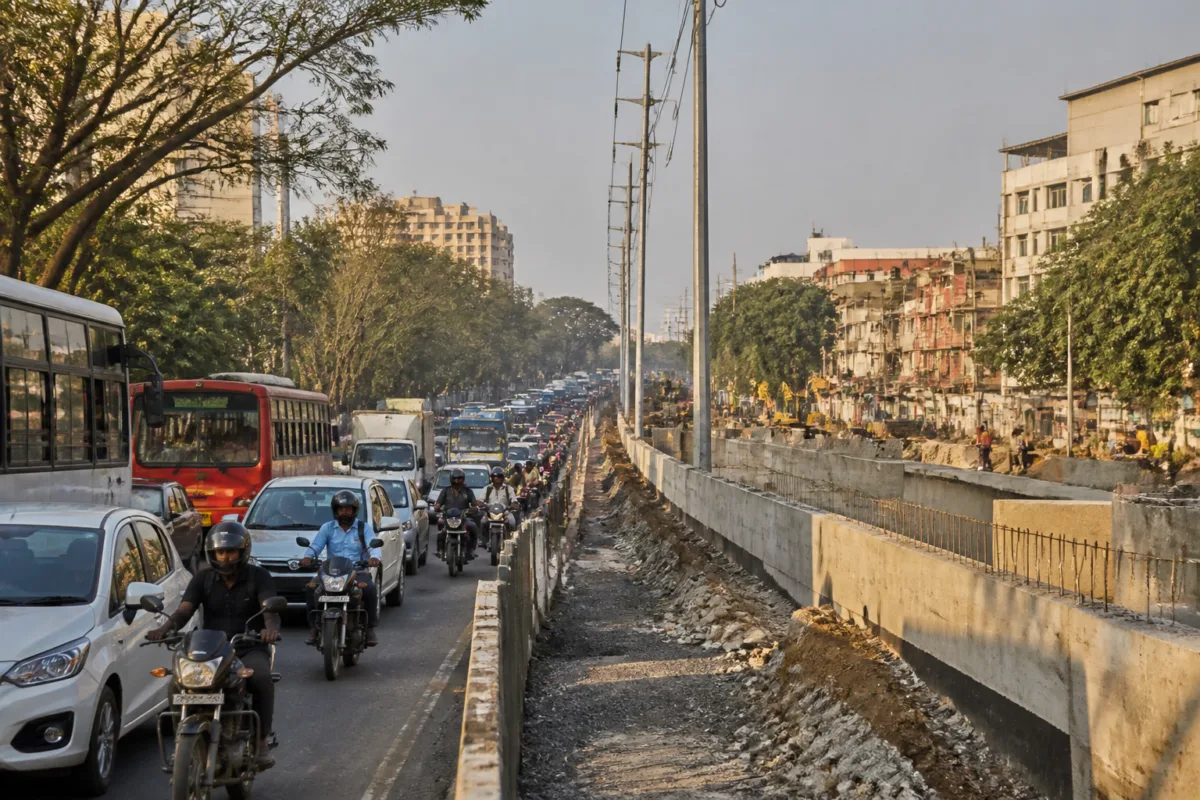
The Pune North Main Road widening project has cleared its most important institutional obstacle after the Ministry of Defence granted working permission to the Pune Municipal Corporation to use 8,883.24 square metres of defence land at Ghorpadi. The approval allows PMC to advance the widening of the approximately 2-kilometre stretch between ABC Farm Chowk and Tadigutta Chowk, but it also shows that the project’s delivery depends as much on land administration and asset coordination as on road construction itself.
PMC plans to widen the existing 18-metre road to 30 metres. The proposal is intended to improve movement along a corridor linking Koregaon Park, Mundhwa, Magarpatta, Pune Cantonment, Kalyaninagar and Hadapsar railway station. For commuters, the road is a daily connection between residential areas, employment centres and transport nodes in eastern Pune. For the civic administration, however, completing it requires the alignment of defence land, utilities, boundary assets, statutory permissions and construction sequencing.
The Ministry of Defence permission, conveyed through a letter dated September 17, is based on an equal value infrastructure arrangement. The defence land covering survey numbers 40 and 41 has been valued at Rs 29.86 crore. PMC must provide infrastructure of equivalent value, in addition to paying the full cost of the road-widening project and associated work, according to Vikash Kumar, defence estates officer of the Pune division.
That arrangement is significant because it is not a conventional transfer of vacant public land. The permission is subject to demarcation and formal approval for permanent transfer by the competent authority. A Board of Officers from the defence authorities will physically demarcate the land and assess existing assets before the handover is completed. PMC must also use the land only for the approved project and cannot sell or mortgage it.
These conditions place the project within a wider pattern of urban infrastructure delivery in which road construction is preceded by negotiations over land ownership, asset valuation and institutional control. The road may be publicly used, but the land required for its widening remains under a separate administrative system. Until the boundary is formally handed over and the associated defence assets are addressed, the road project cannot be treated as having received unrestricted access to the full alignment.
PMC had proposed widening the stretch to 30 metres in December 2023, citing increasing traffic from vehicles travelling between Mundhwa, Magarpatta, Pune Cantonment, Kalyaninagar and Koregaon Park. The proposal then awaited clearance from defence authorities because part of the required land belonged to the defence establishment. In September 2025, the civic administration began advancing the project in phases and shifted utilities, including electricity cables, water pipelines and poles. Around Rs 2.11 crore had been earmarked for this work.
The sequence illustrates why partial progress has not automatically translated into a completed corridor. Work on the carriageway towards Tadigutta Chowk had progressed, but the defence parcel remained a major constraint on the remaining portion. PMC executive engineer Sachin Bagade said the work on one lane was in its final stage and that the civic body would first build the defence boundary wall after the land was handed over, before beginning the widening work. He said the statutory procedure would take a few weeks.
The project’s traffic rationale is straightforward. The existing road carries private cars, buses, heavy vehicles and delivery vehicles through a corridor serving several eastern Pune neighbourhoods. The report records commuters describing long delays, including one Mundhwa-based software professional who said he spent almost 45 minutes daily in traffic snarls. A commuter from Magarpatta described the evening journey as a persistent problem linked to narrow lanes and slow-moving traffic.
But the reported commuter experience also points to a distinction between adding road width and improving the functioning of the entire corridor. Residents and workers have called for the widening to be completed in a coordinated manner rather than in isolated stretches. The nominated member of the Pune Cantonment Board, Sachin Mathurawala, said commuters were facing daily congestion because of the ongoing work and urged both agencies to complete their procedures quickly.
The administrative responsibilities are divided across the project. PMC is responsible for the road work, utility protection or relocation, associated construction and the cost of the widening. Defence authorities control the demarcation, assessment and handover of the land and assets. The Ministry of Defence conditions also require PMC to reconstruct any damaged defence assets, obtain necessary statutory clearances and maintain safety during construction.
This division makes the next stage more consequential than the announcement of permission alone. The working permission removes a major constraint, but it does not eliminate the remaining procedural steps. The physical handover, boundary wall construction, utility management and statutory clearances must be completed before the newly available land can support the final road alignment.
The project also reflects the pressure placed on Pune’s eastern corridors by the concentration of homes, workplaces and commercial activity across connected areas. The North Main Road is not described as an isolated local street in the supplied evidence; it functions as a link across multiple urban districts and transport destinations. That makes interruptions or bottlenecks on the stretch visible far beyond the immediate Ghorpadi site.
At the same time, the available information does not establish how much travel time will fall after completion, whether junctions along the corridor will be redesigned, or how traffic will behave once additional lanes are opened. The report notes that commuters have sought better junction management, but no specific junction plan or post-completion traffic estimate has been provided. The confirmed gain at this stage is institutional: PMC has received working permission to access the defence land under defined conditions.
The central question now is whether the project can move from permission to coordinated execution. The answer will depend on the speed of the Board of Officers’ demarcation, the formal handover, boundary wall construction and the civic body’s ability to complete the remaining widening without creating disconnected sections. PMC’s stated next step is to begin the boundary wall work after the defence land is handed over and then undertake the road widening on the parcel.

