


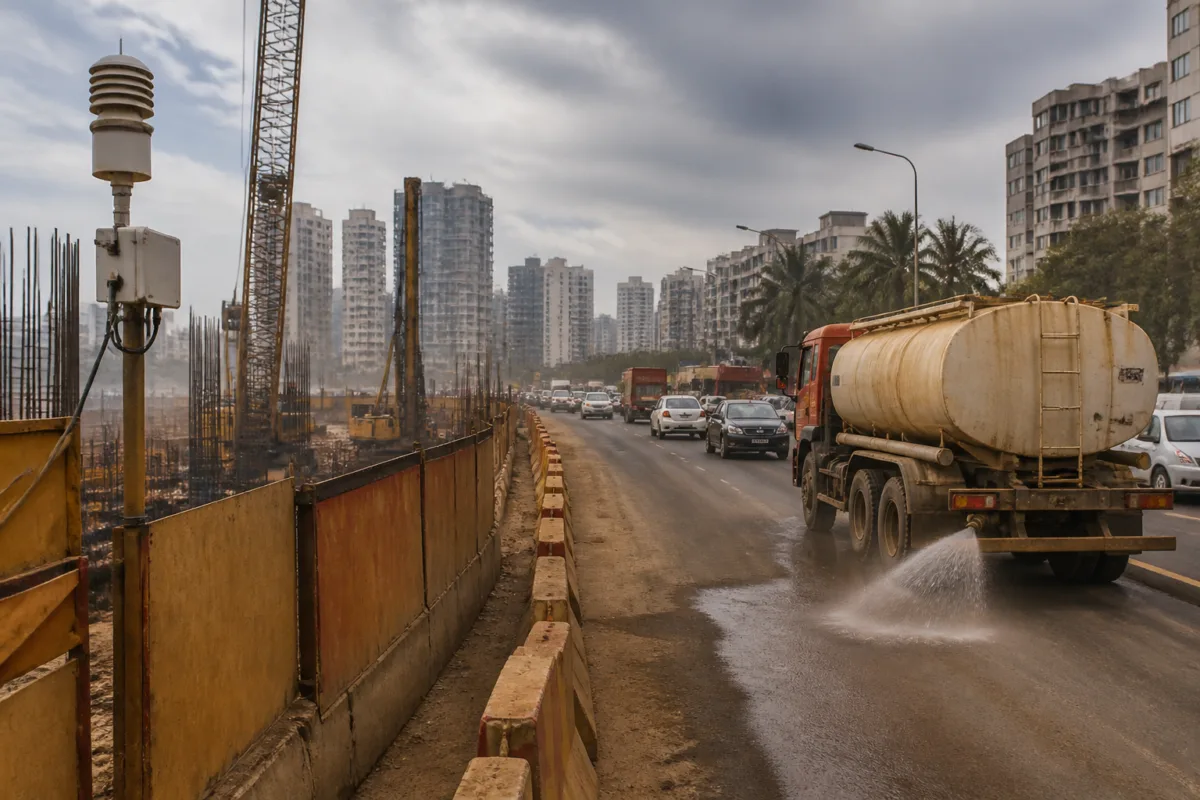
The Brihanmumbai Municipal Corporation plans to use AI-enabled analytics across around 3,000 air-quality sensors in Mumbai and revive road washing with non-potable water as it steps up measures to control pollution, Additional Municipal Commissioner Avinash Dhakane said on October 23.
The road-washing proposal had been rejected by the civic standing committee a week earlier amid the city’s ongoing 10% water cuts. The BMC now intends to bring it back after asking every ward to identify possible sources of non-potable water, including wells and lakes, Dhakane said.
The proposal was submitted by the BMC’s chief engineer for solid waste management. It envisages hiring water tankers fitted with jetting systems to wash roads across all seven civic zones for 150 days, excluding the monsoon season. The estimated cost of the exercise is Rs 8.25 crore.
The proposed use of non-potable water is intended to address the water-supply concerns that prompted the standing committee’s rejection. The BMC has not indicated in the supplied report when the revised proposal will be placed before the committee or whether it will receive approval.
Separately, the civic body plans to use data from air-quality monitoring sensors installed at infrastructure and construction sites, including sites managed by the BMC. Dhakane said manually monitoring all 3,000 sensors and identifying locations where pollution limits have been breached was not feasible.
Under the planned system, AI-enabled analytics would help identify pollution hotspots and alert officials when air-quality levels deteriorate or prescribed limits are exceeded. The alerts could prompt corrective measures at construction sites and help the BMC target interventions such as road washing at locations where dust pollution is recorded.
The plan places construction-site emissions and road dust within a common monitoring framework. However, the report does not specify the AI system to be used, the prescribed thresholds that would trigger alerts, or the enforcement action that would follow a breach. It also does not provide a timeline for integrating the sensor network or explain whether all sensors currently transmit data continuously.
Dhakane said Mumbai had recorded 231 days of good and satisfactory air quality so far this year, compared with 222 days last year and 216 days the year before. The figures were cited as part of the BMC’s assessment of air-quality conditions in the city.
He also addressed differences between air-quality readings shown on different platforms, saying the Central Pollution Control Board’s Sameer application was the only reliable source for monitoring Mumbai’s air quality. According to Dhakane, other applications may not use standardised monitoring devices similar to those deployed by the CPCB.
The next steps are the identification of non-potable water sources by municipal wards and the revival of the road-washing proposal. The BMC is also expected to develop its AI-based process for analysing sensor data and alerting officials to pollution hotspots.

