


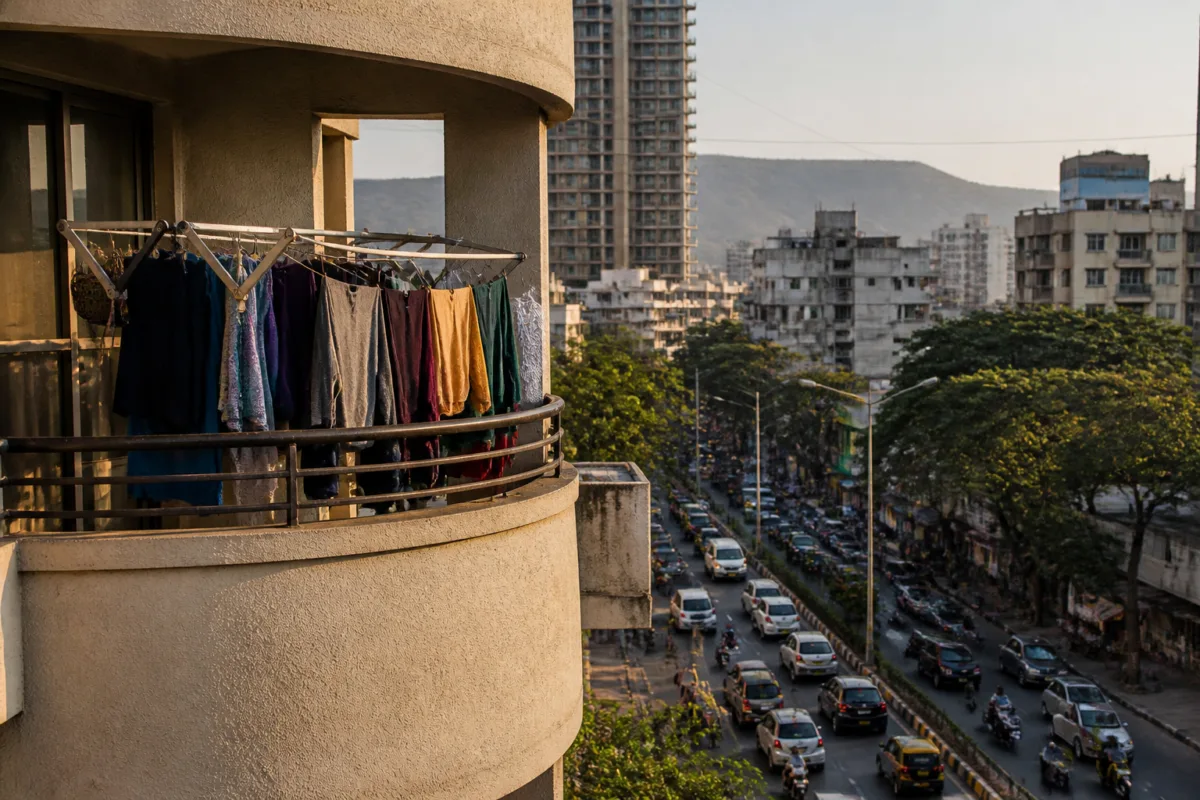
The Pune Municipal Corporation’s proposed restriction on drying clothes on balconies facing main roads has turned a question of urban appearance into a broader debate about what municipal governance should regulate, what it should fix first and how residents actually live in increasingly dense housing. Announced by PMC Commissioner Naval Kishore Ram at a ‘Swachh Samvaad’ programme, the proposal would target what the civic body describes as visual pollution while also introducing measures for vacant plots, waste dumping and sanitation in informal settlements.
The immediate proposal is relatively narrow: the PMC is considering a regulatory framework to stop residents from hanging washed clothes on balconies that face principal roads. Officials said execution guidelines, public awareness measures and penalties could be drafted within seven days. But the reaction has exposed a structural tension in Indian cities. Municipal administrations often have broad responsibilities for streets, waste, sanitation, public health and urban appearance, while residents experience these responsibilities through the limited and sometimes poorly designed spaces available inside their homes.
In Pune’s apartment-heavy neighbourhoods, balconies are not merely decorative extensions of a building facade. They can be among the few places with adequate sunlight and ventilation for drying clothes. Ramesh Kulkarni, a resident of Kothrud, told Pune Mirror that indoor drying options were often impractical in high-density apartments. Ananya Deshmukh, a resident of Viman Nagar, similarly said that limited indoor sunlight made balconies the only functional place available for daily laundry.
These accounts do not settle the question of whether a civic body can regulate the appearance of building fronts. They do, however, show why a blanket restriction could create an enforcement problem. The proposal treats the visible facade as part of the city’s visual order, while residents treat the same balcony as part of the functional home. The gap between those two perspectives is where urban regulation becomes difficult: a rule that appears simple from a road corridor may be intrusive or impractical when applied inside a household.
### When aesthetics become a municipal priority
Commissioner Ram said the administration had the authority to preserve urban beauty and order and that clothes hung on front-facing balconies degraded the visual harmony of principal thoroughfares. The PMC’s position, as reported, is that Pune’s rapid expansion requires decisive administrative action to protect its visual character.
That argument places residential facades within the civic body’s understanding of streetscape management. The same logic is frequently applied to hoardings, banners, encroachments, overhead cables and poorly maintained public infrastructure. The difficulty is that these issues do not carry the same institutional character. Illegal hoardings and dangerous cables occupy or affect public space, while laundry on a balcony is connected to ordinary domestic use of privately occupied space.
Residents and activists have therefore questioned not only the proposed restriction but also the allocation of administrative attention. Deshmukh urged the PMC to focus on illegal hoardings, oversized banners and dangerous tangles of overhead cables along main roads. Civic activist Quaneez Sukhrani pointed to sanitation in slums and the lack of safe pedestrian space, arguing that these were more urgent concerns than regulating household laundry.
The criticism is not necessarily an argument against urban design. It is an argument about sequencing. A city’s visual character is shaped by the condition of its footpaths, waste systems, public toilets, cables, signs, building edges and open land as much as by what residents place on balconies. If enforcement begins with the most visible and easiest-to-target household behaviour while larger civic failures remain unresolved, the administration risks making aesthetic regulation appear disconnected from everyday urban safety.
### The capacity question behind the proposal
The report places the proposal within the PMC’s larger capacity challenge. Ram referred to Pune’s population as nearing 80 lakh and cited a civic budget of Rs 16,000 crore alongside a workforce of 25,000. The figures, as presented in the report, indicate the scale at which the corporation is expected to manage an expanding urban area, even as basic service conditions remain uneven.
The PMC is simultaneously dealing with open plots that are used for dumping household waste and construction debris. Its proposed response would require vacant-plot owners to install green protective netting and proper fencing. The administration has also expressed concern about poorly maintained public toilets and is considering free municipal sanitation and waste collection services in slum clusters where compliance with waste collection fees is low.
Taken together, these proposals reveal a municipality working across several types of intervention. Some are aimed at changing resident behaviour, some at placing responsibilities on private landowners, and others at extending or subsidising basic services. The balcony proposal is therefore not an isolated aesthetic announcement. It forms part of a wider regulatory approach in which the PMC is seeking to improve visible order, prevent dumping and address sanitation gaps through a combination of rules, infrastructure and service delivery.
But the different measures also require different forms of capacity. A restriction on balcony laundry would need a clear definition of which roads and balconies are covered, a system for identifying violations, a process for issuing penalties and a way to address practical exceptions. Green netting around vacant plots would require monitoring of private landowners and enforcement against continued dumping. Free sanitation and waste collection in slum clusters would require reliable service operations and administrative coordination.
The report does not establish how the proposed balcony rules would be implemented or what penalties might apply. That information was expected to emerge through guidelines and public awareness measures to be drafted within seven days. Until then, the central issue is not only whether the PMC has the authority to act, but whether it can design a proportionate and workable framework.
### What the dispute says about housing conditions
The residents’ objections point to a housing issue that aesthetic policies can overlook. In many modern flats, balconies are among the few semi-open spaces available to households. Their usefulness depends on layout, sunlight, ventilation and the number of people sharing the home. If indoor drying space is limited, banning a common household practice without addressing the design constraints of apartments would transfer the burden of urban appearance from building design and planning decisions to residents.
That does not mean every use of a balcony is automatically compatible with a public-facing building edge. Cities can have legitimate concerns about safety, obstruction, water dripping onto public areas or the visual condition of major corridors. However, the material supplied does not identify such specific harms in relation to laundry. The stated basis is visual pollution and the degradation of visual harmony.
This distinction matters for the quality of regulation. A rule addressing a documented safety or obstruction risk would have a different public-interest basis from a rule directed primarily at appearance. The PMC’s eventual guidelines will determine whether the policy remains a broad prohibition or becomes a more limited framework addressing particular locations, building conditions or public-space impacts. The supplied report does not yet provide those details.
The dispute also shows how the boundary between private and public space is negotiated in a dense city. A balcony may be visible from a public road, but it remains part of a home’s daily functioning. Treating visibility as sufficient grounds for intervention could create a precedent for regulating other ordinary domestic practices that affect the appearance of buildings. Conversely, ignoring the condition of building fronts can weaken the coherence of important streets and corridors. The policy challenge is to establish where that boundary lies and why.
### The larger municipal priority test
The PMC’s own announcement places the balcony proposal beside more consequential concerns: illegal dumping, construction debris, public toilets and sanitation services in informal settlements. That juxtaposition has made the proposal a test of institutional priorities. It asks whether a civic body can pursue urban aesthetics while also meeting basic service obligations, and whether both goals can be pursued without allowing one to substitute for the other.
For residents, the answer will be judged less by the language of visual character than by how the rules are applied. A policy that is clearly defined, publicly explained and connected to specific public-space concerns would be easier to distinguish from arbitrary intrusion. A policy that imposes penalties on ordinary household activity while footpaths, waste points and sanitation facilities remain visibly deficient would face a stronger legitimacy challenge.
The vacant-plot proposal raises a related question about responsibility. Requiring owners to fence land and install green netting could help prevent unauthorised dumping, but the outcome would depend on monitoring, collection systems and enforcement against those who dump waste. The measure addresses the condition of private plots, while the underlying waste problem involves households, contractors, landowners and municipal operations. The report does not specify how these responsibilities would be coordinated.
The proposed free sanitation and waste collection services in slum clusters also point to a different model: instead of relying mainly on compliance with fees, the PMC is considering direct provision of essential services in areas where collection is low. That approach recognises that sanitation outcomes depend on access and service reliability as well as payment systems. It also shows that the corporation’s policy choices extend beyond enforcement and into questions of municipal inclusion.
Pune’s balcony laundry debate therefore carries significance beyond the immediate proposal. It reveals a city administration trying to manage rapid expansion with finite staff and a large but heavily committed budget, while residents contest the order in which problems are addressed. The evidence currently confirms that the PMC is developing a regulatory framework and a set of related sanitation and land-management measures. It does not yet confirm the final rules, penalties, exemptions or implementation mechanism.
The next important developments are the guidelines expected to be drafted within seven days and the public response to them. Those documents will show whether the balcony proposal becomes a broad appearance-based ban or a narrower measure tied to clearly defined public impacts. They will also indicate whether the PMC can connect its pursuit of visual order with the more basic infrastructure and sanitation concerns that residents and activists have placed at the centre of the debate.

