


Godrej Properties’ Q2 results present a sharply divided picture of India’s organised residential real-estate market. The developer reported record bookings and collections, but its reported profit and EBITDA fell steeply because project-completion accounting delayed the recognition of revenue and earnings. The contrast matters because it shows how sales momentum, cash generation and reported profitability can move in different directions in a construction-led business.
For the quarter ended September 30, 2026, Godrej Properties recorded bookings of ₹8,008 crore from the sale of 3,658 units covering 6.2 million sq. ft. That took its first-half booking value to a record ₹16,659 crore, 7 per cent higher than in the corresponding period. Collections for the quarter reached ₹5,318 crore, rising 31 per cent year-on-year, while first-half collections stood at ₹9,666 crore, up 25 per cent.
These figures indicate strong customer conversion and cash inflows from projects already sold. They also provide a different view of the company from its reported income statement. Consolidated net profit for the quarter fell 62 per cent to ₹154 crore from ₹405 crore a year earlier. EBITDA declined 72 per cent to ₹171 crore. For the first half, net profit fell 50 per cent to ₹504 crore and EBITDA dropped 53 per cent to ₹717 crore, even as total income grew 13 per cent to ₹3,912 crore.
The divergence is not necessarily contradictory. In a project-completion accounting model, booking a home and collecting money do not immediately translate into reported revenue or profit. Recognition depends on the stage and accounting treatment of construction and project completion. A developer can therefore report strong bookings and collections while its current-period profit remains subdued because the associated revenue is recognised later.
That distinction is particularly important in housing, where the commercial cycle begins with land acquisition and project approvals, moves through launches and bookings, and ends with construction, possession and accounting recognition. The financial result seen in any one quarter may reflect an earlier project cycle rather than the most recent sales performance.
Godrej Properties’ Q2 numbers show how the company’s operating indicators are currently stronger than its reported earnings. Operating cash flow rose 297 per cent quarter-on-quarter and 33 per cent year-on-year to ₹1,584 crore during the quarter. First-half operating cash flow reached ₹1,983 crore. Collections, rather than accounting profit alone, are therefore central to understanding the company’s ability to fund construction and sustain project expansion.
At the same time, the cash-flow picture requires attention to the cost of converting bookings into completed homes. Construction-related outflows rose 42 per cent in the first half. This increase reflects the capital intensity of the development model: sales generate collections, but projects require continuing expenditure on construction before homes can be delivered and the associated revenue fully recognised.
The result is a business balancing two demands. It must convert demand into bookings and collections, while also spending enough to maintain construction progress and future delivery. Strong bookings are valuable only when they translate into execution, collections and eventual handover. Higher construction outflows can support that process, but they also increase the need for disciplined cash management.
The company’s expansion during the first half adds another layer to this picture. Godrej Properties added four new projects with an expected booking value of ₹15,500 crore, achieving 78 per cent of its full-year guidance. These additions enlarge the future sales pipeline and strengthen the company’s presence across its development markets. They also create a longer execution queue, with approvals, construction schedules, customer collections and delivery obligations extending across multiple project cycles.
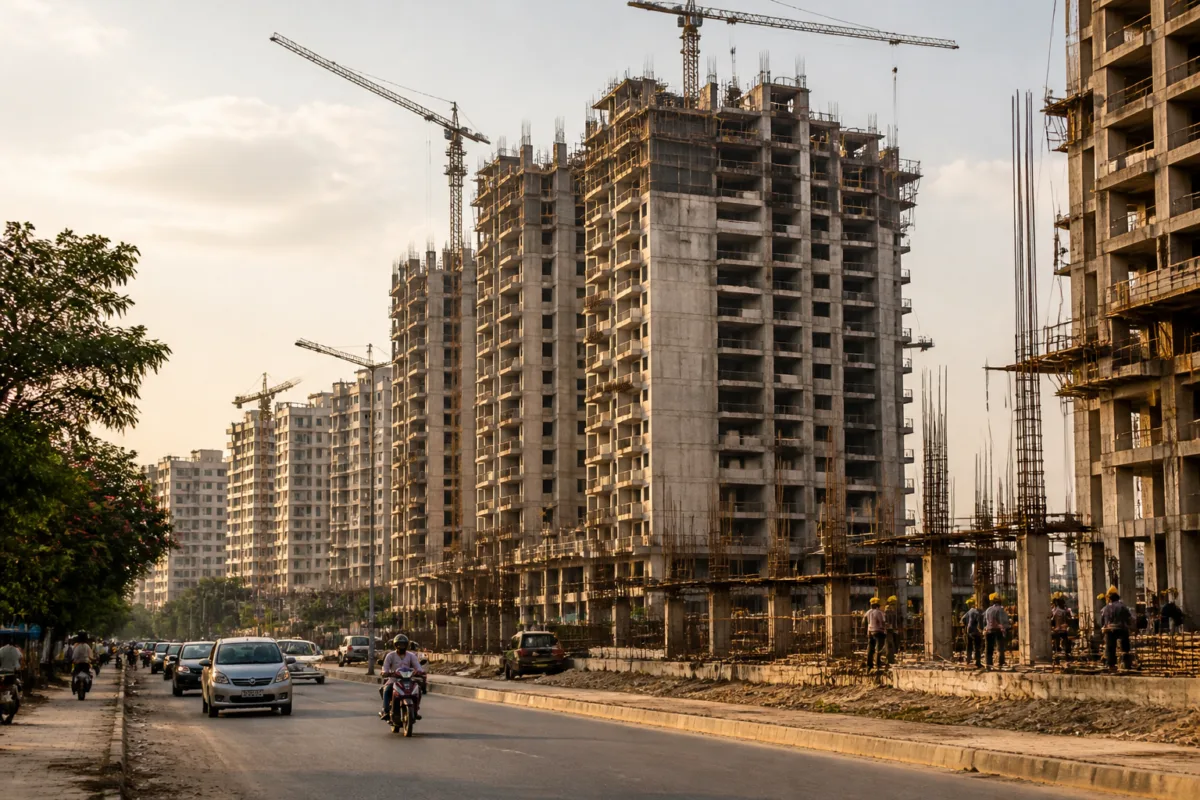
This is where the real-estate story moves beyond a quarterly earnings comparison. The headline numbers show demand, but the operating model determines whether that demand becomes completed housing stock. For cities, the consequences are practical. New project launches affect land use, construction activity, local infrastructure demand, employment and the future supply of formal housing. The quality and pace of execution influence when buyers receive homes and when surrounding areas absorb additional pressure on roads, utilities and public services.
Godrej Properties said it expects ₹15,000 crore in collections and ₹7,000 crore in operating cash flow in the second half of FY27. The company also targets a 20 per cent reported return on equity in FY28. These are management expectations, not completed outcomes, and their achievement will depend on collections, construction progress, project launches and the timing of revenue recognition.
The company’s guidance also highlights the difference between a real-estate developer’s reported earnings and its development platform. A developer may build value through land access, project additions and customer demand long before that value appears in recognised revenue. Conversely, a strong bookings number does not by itself establish that all projects are progressing at the required pace or that future profits will arrive on schedule.
For buyers, the most relevant indicators are not limited to a developer’s quarterly profit. Booking growth shows demand for the company’s projects, while collections indicate the flow of customer payments. Construction-related outflows and operating cash flow reveal how the business is funding execution. Project additions show future scale, but also expand the obligations that must eventually be delivered. Reported earnings provide another measure, although they may lag operating activity under project-completion accounting.
The first-half data illustrates this layered structure. Booking value reached ₹16,659 crore, collections stood at ₹9,666 crore, and operating cash flow was ₹1,983 crore. At the same time, first-half net profit declined 50 per cent and EBITDA fell 53 per cent. The company’s figures therefore describe a developer with strong sales and collections but lower currently recognised profitability and rising construction-related cash requirements.
That combination is not unique to one quarter’s accounting presentation. It reflects the institutional mechanics of large-scale housing development, where land, approvals, construction finance, customer payments and recognition rules interact. It also underlines why a single measure can give an incomplete view of an urban developer’s performance.
The larger question is whether the company can maintain collections and cash generation while converting its enlarged project pipeline into completed inventory. The supplied results establish that Godrej Properties has recorded strong first-half bookings, collections and project additions. They also establish that reported earnings have weakened and construction outflows have increased. What remains to be demonstrated is how these trends develop through the second half of FY27 and whether the expected collections and operating cash flow are achieved.
For now, the evidence points to a real-estate business in which demand remains visible in bookings and collections, while profitability is being shaped by execution timing and accounting recognition. The next significant indicators will be second-half collections, operating cash flow, construction expenditure, project progress and the conversion of new launches into delivered housing and recognised earnings.

