


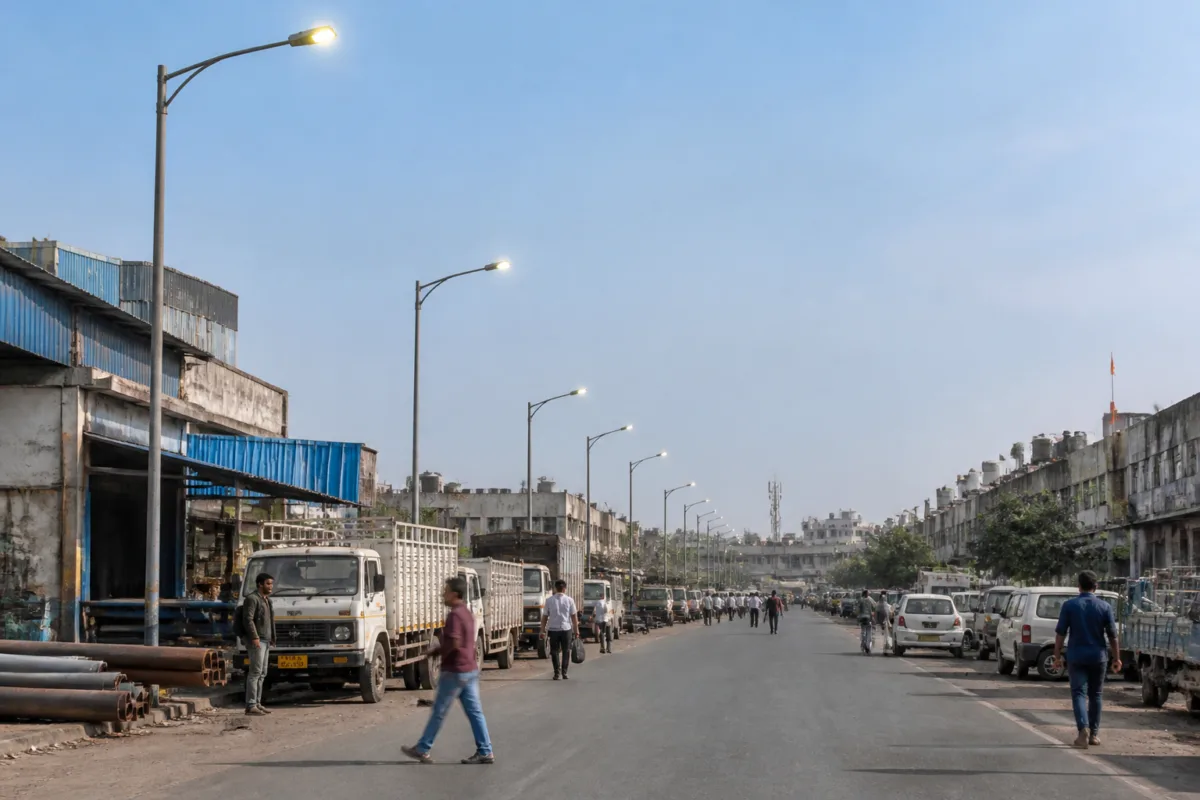
Streetlights remaining on during daylight in Surat’s Govind Nagar industrial area have become more than a complaint about wasted electricity. The episode, reported by the Times of India, exposes how a routine municipal function can undermine wider conservation efforts when monitoring, complaint resolution and operational accountability do not work together.
The streetlights in the Udhna area have reportedly stayed on through the day for several months. Govind Nagar is described as an industrial and commercial hub with around 500 plots, making the problem visible to business owners, workers and residents who pass through the area regularly. The issue has continued even as Gujarat faces a reported power crisis and industries are facing electricity curtailments of up to eight hours a week to conserve power.
The central concern is therefore not only the electricity consumed by the lamps. It is the contradiction between a public conservation message and the condition of civic infrastructure on the ground. When industries are asked to suspend operations during designated hours, daytime streetlights operating unnecessarily can make the conservation effort appear unevenly applied. The impact is financial as well as administrative: electricity is paid for through public funds, while the municipal system responsible for switching, monitoring and repairing the lights appears to have failed to close a known complaint.
The report does not establish the technical cause of the malfunction. The lights could be linked to a faulty timer, a control-panel problem, a damaged sensor, manual switching, an electrical fault or an incomplete maintenance response. What is established in the supplied account is that residents and business owners say the lights have remained on during the day for months, and that repeated complaints have not produced a lasting solution.
That distinction matters because streetlight operations are usually a chain of small administrative tasks rather than a single decision. A lighting circuit must be connected to an operating schedule or control system. Faults need to be identified, recorded and assigned to a maintenance team. The repair must then be checked after completion. If any link fails, a problem that appears minor at street level can persist across an entire lane or industrial estate.
The experience of Govind Nagar residents suggests a failure in that feedback loop. Shop owner Musharaff Ansari told the Times of India that he had complained several times and that the lights were switched off only for a day or two before returning to permanent operation. Resident Divyesh Kumavat said he submitted photographs to the Surat Municipal Corporation six months ago and again three months ago, but the lights were still on when the area was revisited.
These accounts point to a gap between complaint registration and verified resolution. A complaint may be marked as attended after a temporary switch-off, while the underlying fault remains. Alternatively, different agencies or maintenance contractors may be responsible for the power supply, control equipment and physical lights. The supplied report does not identify the operating arrangement in Govind Nagar, so it cannot establish which institutional link failed. It does, however, show why a one-time response is insufficient for infrastructure that operates every night and across large areas.
The scale of the location adds to the governance question. Govind Nagar is not described as an isolated residential lane but as an industrial and commercial hub comprising around 500 plots. A fault affecting rows of streetlights in such an area is visible, repeated and potentially measurable. It should be possible for a municipal monitoring system to identify that lights are drawing power during daylight or to receive and reconcile repeated complaints about the same circuit.
The report also highlights the difference between infrastructure provision and infrastructure management. Installing streetlights is a visible public-works activity, but ensuring that they operate only when required depends on less visible systems: timers, sensors, inspections, maintenance contracts, control rooms, field staff and complaint databases. The public experiences the entire system as one service. Administrative responsibility, however, may be divided across departments or contractors. Without a clear owner for the final outcome, persistent failures can circulate between units without being resolved.
This is particularly consequential during a reported power shortage. The article says industries in Gujarat are facing weekly power curtailments of up to eight hours and are being required to suspend operations during designated periods. That context turns a local streetlight fault into a question of institutional credibility. Conservation policies rely not only on restrictions but also on visible consistency. When businesses are asked to reduce consumption while public lights reportedly remain on in daylight, the city’s conservation effort can appear disconnected from its own operations.
The available evidence does not quantify the electricity consumed by the Govind Nagar lights, the duration of their daily operation, the number of fixtures affected or the cost to the Surat Municipal Corporation. It also does not establish whether the consumption is material compared with industrial demand in Gujarat. Those figures would be needed to calculate the financial or energy impact precisely. The stronger, evidence-based conclusion is narrower: a publicly visible and reportedly long-running source of avoidable consumption has not been permanently corrected despite repeated complaints.
That distinction is important for urban reporting. Energy efficiency is often discussed through large projects, new equipment and citywide programmes. Yet municipal savings can also depend on basic operational discipline. A timer that works, a control panel that is inspected and a complaint that remains open until the repair is verified may deliver more immediate value than a conservation policy that is not implemented at street level. The Govind Nagar case illustrates this operational side of energy governance without proving that it is representative of all of Surat’s streetlighting network.
The episode also raises questions about the quality of civic data. If the SMC has a central record of streetlight faults, it should be able to identify repeat complaints from the same location, track the time taken to resolve them and distinguish temporary restoration from permanent repair. If it does not have such a system, residents may continue to act as the monitoring layer by documenting faults and repeatedly reporting them. That shifts the burden of basic service verification onto citizens and businesses.
The SMC official quoted in the report said the issue would be checked and that necessary action would be taken to stop the wastage immediately. This is the next formal step identified in the supplied material. The effectiveness of that response will depend on whether the authority identifies the technical cause, records the repair and confirms that the lights operate correctly after daylight returns. The report does not state whether an inspection has already taken place, whether responsibility has been assigned or whether any follow-up deadline has been announced.
For Surat, the larger urban question is how routine civic systems are monitored once they are installed. Streetlights are associated with safety, mobility and public-space access, but their operation also involves energy use, municipal expenditure and maintenance accountability. A city can have extensive infrastructure and still deliver weak outcomes if its control systems do not detect failures or if complaints do not lead to verified closure.
The Govind Nagar case confirms a reported mismatch between conservation expectations and municipal operations in one industrial area. It also shows the limits of complaint-based governance when repeated citizen reports do not produce a lasting fix. What remains unclear is the technical reason for the lights staying on, the amount of power being consumed and whether the SMC’s promised inspection will result in a permanent correction. Those are the developments that will determine whether this remains a local maintenance lapse or becomes evidence of a wider weakness in Surat’s streetlight management.

