


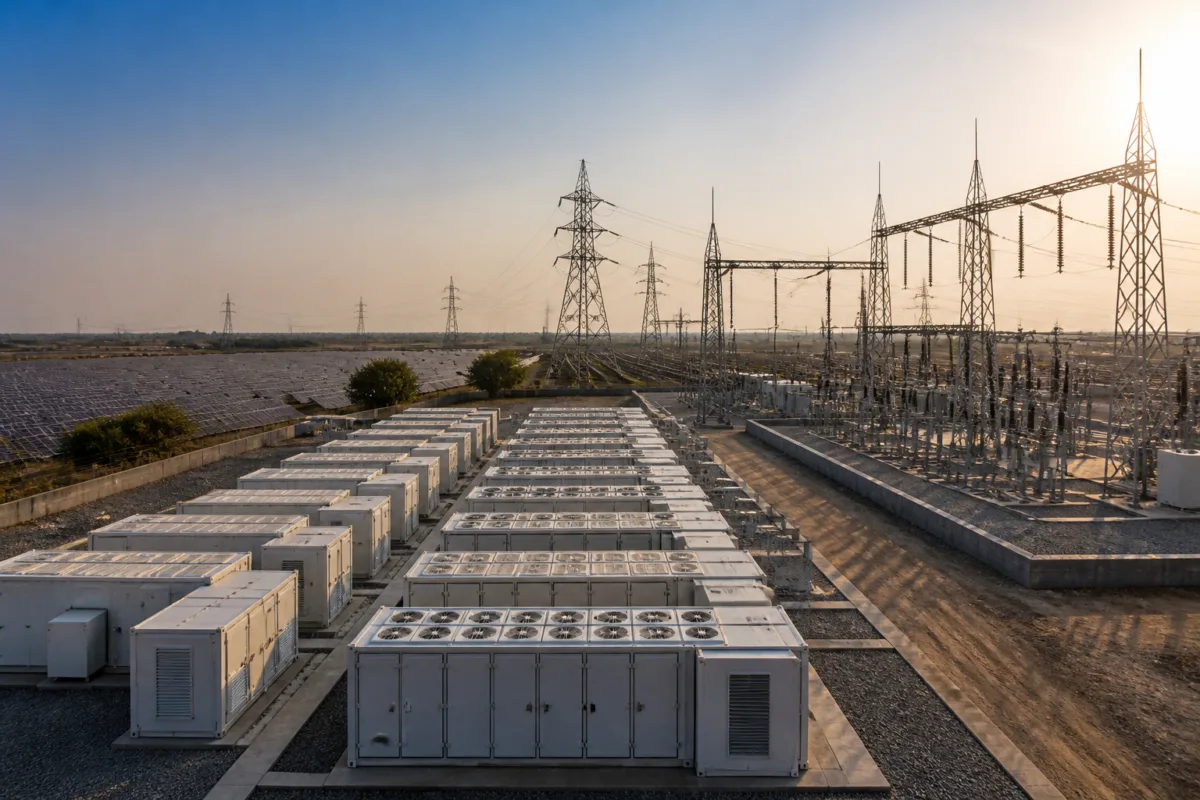
Gujarat’s new battery storage rules address a central weakness in the state’s fast-growing renewable-energy system: solar and wind power may be available when the grid needs less electricity, while demand rises sharply at other hours. The Gujarat Electricity Regulatory Commission’s framework for grid-connected Battery Energy Storage Systems creates rules for ownership, procurement, scheduling, operation and commercial arrangements, giving utilities and developers a formal pathway to use stored electricity when supply is under pressure.
The notification came as Gujarat’s electricity demand reached an all-time high of 29,822 MW on October 16, a 36.6% increase over the corresponding period last year. The state has also ordered power cuts to rationalise supply, while Chief Minister Bhupendra Patel chaired two high-level meetings during the week to review the situation. The Union coal ministry has assured Gujarat of 10 to 11 coal rakes a day until November, indicating that the immediate power challenge involves both fuel supply and the ability to manage demand across the day.
The regulatory intervention therefore does more than recognise battery storage as an emerging technology. It places storage inside the state’s electricity governance system. The framework defines who can develop and own projects, how they will connect to the grid, how their electricity will be scheduled and how different participants can be paid. That institutional clarity is important because batteries are neither conventional generating stations nor ordinary consumers. They draw power, retain it and return it to the grid according to system requirements.
The problem the regulations seek to address is also broader than a short-term shortage. Solar generation can reduce daytime dependence on conventional power but cannot, by itself, provide electricity after sunset. Wind generation can vary with weather conditions. Without storage, renewable electricity may have to be curtailed when generation exceeds demand or when the network cannot carry it to the required location. The framework is intended to reduce such renewable-energy wastage while making stored power available during peak hours.
Under the rules, grid-connected projects above 1 MW will generally be covered, with a minimum storage duration of two hours and connectivity at 11 kV or above, subject to specified exceptions. These thresholds establish the scale at which the commission expects storage to become part of the regulated power system rather than remain a small, isolated installation. Registration with the Gujarat Energy Development Agency will generally be mandatory.
GEDA has been directed to issue a standard operating procedure within three months. That document is expected to cover registration, documentation, testing and commissioning. The next stage of implementation will therefore depend not only on the notification but also on whether the operating procedure translates the framework into predictable administrative steps for project developers, utilities and other users.
The range of models recognised by the regulations is significant. Batteries may be co-located with renewable or conventional generating stations, developed as standalone facilities, linked to transmission infrastructure, connected to distribution systems for peak management or installed at the consumer level. The framework also includes electric-vehicle-linked applications and vehicle-to-grid integration. These categories show that Gujarat is treating storage as a system-wide resource rather than limiting it to solar farms.
Each model addresses a different constraint. A battery located alongside a renewable project can shift electricity to a later period. A standalone facility can be scheduled independently and potentially serve multiple system needs. Transmission-linked storage can help ease congestion, while distribution-linked systems can support local peak management. Consumer-level storage and vehicle-to-grid applications could eventually connect electricity consumption and mobility more closely, although the supplied notification does not establish the scale or timing of such deployment.
The framework’s scheduling provisions reveal where operational authority will remain concentrated. Co-located battery systems will generally be scheduled alongside their associated generating stations, while standalone projects will be scheduled independently. The State Load Dispatch Centre will retain overriding authority to issue dispatch instructions during grid disturbances and to curtail or reschedule battery operations when necessary to protect grid security.
This provision matters because storage capacity is valuable only if it can be called upon at the right time. A battery may have energy available but still be unable to discharge if network conditions, system frequency or local constraints make that operation unsafe. By placing the SLDC’s grid-security role above project-level scheduling, the rules establish that private or commercial operating arrangements cannot override the requirements of the wider electricity system.
The SLDC must also develop procedures for scheduling and sharing transmission-linked costs within two months. Cost allocation is likely to be a central administrative issue because a storage project may provide benefits across more than one part of the network. A facility connected to transmission infrastructure could help manage congestion, support renewable integration and provide power during high-demand periods. The rules identify the need for a cost-sharing mechanism, but the details will emerge through the procedures that follow.
The notification also requires compliance with Central Electricity Authority standards, cybersecurity requirements and battery waste management rules. These provisions place the storage framework within existing technical, digital-security and environmental obligations. Batteries will be connected to critical infrastructure and managed through systems that require secure data and control arrangements. At the end of their operating life, the equipment will also require regulated handling rather than informal disposal.
A senior state power department official described the notification as a “clear and bankable pathway” for storage procurement and operation, saying it would help utilities and developers scale Battery Energy Storage Systems in a disciplined manner and make solar power more reliable during peak hours. The statement identifies the investment problem the rules are designed to address: developers need clarity on how projects will be procured, operated and compensated before they can commit capital at scale.
A senior official associated with grid operations said that defining scheduling, metering and the SLDC’s grid-security powers in advance would reduce operational ambiguity. The official also said storage could provide firming, balancing and ancillary support alongside solar and wind growth. These functions distinguish battery storage from a simple emergency backup system. They position it as a flexible grid asset that can respond to changing supply and demand conditions.
Kunj Shah, chairman of the energy committee of the Gujarat Chamber of Commerce and Industry, said the regulations could reduce uncertainty for private investors and accelerate renewable-energy projects. He pointed specifically to procurement, scheduling and revenue stacking, arguing that a predictable framework could support faster solar-plus-storage deployment and new investment across Gujarat’s renewable-energy ecosystem.
The reference to revenue stacking is important because a battery may be capable of providing several services, but the commercial framework must determine how those services are valued and paid for. A project could be associated with generation, peak management, transmission support or balancing. The notification establishes commercial arrangements as part of the regulatory framework, but the supplied material does not provide tariff structures, procurement volumes or project-specific financial terms.
Gujarat’s immediate demand pressures give the rules a practical test. The state’s 29,822 MW peak and the reported 36.6% year-on-year increase show how quickly electricity requirements can rise. Power cuts and the assurance of additional coal rakes address the supply situation in the near term, but neither measure resolves the timing mismatch between renewable generation and peak demand. Storage is intended to provide that flexibility, although the notification itself does not guarantee that new battery capacity will be commissioned immediately.
The framework also makes clear that storage cannot be assessed only by the number of megawatt-hours installed. Its usefulness will depend on where systems are connected, whether they can be dispatched when required, how transmission costs are shared and whether procurement arrangements create dependable revenue. The two-hour minimum duration provides a baseline for covered projects, but the actual system value will depend on the relationship between storage duration, demand patterns and network constraints.
The larger urban question is how Gujarat will maintain reliable electricity as homes, businesses, industry and transport place competing demands on the grid. Electricity reliability is an infrastructure issue that shapes industrial operations, commercial activity, public services and household life, even when the grid itself remains out of sight. A storage framework can help the state manage a more variable electricity system, but its impact will be determined by implementation rather than notification alone.
The evidence currently confirms that Gujarat has created a formal regulatory basis for grid-connected battery storage at a time of record electricity demand and renewable-integration pressure. The immediate milestones are GEDA’s operating procedure within three months and the SLDC’s scheduling and transmission-cost procedures within two months. Those documents, followed by actual procurement and commissioning, will show whether the framework can convert regulatory clarity into dependable peak-hour power.

