


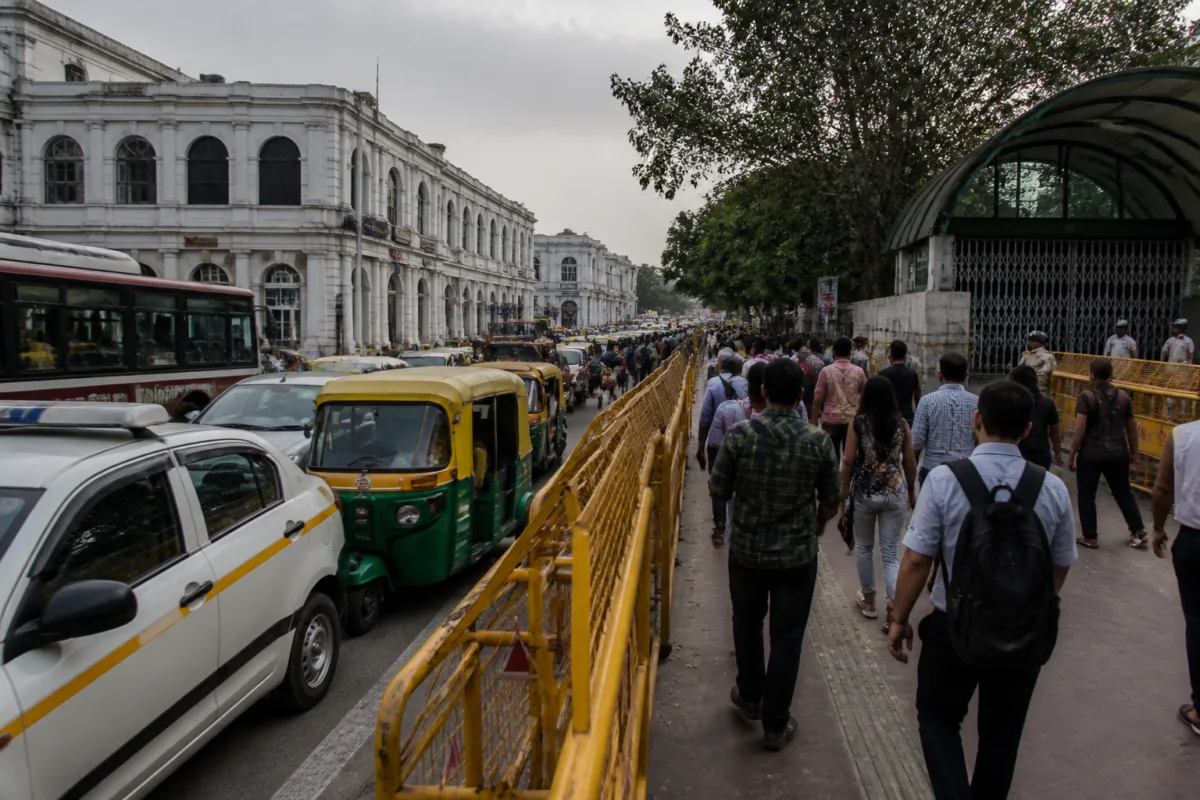
Delhi protests are increasingly being experienced not only as political gatherings but as disruptions to the city’s everyday operating system. Barricades, Metro station closures, traffic diversions and security restrictions have affected traders, commuters, workers and informal transport providers, raising a difficult governance question: how can the right to peaceful assembly be protected without making unrelated citizens pay through lost income, longer journeys and unsafe travel?
The issue came into focus during protests by the Cockroach Janta Party over the removal of Chief Election Commissioner Gyanesh Kumar. The demonstrations were concentrated around parts of central Delhi, but their effects extended into Connaught Place, Khan Market, surrounding roads and public transport networks. The Times of India reported that traders faced weaker footfall during the festive trading period, commuters encountered sealed Metro gates and diversions, and workers whose earnings depend on daily movement found fewer or more difficult trips.
That spread is important because central Delhi is not a collection of isolated protest venues. It is also a dense combination of offices, markets, restaurants, government buildings, transport links and public spaces. A restriction imposed at one location can therefore travel through the network. When a road is narrowed by barricades, traffic moves to adjoining streets. When a Metro station is closed, passengers shift to roads, autos and cabs. When customers avoid a market, the commercial impact is felt by shopkeepers, employees, delivery workers and transport providers rather than only by the people organising or attending a demonstration.
The reported experience of Connaught Place illustrates how the timing of disruption can intensify its economic effect. October marks the start of the festive trading season, when markets typically expect higher footfall before Diwali and the wedding season. Atul Bhargav, president of the New Delhi Traders Association, said shopkeepers were advised to close at 6.30pm on one protest day after discussions among office-bearers. He cited concerns about the safety of employees and customers as well as falling business.
Bhargav said sales that would normally account for 20-25% of business had fallen to around that level on the first day and then dropped to 35-40% over the following two days, according to his account. The wording in the report leaves the basis of these figures with the traders’ association; they are not presented as an independently audited measure. Their significance lies in showing how a short period of reduced access can affect a market that relies heavily on evening crowds.
Khan Market traders reported similar concerns. Sanjeev Mehra, president of the Khan Market Traders Association, said road closures and security arrangements had kept customers away and that the association had written to the prime minister, home minister, commerce minister and other representatives. He estimated losses at around Rs 200-300 crore during the festive period, a figure that the report explicitly said had not been independently verified.
The Confederation of All India Traders offered a broader estimate. Its secretary general, Praveen Khandelwal, said disruptions could put business transactions worth more than Rs 400 crore a day at risk, potentially reaching Rs 4,000 crore over 10 days if they continued. He clarified that these were indicative estimates of business activity at risk, not a verified calculation of actual losses. The distinction matters: the value of transactions that may not take place is different from measured loss, and both are different from the long-term effect of customers shifting to online shopping or changing where they spend.
The costs of the disruption are not confined to commercial accounts. During a separate day of political mobilisation in central Delhi, congestion spread from Connaught Place towards Rajghat, with traffic crawling along the Outer Circle, Panchkuian Road, KG Marg and Tolstoy Marg. Barricades narrowed roads and diversions pushed vehicles onto adjoining routes. The report said some people reported missing trains, although no official figure was available. Social media accounts also described school buses being held in traffic, including one account alleging that children were stranded for nearly an hour.
For commuters, the most consequential feature of such disruption is uncertainty. A person may know the destination but not whether the usual station will be open, whether a cab will be able to reach the pickup point or how much longer the journey will take. Siddhi, a commuter quoted in the report, said she had to wake earlier because her Metro route was closed and that autos were charging high fares for short distances. Prachi described sealed Metro gates, cancelled cabs and the need to walk through chaotic crowds. She also raised concerns about groping and stampede risks when open transit and secure spaces are unavailable.
These accounts show that mobility disruption is not measured only in minutes added to a journey. It can also involve additional fares, missed connections, lost working time and a heightened perception of personal insecurity. The effects are uneven. People with flexible work, private vehicles or the ability to work remotely may be able to absorb them more easily than daily-wage workers, service employees, students, caregivers and commuters dependent on public transport.
The experience of drivers further demonstrates how the same disruption can create different outcomes across the urban economy. Praveen, an e-rickshaw driver, said the number of passengers he could pick up declined when Metro stations shut and fewer people were on the roads. He spent more time looking for passengers and driving further for fewer fares. Sonu, an autorickshaw driver, said he prioritised passengers travelling to protest sites because regular rides had declined, and that drivers sometimes charged extra while focusing on those trips.
This does not establish a single city-wide economic outcome. Instead, it shows how a transport interruption redistributes opportunity. A driver near a protest site may find demand, while another loses fares because familiar routes are blocked. A restaurant near a closed station may lose customers, while a business elsewhere may receive additional demand. The central urban problem is that these adjustments are made individually, without necessarily being supported by a coordinated system for communicating closures, maintaining safe pedestrian movement or protecting access to essential destinations.
The legal and administrative questions are equally significant. A restaurant owner from Connaught Place, Aayush Chopra, approached the Delhi High Court seeking an assessment of losses suffered during the October 10 agitation and compensation from those responsible. The petition also sought to prevent a proposed gathering at Central Park on October 16. The court directed that the matter be listed with connected petitions. The claims in the plea remain the petitioner’s submissions and are not findings on the merits of the dispute.
The petition cited a standing order dated April 28, 2022, which regulated protests in central Delhi and identified Jantar Mantar as a designated site subject to conditions including advance permission. It also referred to the subsequent de-notification of Jantar Mantar and the designation of three other venues on October 11. The dispute therefore involves more than the immediate question of whether a particular gathering should proceed. It also concerns how protest venues are designated, how quickly restrictions are communicated and how responsibilities are allocated when public access and private livelihoods are affected.
Designated spaces can help authorities manage security, traffic and access, but location alone does not resolve the conflict. A protest site is connected to roads, stations, markets and residential areas. Restrictions imposed around it can have consequences well beyond its boundaries. At the same time, demands to limit demonstrations in market areas during the festive season raise a separate concern: how to reduce disruption without converting economic convenience into a reason to unduly restrict peaceful assembly.
The evidence in the reported episode points to a governance gap between permission and management. The formal question may be whether a protest is authorised or whether a road can be closed for security reasons. The practical question is how the city manages the secondary effects: advance public information, alternative routes, station-level communication, pedestrian safety, access for workers and the continuity of emergency and essential travel. The supplied report does not establish that any one of these measures was absent in every location, but the experiences described by commuters and traders show the consequences when movement becomes unpredictable.
Delhi’s protest economy also exposes the limits of headline loss estimates. The traders’ figures vary in scale and are not independently verified, while the report notes that no official count was available for missed trains. Yet the absence of a consolidated measurement system does not mean the costs are immaterial. Lost sales, additional travel expenses, delayed work, reduced daily fares and unsafe journeys are separate forms of urban friction. They accumulate across groups that rarely appear together in administrative assessments.
The larger question is not whether protests or markets should prevail. Both are part of a functioning city: public assembly is a democratic activity, while commerce, commuting and transport sustain everyday urban life. The challenge is to design a system in which the exercise of one right does not automatically transfer its operational costs to people with no role in the dispute.
The reported events confirm that central Delhi’s mobility and commercial networks remain closely interdependent. They also show that the economic figures currently available are largely claims or indicative estimates, while the effects on commuters and workers are documented through individual accounts rather than a comprehensive official assessment. The next developments to watch are the Delhi High Court proceedings, the administration’s approach to protest venues and the mechanisms used to communicate and manage future closures and diversions.

