


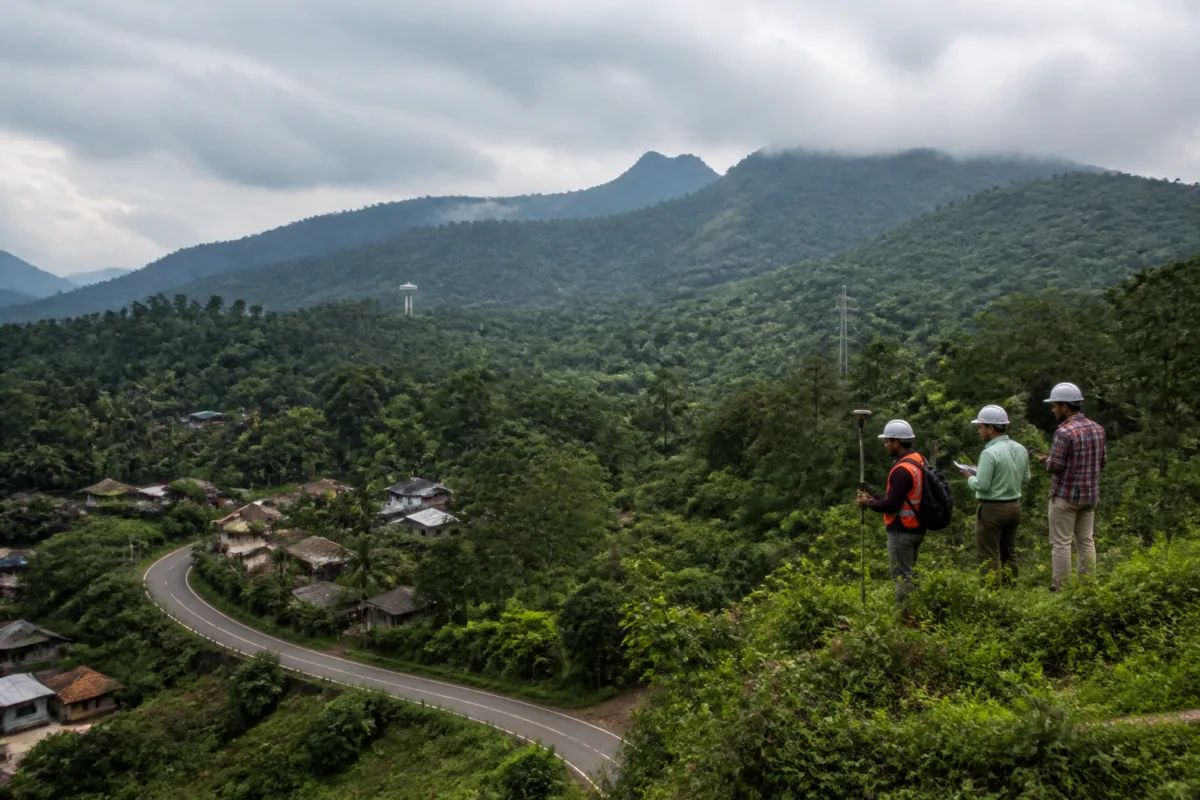
Karnataka’s renewed request to defer the Western Ghats ESA notification has reopened a long-running question in environmental governance: how should a large conservation boundary be finalised when it overlaps with settlements, industrial activity, water infrastructure and proposed energy projects? Chief Minister D.K. Shivakumar has asked the Centre not to finalise the July 27 draft notification for one year, while a state-appointed high-level committee completes field inspections and submits its report.
Shivakumar made the request during a meeting with Union Environment Minister Bhupendra Yadav in New Delhi, according to a report by Prajavani citing PTI. The Chief Minister said the Karnataka government’s committee would submit its findings within a year and asked the Centre to wait until that process was complete. He has also said that a similar request was made to Prime Minister Narendra Modi.
The immediate dispute is not over whether the Western Ghats require protection. The draft notification is intended to designate parts of the mountain range as an Ecologically Sensitive Area, or ESA. The issue is how the boundary is drawn, what local conditions are captured by the notification, and whether projects and economic activities located near or within the proposed area have been assessed through current, site-specific information.
The draft is the seventh notification issued by the Union Environment Ministry for the purpose. It proposes protection for a combined 56,825.7 square kilometres across six states. Karnataka accounts for 20,668 square kilometres of the proposed area, making the state a substantial part of the national conservation exercise. The scale of the proposal means that the final notification will affect more than a single project or district-level administrative decision.
The state government has asked for the notification to be held back until its committee completes field verification over the next year. The Karnataka legislature has rejected the draft in its current form and called for site inspections, according to the report. This places the boundary question at the centre of the process: a map prepared at the policy level must be tested against the physical, economic and administrative realities of the locations it covers.
That demand is important because environmental notifications operate through mapped areas, while the effects of their restrictions are experienced at the level of villages, industrial sites, roads, water infrastructure and forest edges. A broad regional proposal can therefore produce different consequences in different places. The supplied report does not detail the specific restrictions that would apply to each location, but it shows that the state is seeking more time to establish where the proposed ESA intersects with existing activities and planned projects.
One case cited by Shivakumar is the Eco Cane Sugar Energy Limited unit. He told the Centre that the facility does not fall within the proposed ESA and requested that it be excluded from the notified area. The unit was established in 2016 and employs more than 500 people, while approximately 5,000 families depend on it, according to the report.
The demand for an exclusion illustrates the administrative significance of the final boundary. Whether an industrial unit is inside or outside the proposed area is not simply a cartographic detail. It can determine which environmental procedures, permissions or operational constraints become relevant. In this case, the state is presenting the unit through its employment and livelihood linkages, while asking the Centre to reassess its location through the notification process.
The same meeting also covered wildlife-related clearances for the proposed Sharavathi pumped storage project and the Mekedatu balancing reservoir and drinking-water project. These requests bring a second layer of complexity to the ESA debate. The proposed notification concerns ecological sensitivity, while the projects mentioned by the Chief Minister concern energy storage, water management and drinking-water supply. Their progress depends on permissions connected with wildlife and environmental administration.
The report does not establish that the draft ESA notification alone has stopped either project, nor does it provide the projects’ costs, timelines or final approval status. What it does establish is that Karnataka is asking the Centre to process these matters alongside the broader question of how the Western Ghats should be regulated. The state’s position links conservation-related approvals to infrastructure priorities, while the Centre must decide how to assess them within the applicable environmental framework.
This is why the notification is more than a dispute between a state government and the Union environment ministry. It is also a test of how India’s environmental governance system handles overlapping jurisdictions. The Centre issues the draft notification, the state government conducts its own review and makes representations, the legislature expresses a position, and project proponents depend on clearances from specialised authorities. The final outcome will emerge from the interaction of these institutions rather than from a single announcement.
The chronology described in the report shows a process that has not yet reached finality. The July 27 draft is the seventh such notification. Karnataka has formed a high-level committee, requested a one-year deferment, and called for field inspections before the draft is finalised. The Centre has been asked to consult the state before taking further action. These steps indicate that the present stage is one of review and negotiation, not implementation of a final notification.
The available numbers also show why the process carries significance beyond Karnataka. The proposed ESA covers 56,825.7 square kilometres across six states, with Karnataka’s proposed share alone measuring 20,668 square kilometres. The figures establish the geographical breadth of the exercise, but they do not by themselves show how many settlements, households, farms, companies or projects would be affected. That information is not provided in the supplied report, making the proposed field verification particularly relevant to understanding the ground-level impact.
The employment figures cited for the Eco Cane unit provide one local measure of the stakes. More than 500 people work at the facility and around 5,000 families are said to depend on it. The report does not specify whether that dependence is direct, indirect or spread across a wider supply chain. Even with that limitation, the figures show why state authorities are presenting individual facilities as part of a larger livelihood question rather than only as isolated industrial cases.
The Western Ghats ESA debate consequently contains two different forms of uncertainty. The first is geographical: which areas should be included after local inspection and verification? The second is institutional: how will the Centre, Karnataka and the authorities responsible for wildlife and environmental approvals coordinate their decisions? The state’s request for a one-year pause addresses both by seeking more time for evidence and consultation before finalisation.
The larger urban and infrastructure question is how environmental protection is incorporated into regional development decisions before projects become operational or communities face sudden regulatory changes. The projects mentioned in the report are not all urban in location, but their stated purposes—pumped energy storage and drinking-water supply—connect ecological decisions in the Western Ghats to electricity systems and water security beyond the immediate notification area.
At the same time, the report does not resolve the underlying policy disagreement. Karnataka has rejected the draft in its present form and requested field inspections, while the Union process is aimed at protecting ecologically sensitive parts of a mountain range spread across six states. The evidence currently confirms the state’s request, the scale of the proposed area and the institutional steps it wants completed. It does not confirm whether the Centre will grant the one-year deferment, alter the proposed boundary or exclude the Eco Cane unit.
The next important development will therefore be the Centre’s response to Karnataka’s request and the work of the state-appointed high-level committee. Its field inspections and report are intended to provide the basis for the state’s position before the draft notification is finalised. Until those steps are completed, the Western Ghats ESA notification remains a live negotiation between conservation goals, local verification, livelihoods and proposed infrastructure approvals.

