


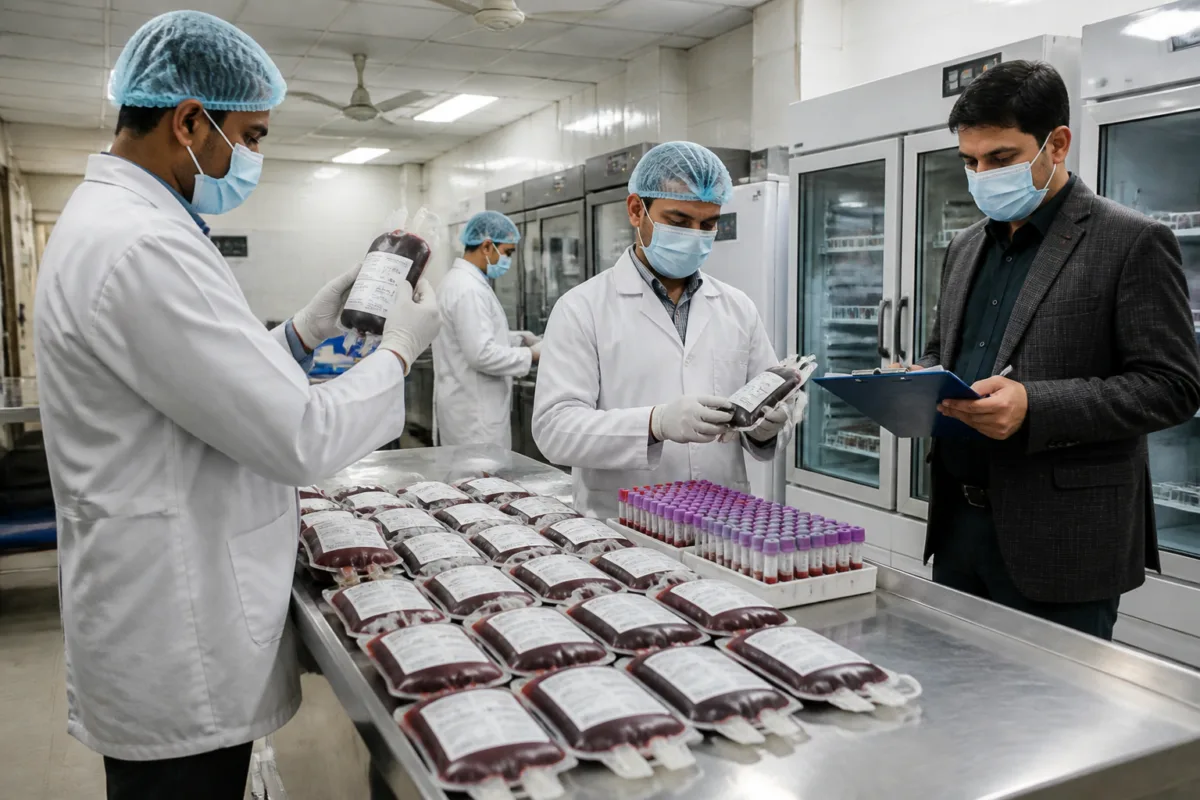
Uttar Pradesh’s proposed blood safety measures address a weakness that is easy to miss in a system built around individual blood-bank compliance: what happens when large consignments of blood move between states and the receiving centre must rely on the supplier’s testing records. The Uttar Pradesh Food Safety and Drug Administration (UPFSDA) has asked the National Blood Transfusion Council (NBTC) to mandate re-testing of blood units at recipient centres, after inspections revealed gaps in testing practices, storage records, staffing, hygiene and documentation.
The proposal is not yet a regulation. It is a request for the national blood-transfusion authority to introduce additional controls for bulk-transferred units. Its significance lies in the problem it identifies: the safety chain does not end when blood leaves the supplying blood bank. It continues through transport, receipt, documentation, storage and eventual transfusion. If any part of that chain cannot be verified, the receiving institution may have difficulty establishing whether the consignment meets prescribed requirements.
Under the UPFSDA proposal, at least 1% of the units in every bulk consignment would be screened again, with a minimum of one unit per consignment, whichever is higher. The proposed testing would take place at a government centre and in the presence of a drug inspector. Officials said the objective is to verify the quality of blood supplied from outside Uttar Pradesh and ensure that blood reaching patients meets the required standards.
The additional testing is particularly important because contaminated blood can transmit infections including Hepatitis B, Hepatitis C and HIV. The proposal does not state that every bulk-transferred unit is unsafe. Instead, it responds to the difficulty of confirming whether suppliers consistently followed prescribed collection and testing procedures when documentation accompanying consignments was incomplete.
That distinction matters for how blood safety is governed. The supplier remains primarily responsible for infection testing under the existing arrangement described by the UPFSDA. A receiving centre therefore depends on the supplier’s test results, transfer records and transport documentation. When those records are missing or inadequate, the receiving centre’s ability to independently assess the consignment is limited. Re-testing a sample at the destination would create an additional verification point rather than transferring the entire burden of quality assurance to the recipient facility.
The proposal followed inspections conducted across 208 blood centres in Uttar Pradesh in March 2026. Authorities reported serious irregularities in several parts of blood-bank operations, including infection-testing practices, records related to temperature-controlled storage, the availability of trained technical staff, hygiene conditions and documentation. Officials also found shortcomings in paperwork linked to large consignments of Packed Red Blood Cells, or PRBC, procured from other states.
The scale of the inspection drive and the subsequent regulatory action indicate that the issue extends beyond a single defective record or isolated facility. The UPFSDA reported that licences of 55 centres were cancelled following the inspections. The supplied report does not specify how many of those cancellations were directly connected to bulk transfers, nor does it provide a centre-by-centre breakdown of the violations. It does, however, establish that the inspections identified weaknesses across multiple operational areas that are essential to maintaining blood quality.
Temperature control is one of those areas. Blood products are not simply transported from one building to another; their movement depends on controlled conditions and traceable records. The proposed checklist would require documentation of temperature logs during transport, along with information on transfer time limits. This places transport records within the same oversight framework as test reports and blood-bag condition, rather than treating movement between centres as an administrative step.
The proposed labelling requirements are similarly aimed at closing gaps in traceability. Each unit would be marked “Bulk Transferred Unit” and would carry the name, address and licence numbers of both the supplier and recipient centres. Such information would allow the unit to be linked to the institutions responsible for collecting, testing, transferring and receiving it. The proposal also calls for at least two pilot tube segments to be supplied with each unit, enabling additional testing material to remain associated with the blood bag.
The requirement for pilot tube segments reflects the practical challenge of testing blood products after transfer. The proposal specifically recommends that at least two segments accompany each unit. The supplied material does not state how the segments would be used in every case or whether the requirement would apply to all blood movements beyond bulk consignments. It does make clear that the UPFSDA sees them as part of a stronger verification system for transferred units.
Another proposed control would require recipient centres to inform the local drug inspector before accepting a bulk transfer. This would create an advance notice mechanism for regulators. Instead of learning about a consignment only through later records or an inspection, the local authority would have an opportunity to know when a shipment is arriving and oversee the receipt process. The UPFSDA has also proposed a standard operating procedure and checklist for every consignment.
The checklist would cover the condition of the blood bag and pilot tubes, test reports, the identity and licensing details of both centres, permitted transfer time limits and temperature records during transport. Together, these requirements would make the movement of blood more document-intensive. That may increase administrative work for blood banks, but it would also create a clearer chain of responsibility between the supplying and receiving institutions.
The institutional question is whether the proposed safeguards can be applied consistently across different states and facilities. UPFSDA has sent the proposal to the NBTC, making the issue a matter for coordination beyond Uttar Pradesh. Bulk transfers involve at least two blood banks, transport conditions and regulatory jurisdictions. A state-level inspection can identify failures within facilities operating in the state, but a common framework would be needed if recipient centres are to verify consignments supplied from outside the state using consistent procedures.
The proposal also highlights the difference between formal compliance and operational assurance. A blood bank may have a test report, a storage record or a licence document, but the receiving institution still needs to establish that the paperwork corresponds to the actual unit or consignment and that conditions were maintained during movement. The UPFSDA’s recommendations focus on linking those records to identifiable units, institutions and transport events.
The available evidence does not establish how often unsafe or improperly tested blood entered the transfusion system, whether any patient was harmed, or how many bulk consignments were affected by the documentation gaps. It also does not state whether the NBTC has accepted, modified or rejected the proposal. Those are important limits. The immediate development is a regulatory request arising from inspections, not the announcement of a final national rule.
What the proposal confirms is that blood safety depends on infrastructure that is both clinical and administrative. Testing laboratories and trained technical staff are essential, but so are temperature-controlled storage, transport logs, accurate labels, functioning inspection systems and records that remain intact as blood crosses institutional and state boundaries. A weakness in any one of these areas can make later verification difficult.
The next stage will depend on the NBTC’s response to the UPFSDA’s recommendations. The proposed re-testing threshold, labelling system, pilot tube requirement, advance notification process and consignment checklist would need to be considered within the national blood-transfusion framework. Until that decision is made, the existing arrangement described by the UPFSDA remains in place, with infection testing primarily assigned to the supplier blood centre. The key issue for regulators is whether that arrangement provides enough visibility when blood is transferred in bulk between states and the destination centre must rely on records created elsewhere.

