


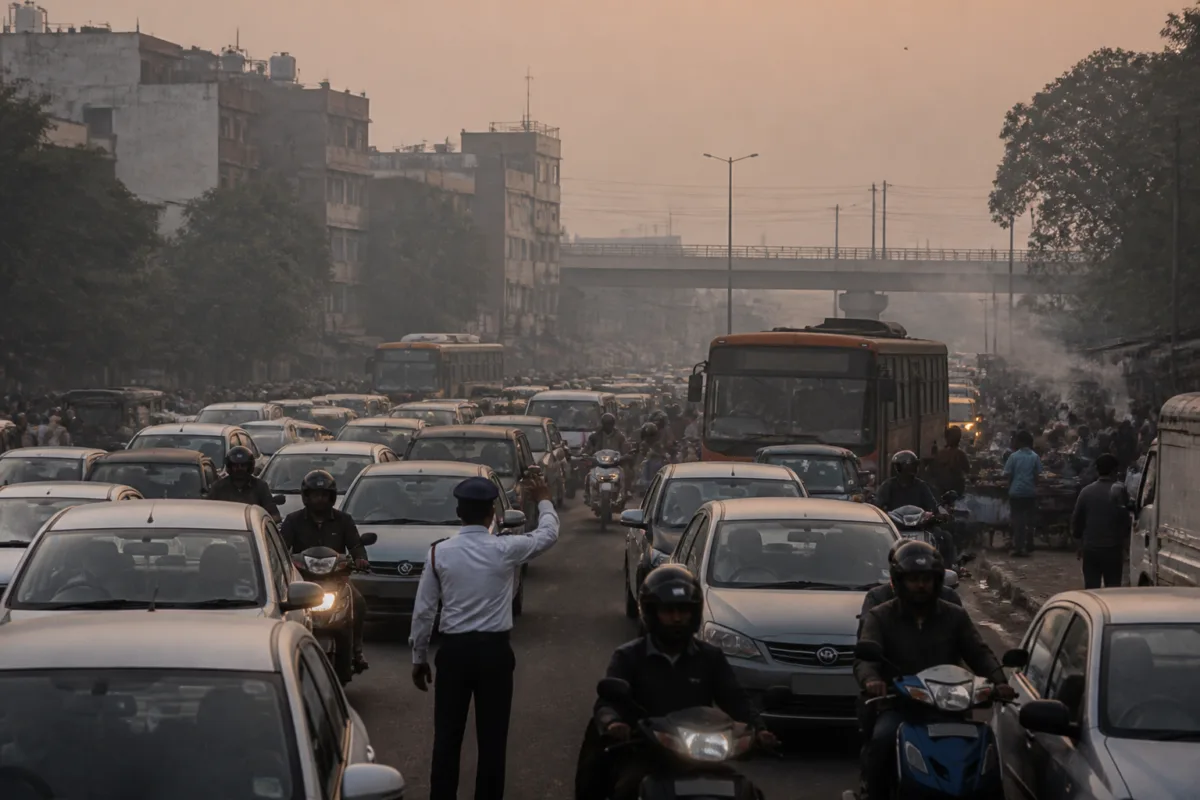
Delhi’s air quality deteriorated from the ‘Moderate’ to the ‘Poor’ category within a day, prompting the Commission for Air Quality Management (CAQM) to impose Stage 1 of the Graded Response Action Plan (GRAP) across Delhi-NCR on October 21. The restrictions target construction activity, open waste burning, fuel use and traffic-related emissions as forecasts indicate that air quality is likely to remain poor over the coming days.
The city’s air quality index (AQI) rose from 179 on October 20 to 244 at 2 pm on October 21, according to the Indian Express report. An AQI between 201 and 300 triggers GRAP Stage 1. The emergency plan has four stages, with progressively stricter measures linked to the level of air pollution.
Under Stage 1, construction and demolition activity is not allowed on plots larger than 500 square metres. Open waste burning is also banned. Roadside eateries and commercial kitchens have been barred from using coal and wood as fuel, while diesel generator sets may be used only in emergency or essential situations.
The measures also require agencies to maintain uninterrupted electricity supply to reduce the need for diesel generators. Traffic personnel are to be deployed at congestion points to improve the movement of vehicles and reduce idling. Authorities are also expected to issue public alerts on pollution levels and health advisories.
Public transport is included in the response plan. Agencies have been directed to augment services by adding compressed natural gas and electric buses and increasing metro frequency. The measures also call for the introduction of differential rates to encourage travel during off-peak hours.
The CAQM’s decision followed forecasts from the India Meteorological Department and the Indian Institute of Tropical Meteorology indicating that Delhi’s AQI was likely to remain in the ‘Poor’ category in the coming days. GRAP Stage 1 is intended as a short-term response to deteriorating air quality, with restrictions focused on activities and operations that can add to local pollution.
The restrictions place construction sites, commercial kitchens, municipal agencies, electricity providers and public transport operators under different implementation responsibilities. Their immediate effect will depend on enforcement of the construction and waste-burning bans, compliance with fuel restrictions, traffic management at congestion points and the availability of additional bus and metro services. The CAQM’s air-quality forecasts and subsequent AQI levels will determine how the response proceeds.

