


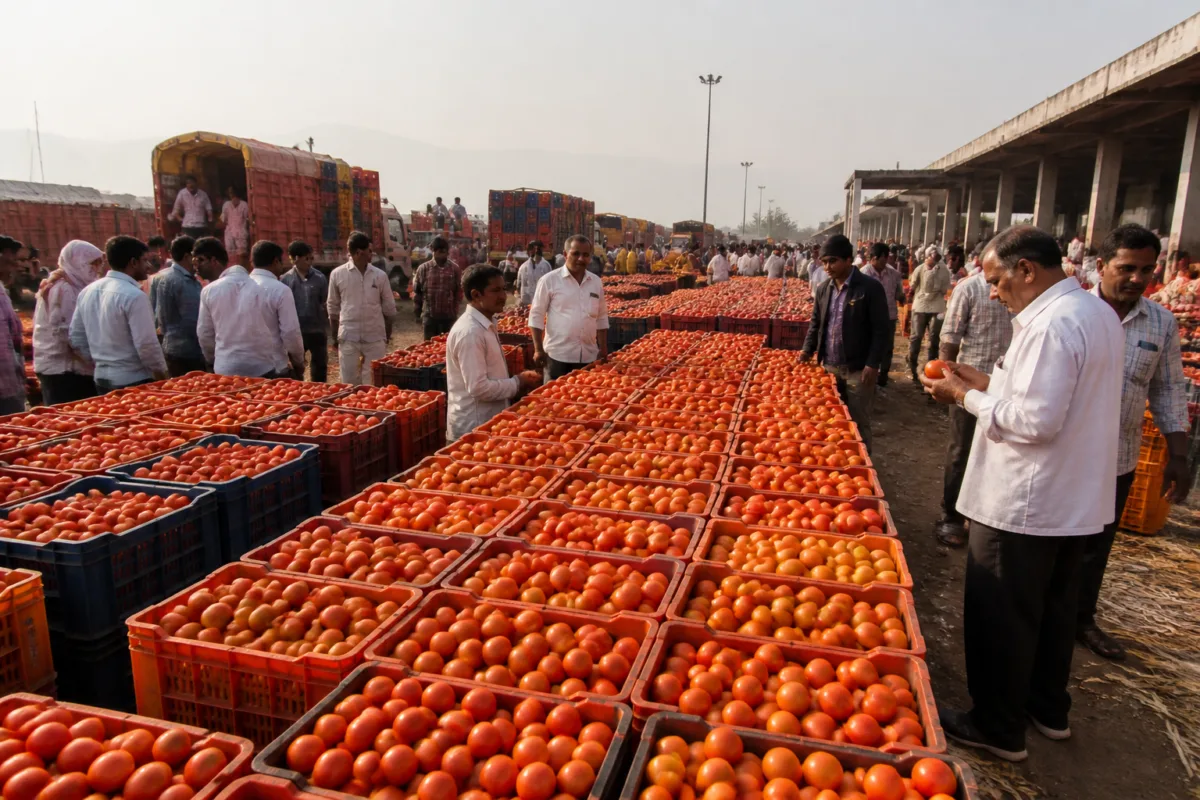
Tomato prices at Pimpalgaon APMC, one of India’s biggest wholesale tomato markets, have fallen nearly 65% in a week to Rs 111 for a 20kg crate, as heavy arrivals, weak demand and faster ripening caused by high temperatures pushed supply far beyond what buyers could absorb. The crash is also being felt in Nashik’s retail market, where tomatoes were selling at about Rs 20 per kg on Monday, down from nearly Rs 40 per kg a week earlier.
The average wholesale rate declined from Rs 321 per 20kg crate on October 12 to Rs 111 on Monday, equivalent to a fall from about Rs 16 per kg to Rs 5.55 per kg. The sharp reduction has increased pressure on growers already dealing with rising cultivation costs and uncertainty over whether their produce will cover harvesting and transport expenses.
An official at the Agricultural Produce Market Committee said daily arrivals had reached between 3 lakh and 3.75 lakh crates during the past week. The official attributed the price collapse to a sudden increase in supply that substantially exceeded demand. On Monday, prices varied from Rs 20 to Rs 331 per crate depending on quality. Poor-quality tomatoes fetched as little as Rs 1 per kg, while premium produce sold for up to Rs 16.55 per kg.
The difference between grades has become significant as farmers bring large quantities to the market at the same time. APMCs generally record prices according to quality, and the Monday range showed how quickly weaker produce can lose value when arrivals are high and buyers have limited room to absorb additional stock.
The supply surge has also been linked to weather conditions. An official overseeing the tomato section at the APMC said high temperatures had accelerated ripening, causing unusually large quantities of tomatoes to reach the market simultaneously. Since tomatoes are perishable, growers and traders have limited time to hold back produce when prices weaken, adding to the pressure during periods of concentrated arrivals.
Retail prices have not fallen at exactly the same pace as wholesale rates. A retailer said wholesale price movements typically take one or two days to appear in the retail market. If the wholesale decline continues, further correction in Nashik’s retail prices is expected in the coming days. For consumers, this could mean cheaper tomatoes, but the lower retail rate does not necessarily translate into improved returns for farmers because the wholesale price has fallen much more sharply.
Demand has offered little support to the market. APMC officials pointed to a slowdown during the Navaratra period, when several wholesale markets remained closed, as well as weaker export demand. The disruption reduced the number of buyers available for the large arrivals reaching Pimpalgaon.
Demand from major consuming states has also weakened. Uttar Pradesh, Bihar and Madhya Pradesh are currently meeting their requirements through local supplies, reducing their dependence on tomatoes transported from Nashik. This has narrowed the market available to Pimpalgaon growers at a time when local arrivals are at unusually high levels.
Traders have warned that prices could fall further if the current combination of high arrivals and weak demand persists. The immediate market indicators to watch are daily crate arrivals, quality-wise price movement, export demand and the reopening or recovery of wholesale channels affected during Navaratra. For farmers, the next few trading sessions will determine whether the present crash is a short-lived supply glut or a prolonged period of depressed returns.

