


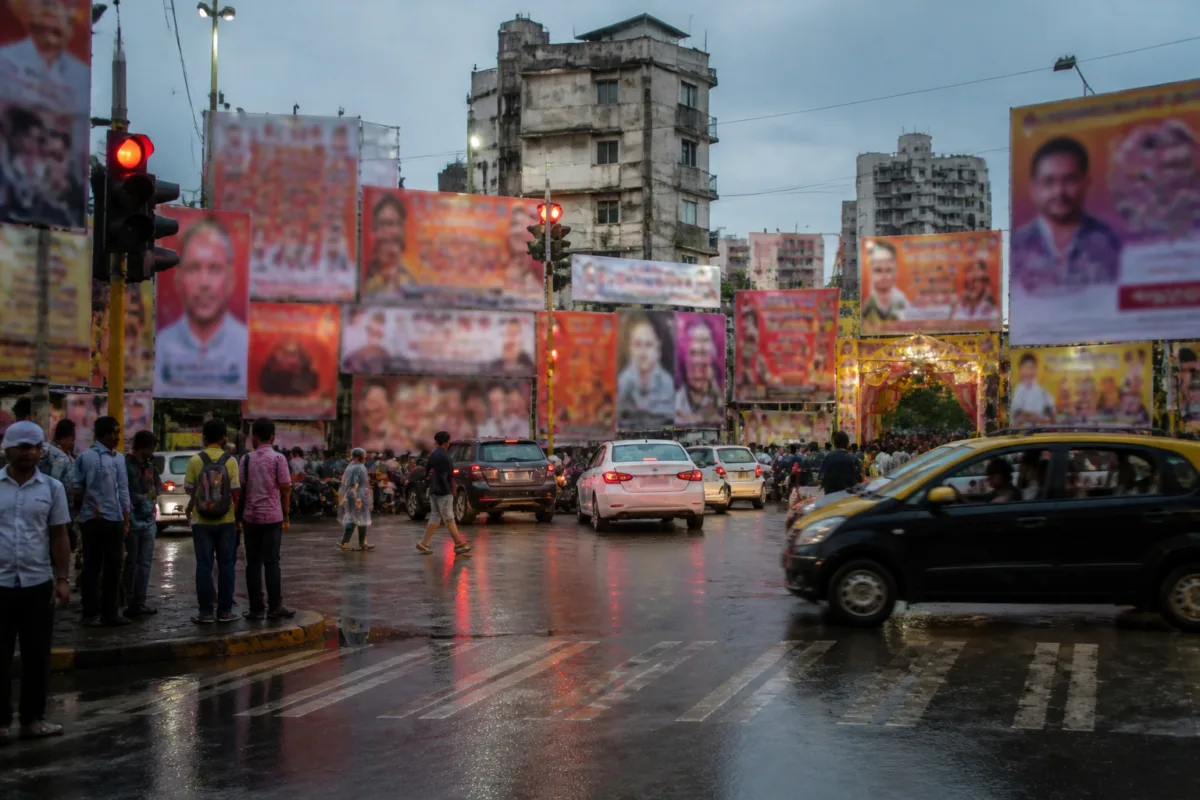
Mumbai’s illegal banners are back in public view despite repeated judicial scrutiny, revealing a civic enforcement problem that extends beyond festive-season advertising. A report by Navbharat Times – Mumbai says political leaders, builders, shopkeepers, companies and Dandiya organisers have covered roads, junctions, electricity poles and other public spaces with banners and posters during Navratri. The report identifies areas from Borivali to Mulund, including Borivali, Kandivali, Chandivali, Ghatkopar and Mulund.
The immediate visual change is familiar: public infrastructure becomes advertising space, political greeting messages compete with commercial promotions, and temporary event publicity occupies places that are meant to serve movement and public access. But the more important question is institutional. If the Bombay High Court has previously directed the Brihanmumbai Municipal Corporation (BMC) and the police to act against unauthorised hoardings, why do such displays continue to appear across multiple parts of the city?
The answer cannot be established fully from the supplied report. It does, however, point to a system in which the responsibility for controlling illegal publicity is distributed across municipal and police authorities, while the incentives to put up banners remain strong for organisers, politicians and businesses. That mismatch between enforcement responsibility and the benefits of unauthorised publicity is central to understanding why court orders alone have not cleared Mumbai’s streets.
The report says the current surge is linked to Navratri and Dandiya events. It describes political strength displays and commercial promotion taking place through such events, involving elected representatives, builders, shopkeepers and companies. Organisers are reported to earn significant amounts from the activity, while the BMC is allegedly not receiving the expected revenue. The report does not provide figures for organiser income, municipal dues, the number of banners or the value of unpaid fees. Those gaps matter because the difference between permitted advertising and illegal display is ultimately a question of records, permissions, payments and enforcement.
Public space is the most visible point of failure. Banners have reportedly appeared on roads, traffic junctions, electricity poles and other public locations. Such locations are not neutral surfaces. A banner placed near a road can affect visibility, obstruct a traffic sign or distract drivers. The report says the proliferation creates a risk that traffic indicators may become less visible and that motorists may face difficulty. It does not document a specific crash or traffic incident linked to the banners, so the safety concern should be understood as an identified risk rather than an established accident finding.
The geography described by the report is also significant. The locations stretch from the western suburb of Borivali to the eastern suburb of Mulund, with Kandivali, Chandivali and Ghatkopar also mentioned. This is not presented as an isolated display outside one venue. The reported spread across different suburban areas suggests that the problem is being experienced at the scale of the municipal city, even though the report does not provide a ward-wise count or identify which authority approved or removed individual displays.
That distinction is important for governance. A city-wide enforcement problem cannot be solved only by removing banners after complaints. It requires a functioning chain of action: identifying the responsible organiser or advertiser, checking whether permission was granted, determining whether fees were paid, removing unauthorised material and imposing consequences that are strong enough to discourage repetition. The supplied report does not establish how often each of these steps is being carried out. It does show that residents can see the output of weak enforcement even when the administrative process remains largely invisible.
The Bombay High Court’s earlier intervention adds an institutional layer to the story. According to Navbharat Times – Mumbai, the court criticised the BMC and police administration in December 2024 for failing to take concrete measures against illegal hoardings despite clear directions. The current report says that, during Navratri, unauthorised banners and posters were again visible across Mumbai. This creates a gap between judicial direction and street-level implementation: the order may be clear, but compliance depends on routine action by agencies that control public spaces and regulate public gatherings.
A court order cannot itself monitor every junction, pole or event venue. Implementation therefore depends on administrative systems that convert a legal direction into inspections, permissions, removal notices, penalties and follow-up. Where banners are installed temporarily for festivals, enforcement also has to operate quickly. By the time a complaint is processed, an event may have ended or the publicity may have achieved its purpose. The report offers no evidence on response times, removal rates or penalties imposed, but the continued visibility of banners raises questions about whether the enforcement cycle is fast and consistent enough.
The issue also exposes an unclear relationship between celebration, political communication and commercial advertising. The report refers to political parties, religious groups, social organisations and business establishments as participants in the publicity activity. These groups may have different legal positions and different relationships with local authorities, yet their material can occupy the same public locations. Without transparent permission records, citizens cannot easily distinguish between an authorised display and an illegal one, or know who is responsible for removing it.
The revenue question is equally important. The report says organisers benefit financially from Dandiya-related publicity while the BMC does not receive the expected revenue. If accurate, this would mean that public space is being monetised without a corresponding public return. The supplied material does not state the applicable fee structure, the permissions required, the amount allegedly lost or whether any formal assessment has been made. Those facts would be necessary to measure the financial impact. Even without them, the reported mismatch highlights a basic municipal concern: advertising activity in public places should be visible in official records and linked to enforceable payment and safety conditions.
Mumbai’s banner problem therefore has three connected dimensions. The first is visual and environmental: public places become cluttered and the city’s appearance is altered. The second is operational: banners may interfere with the visibility of traffic signs and create difficulties for road users. The third is administrative: public agencies appear unable, or insufficiently equipped, to ensure that court directions and municipal rules are followed consistently. Treating the matter only as a question of beautification would miss the deeper problem of accountability.
The report does not establish whether every banner mentioned was illegal, who installed particular displays or which departments failed to act in each location. It also does not provide a response from the BMC, Mumbai Police, organisers, political representatives or builders named in the broader description. Those limitations prevent a definitive assessment of enforcement performance in individual cases. They also underline why permission registers, removal records and official responses are essential to any fuller investigation.
What the available evidence does establish is narrower but still significant: Navratri-related publicity has coincided with widespread banners and posters across several Mumbai neighbourhoods; the report links the displays to political, religious, social and commercial actors; and the recurrence follows earlier Bombay High Court criticism of the civic and police response to illegal hoardings. The next administrative test is whether the BMC and police can identify the responsible parties, remove unauthorised material, protect traffic visibility and clarify the revenue and permission trail behind public-space advertising. Until those actions become routine and measurable, the city’s repeated banner cycles will continue to signal a gap between regulation on paper and governance on the ground.

