


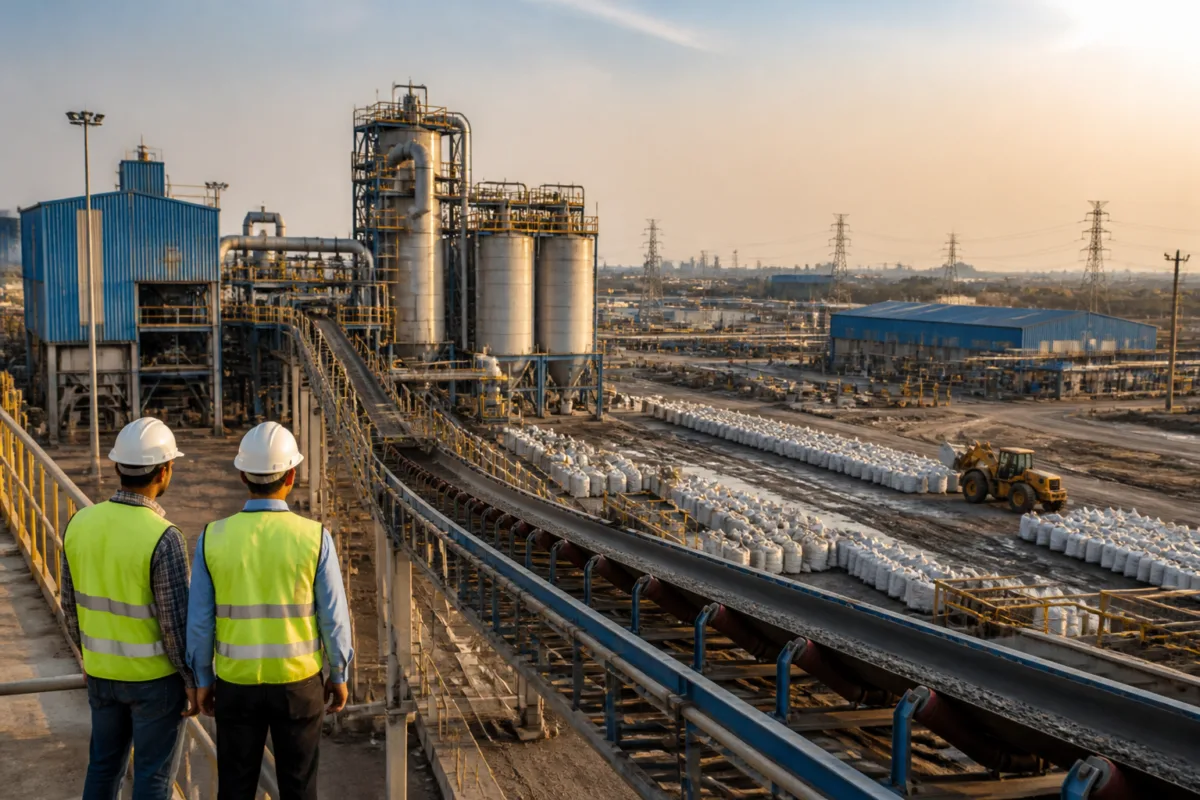
India’s critical minerals problem is not limited to what lies beneath its soil. The more consequential weakness is the missing industrial bridge between geological resources and the refined, high-purity materials needed by electric vehicles, renewable-energy equipment, semiconductors, appliances and other manufacturing sectors.
That vulnerability became visible in April 2025, when China tightened exports of certain rare-earth products. Indian automakers, component manufacturers, home-appliance makers and clean-energy industries faced disruption as supplies of rare-earth magnets came under pressure. Assembly lines were forced to wait for components, exposing how a restriction imposed outside India can interrupt production inside the country.
The episode was significant because it showed that mineral security is not only a mining question. It is also a question of refining, processing, industrial coordination and product manufacturing. India may have critical minerals in the ground, but that does not automatically give Indian companies access to the materials required by advanced industries.
The gap is commonly described as the missing “midstream” of the mineral supply chain. Upstream activity involves identifying and extracting ore. Downstream activity involves converting refined material into products such as permanent magnets, batteries, components or other industrial goods. The midstream sits between those two stages: processing raw ore and refining it into consistent, high-purity material suitable for manufacturing.
This distinction matters because a country can possess mineral deposits and still remain dependent on imports. Without commercial extraction, processing capacity and refining facilities, domestic resources do not translate into supply security. The result is a supply chain that begins in India’s geology but ends in another country’s industrial system.
## The supply-chain weakness behind the headline
The Economic Times report cites International Energy Agency data showing that China accounted for 94% of global permanent-magnet production in 2024. Permanent magnets are essential to several industrial applications, including components used in automobiles and clean-energy technologies. The April 2025 disruption demonstrated the practical effect of that concentration: when exports are tightened, manufacturers elsewhere can face shortages even if their own economies possess some of the relevant raw materials.
India’s domestic permanent-magnet production capacity remains limited, according to the report, while imports meet much of current demand. The significance of this dependence extends beyond the price of an individual component. When a specialised input is unavailable, the impact can move through an entire production chain, affecting assembly schedules, inventory planning and the ability of manufacturers to fulfil orders.
The same logic applies to other critical minerals. Lithium and cobalt are identified in the report as examples of imported minerals that affect Indian manufacturing. The issue is not simply whether India can obtain these materials on international markets. It is whether the country can establish enough control over the stages that make them usable for domestic industry.
That control is difficult to achieve through mining alone. Ore must be extracted at commercial scale, processed reliably and refined to the purity required by specific industrial applications. The material must then reach manufacturers through a stable supply network. Each stage requires technical capability, investment, quality control and an industrial ecosystem capable of converting refined inputs into products.
The supplied report does not establish the precise capacity of India’s planned or existing refining facilities, nor does it provide a detailed timeline for closing the gap. That limitation is important. The evidence clearly establishes the vulnerability and identifies the midstream as the central weakness, but it does not show that the problem has already been solved or quantify the scale of capacity required.
## Why resources alone do not create resilience
Mining policy often begins with the question of resource availability: which minerals exist, where they are located and whether they can be extracted. For manufacturing resilience, however, the more difficult questions begin after extraction. Can the ore be processed economically? Can refineries deliver consistent quality? Can companies manufacture products at sufficient scale? Can domestic users rely on those products when international trade is disrupted?
These are industrial-system questions rather than purely geological ones. They connect mining with chemicals, engineering, energy, logistics, manufacturing and research. A failure at any one stage can preserve import dependence even when other stages are developed.
This is why the distinction between raw material ownership and supply-chain control is central to India’s critical minerals story. A deposit may have strategic value, but that value remains unrealised if extraction is commercially unviable or if the refined output must still be imported. Similarly, a refinery may reduce dependence on raw-material imports without creating domestic capacity to produce the magnets, batteries or components that manufacturers need.
The rare-earth episode also illustrates the importance of concentration. The IEA figure cited by the report places China’s share of global permanent-magnet production at 94% in 2024. Such concentration makes the downstream market vulnerable to policy changes, export controls and disruptions in a single dominant production base. For Indian manufacturers, the risk is not confined to direct imports from China. A globally concentrated supply chain can affect prices and availability across multiple markets.
The impact is particularly relevant to sectors that India is seeking to expand. Electric vehicles require specialised materials and components. Renewable-energy systems depend on industrial equipment that can include permanent magnets and other critical inputs. Semiconductor ambitions require reliable access to high-quality materials and complex manufacturing inputs. The report links these ambitions to the unresolved midstream gap, suggesting that expansion in end-use industries will remain exposed until processing and refining capacity improves.
## The institutional challenge is bigger than mining
The report quotes Pradeep Singh, Additional Director General, Policy Support System, Geological Survey of India, in connection with India’s mineral resources and the processing challenge. The involvement of the Geological Survey of India points to the role of public geological knowledge in identifying and assessing resources. But mapping or identifying deposits is only one part of the chain.
The institutional challenge begins when geological information must be converted into commercial projects. That requires coordination between exploration, mining approvals, processing technology, industrial finance, environmental compliance, infrastructure and end-user manufacturing. The report says efforts to enhance mineral processing and create integrated production facilities are under way, but the supplied material does not detail the schemes, companies, funding structures or implementation milestones involved.
That missing detail matters because integrated facilities are intended to address more than one isolated bottleneck. If mining, refining and product manufacturing are developed separately, the country may continue to depend on imports at the points where the chain remains weakest. An integrated approach can, in principle, connect domestic resources to domestic industrial demand. But the effectiveness of that approach depends on execution, commercial viability and the ability to maintain consistent output.
The policy question is therefore not simply whether India should mine more. It is whether policy can create a complete and competitive value chain. This includes the less visible industrial capabilities that determine whether raw material becomes a usable input: separation, purification, refining, component production and quality assurance.
The source material does not provide enough evidence to judge whether current efforts are moving at the required speed. It does, however, establish that the existing system remains exposed. Until domestic capacity expands across the midstream and downstream stages, manufacturers will continue to face risks that cannot be eliminated by resource ownership alone.
## The urban and industrial dimension
Critical minerals are often discussed as a national-security or trade issue, but the consequences are also urban and infrastructural. Manufacturing clusters, logistics networks, energy systems and employment centres depend on reliable industrial inputs. If a shortage interrupts production, the effect can travel through supplier networks and affect the functioning of industrial regions.
Electric vehicles and renewable-energy equipment also sit within the wider transformation of cities. Transport electrification depends on vehicles, components and charging-related equipment. Energy transition projects depend on machinery and materials that must be available at predictable cost and quality. When these inputs are exposed to external supply decisions, the pace and cost of urban transition can also be affected.
That does not mean every disruption will immediately stop urban projects or consumer manufacturing. The evidence supplied does not support such a conclusion. It does show, however, that dependence is embedded in the systems supporting India’s industrial and clean-energy ambitions. The vulnerability becomes visible when a dominant foreign producer changes export policy and domestic manufacturers discover that substitutes are not readily available.
The deeper question is whether India’s industrial strategy can move from announcing resource potential to building operational capacity. The answer will depend less on the size of mineral deposits than on the country’s ability to establish reliable midstream facilities and connect them to product manufacturing.
India’s critical minerals challenge is therefore an unfinished production story. The country has resources, but the supplied evidence shows that resources alone have not yet created resilience. The April 2025 rare-earth disruption exposed the cost of that gap, while the IEA’s 94% figure underlined the scale of global concentration. The next developments to watch are the actual capacity, timelines and integration of India’s processing, refining and manufacturing efforts. Until those are demonstrated, electric vehicles, renewable-energy equipment and other strategic industries will remain vulnerable to supply chains controlled elsewhere.

