


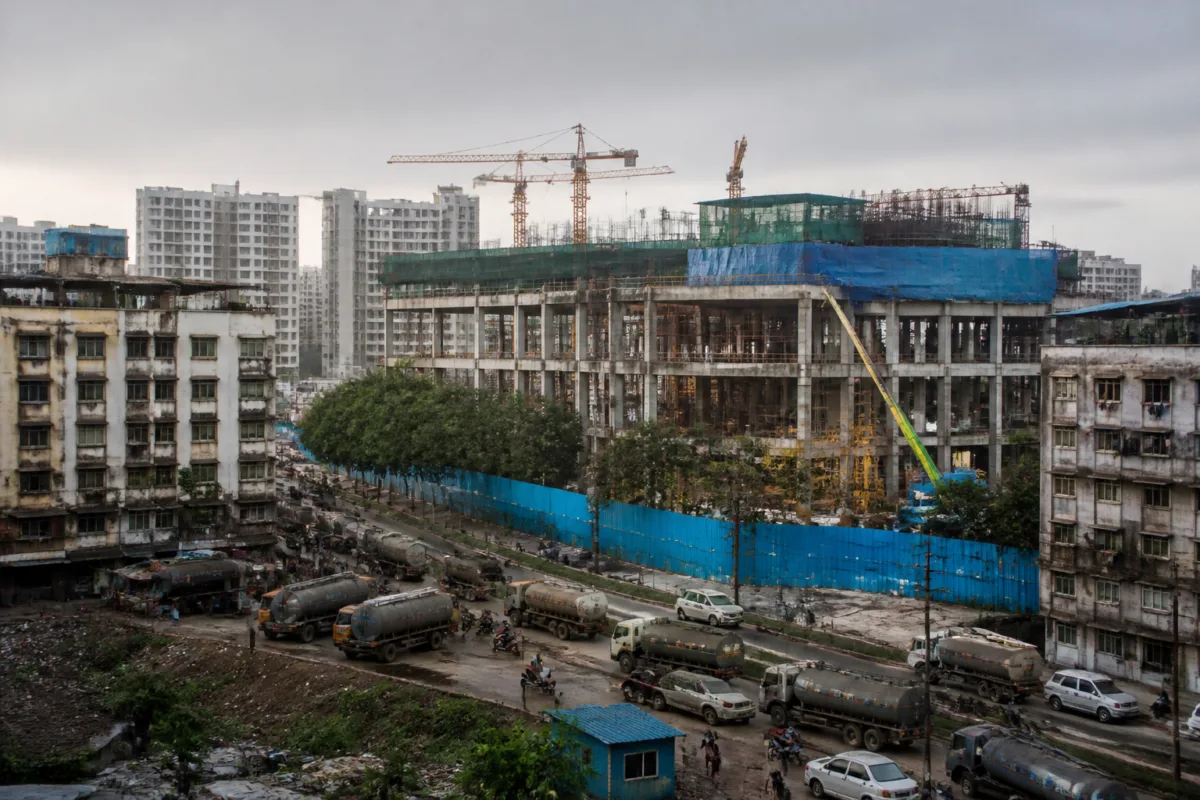
The renewed opposition to the proposed Thane data centre at Balkum is no longer framed only as a dispute over a single construction site. Activists are asking whether a large hyperscale facility should proceed in a densely populated urban area while parts of Thane and its suburbs continue to depend heavily on private tankers, and while a state-appointed committee is reviewing safeguards for Maharashtra’s data centre policy.
Dayanand Nene of the citizen initiative WakeUp Thanekar has written to Chief Minister Devendra Fadnavis seeking an immediate suspension of construction until the state’s water crisis eases and the committee headed by nuclear scientist Dr Anil Kakodkar submits its report. The demand places a specific project inside a broader policy question: whether the civic and environmental requirements of data centres are being assessed before urban land and public resources are committed to them.
The available report does not establish the Balkum facility’s proposed capacity, its projected water demand, the source of its water, or the precise status of approvals and construction. Those details are important because the urban impact of a data centre depends not only on its built-up area, but also on the design of its cooling systems, backup power arrangements, electricity demand, fire-safety systems, access roads and operating requirements. Without that information, the public debate remains strong on principle but incomplete on measurable project-level impacts.
What is clear is that water has become the central point of contention. Nene has argued that data centres require substantial quantities of water for cooling and operations, while several parts of Thane and nearby suburbs rely heavily on private tankers for daily needs. His objection is not presented as opposition to technology or investment. Instead, he has asked the government to consider whether industrial requirements should receive priority when residents face uncertainty over basic water access.
That question exposes a difficult feature of urban infrastructure planning. Data centres are commonly treated as strategic digital infrastructure because they support online services, enterprise operations and technology-dependent economic activity. Yet they also function as physical facilities, occupying land and drawing on urban systems. Their policy treatment therefore cannot be limited to investment value or the number of jobs associated with construction. Local authorities must also account for the infrastructure that makes them operational: reliable power, water, cooling, fire protection, waste management, road access and emergency response.
The state’s decision to constitute a special committee under Dr Anil Kakodkar indicates that these questions are already being considered at the policy level. According to the report, the committee has been tasked with reviewing Maharashtra’s data centre policy and recommending safeguards and standard operating procedures. Nene’s request is that projects with significant environmental and civic implications should wait for those findings before moving further.
The institutional issue is therefore as important as the protest itself. If a policy review is underway, the government will have to clarify how existing and proposed projects are to be treated during the review period. It will also need to distinguish between general safeguards and site-specific conditions. A statewide operating procedure may set minimum requirements, but it may not resolve whether a particular urban location has sufficient water infrastructure, road capacity, electrical resilience or emergency access.
The Balkum debate also illustrates why data centre approvals cannot be evaluated through a single department. Water availability is a municipal and regional infrastructure concern. Power supply and backup generation involve energy systems and pollution controls. Fire safety requires technical review and emergency planning. Traffic effects depend on the site’s access roads and the movement of construction and maintenance vehicles. Heat generation, noise and diesel-generator emissions add further questions about how a large facility would coexist with surrounding residential areas.
Nene has specifically raised noise pollution, diesel-generator emissions, fire safety, heat generation and traffic disruption as potential concerns. These are claims and concerns voiced by the project’s opponents, not findings established in the supplied report. Their significance lies in the breadth of the issues being raised. The controversy is not limited to whether the project consumes water; it is about whether the cumulative effect of its operations has been assessed in relation to an already stressed urban ecosystem.
The response from Manoj Pradhan, district president of the NCP (Sharadchandra Pawar), adds a neighbourhood dimension to the policy dispute. Pradhan has put up protest posters around the proposed facility and said residents need to know why it is being built in a densely populated urban area. He has also warned that sustained noise could affect residents’ well-being, while stressing that his position is not against development or the data centre itself.
That distinction matters. The opposition described in the report is not a rejection of digital infrastructure in general. It is a demand for location-sensitive development. A facility may be economically valuable and technologically important while still being poorly matched to the civic conditions of a particular neighbourhood. The relevant question is not simply whether Thane should host a data centre, but whether the project’s design and safeguards are adequate for Balkum and whether residents have received enough information to evaluate those safeguards.
The report offers no independent assessment of the facility’s water consumption, no statement from the developer, no response from the Thane civic administration and no position from the state government on the activists’ demand. It also does not specify whether construction has reached a stage at which a suspension would affect contracts, approvals or implementation milestones. These gaps prevent a final assessment of the project’s actual environmental burden, but they also identify the information that public authorities should make available if the dispute is to move beyond competing assertions.
The water question is particularly important because tanker dependence changes the meaning of infrastructure expansion. Where households already rely on privately supplied water, a new high-consumption industrial or technology facility can become a symbol of unequal access even before its actual demand is demonstrated. Perception alone should not replace technical evidence, but it is a governance signal: residents are measuring new development against the reliability of the services they receive every day.
The Kakodkar committee’s recommendations could provide an opportunity to establish a more transparent framework. The report says the committee is expected to recommend safeguards and standard operating procedures, but it does not detail the proposed review criteria or timeline. The eventual policy will need to clarify how water security, energy use, emissions, noise, fire risk, heat and traffic are to be assessed, and which authority will monitor compliance after a facility begins operations.
For Thane, the immediate issue is whether the Balkum project proceeds before those policy questions are resolved. For Maharashtra, the larger issue is whether data centre expansion will be governed primarily as an investment opportunity or as a form of urban infrastructure with measurable demands on public systems. The answer will shape how future projects are assessed across dense metropolitan areas.
The evidence currently confirms a renewed, attributable demand for a pause and a live state-level review of data centre safeguards. It does not yet confirm the facility’s actual water requirements, the adequacy of its approvals or the government’s response to the requested halt. Those facts, along with the Kakodkar committee’s eventual recommendations, will determine whether the Balkum controversy produces a project-specific compromise or a clearer framework for locating and regulating data centres in Maharashtra.

