


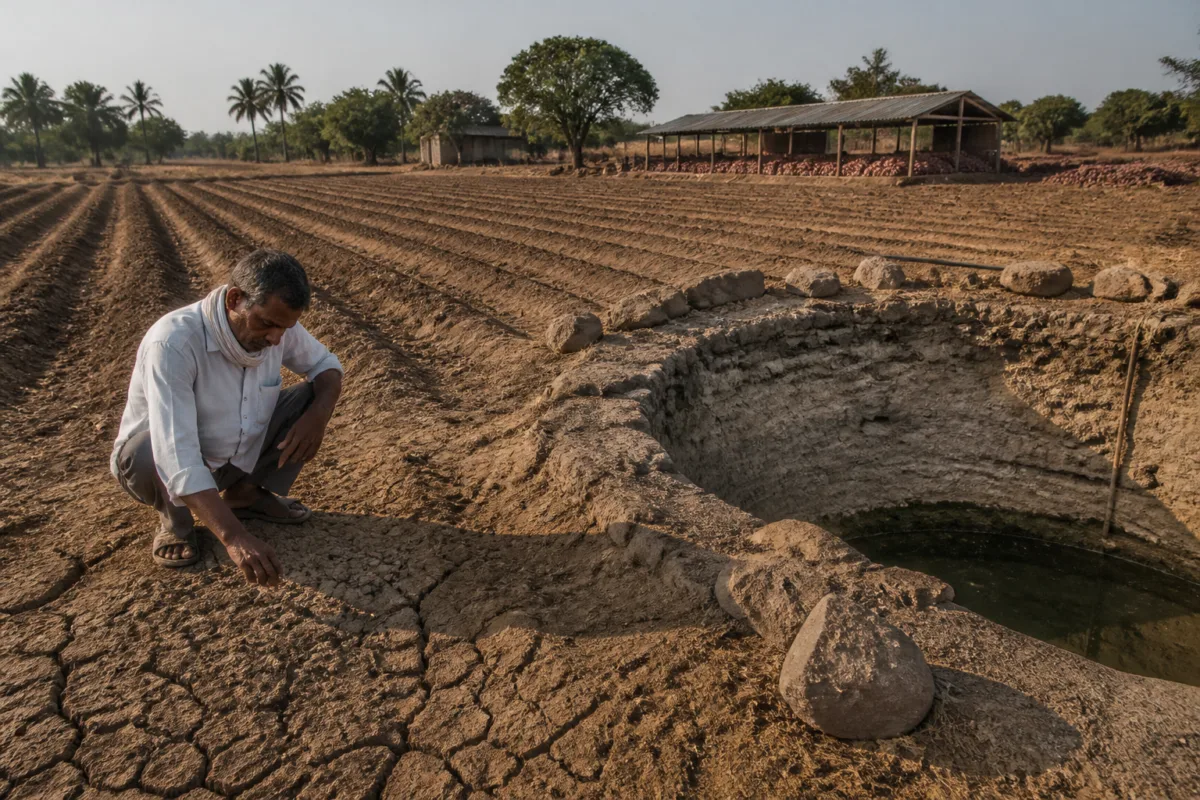
A worsening water crisis in the onion-growing belt around Takali Haji in Pune district is forcing farmers to reconsider the crop that has long supported their incomes, exposing how rainfall uncertainty and water-allocation priorities can reshape a local agricultural economy before a season has even begun.
The Sakal – Pune report, published on October 17, says the Bet area around Takali Haji in Shirur taluka is facing severe water scarcity after inadequate rainfall left the soil without sufficient moisture. Wells have reportedly reached their lowest levels, and farmers have begun turning away from preparing onion seedlings. The result could be a substantial reduction in the area planted under onions this season.
The immediate concern is agricultural. The wider issue is how a water-stressed region manages competing demands from drinking water, irrigated crops, orchards, agricultural labour and the storage infrastructure built around a crop economy. In Takali Haji and neighbouring villages, the availability of water is not only determining whether a field can be cultivated. It is influencing whether the local onion economy can continue to function at its established scale.
How the onion farming crisis is unfolding
Takali Haji is described in the report as an onion-producing centre. Onion cultivation extends across Takali Haji, Jambut, Pimpalkhed, Wadner, Phakte, Chandoh, Nimgaon Dude, Mhase and Dongargan, as well as areas along the Ghod and Kukadi rivers. Thousands of onion storage sheds have been built across this belt, reflecting the crop’s importance to household incomes and the local agricultural supply chain.
The seasonal production cycle normally begins after the Ganesh festival, when farmers start preparing onion seedlings. Planting gathers pace around the Dussehra-Diwali period, and the work creates substantial demand for farm labour. This year, however, the report says farmers have begun stepping back before the seedling stage because the soil does not contain enough moisture for planting.
That timing is significant. A crop reduction is not occurring only because plants have failed after being sown. Farmers are making a decision before cultivation begins, based on their assessment of available water. Land has already been prepared by several farmers after the soybean and millet harvests, but the absence of irrigation water has left them asking whether planting onions is feasible at all.
The decision not to raise seedlings therefore becomes an early indicator of agricultural stress. It shows how farmers absorb water risk through changes in crop planning. It also means that the effects can spread beyond fields: seasonal labour demand, seedling production, transport, storage and trading activity may all be affected if the planted area contracts significantly.
Water priority is shaping the crop economy
The report identifies a central institutional tension. Although dams in the Kukadi project are said to be filled, the government has stated that drinking water will receive priority over agricultural water. Farmers are consequently uncertain about how much water will reach rivers and canals for cultivation.
This distinction between water stored in a project and water available to a farm is essential. Reservoir storage does not automatically translate into reliable irrigation for every village or crop. The final outcome depends on allocation priorities, releases, canal flows and access to groundwater. In the Takali Haji area, the uncertainty over river and canal supplies is being compounded by falling well levels.
The result is a layered water crisis. Surface-water availability is uncertain from the farmers’ perspective, while groundwater is already under pressure. Even farmers who have access to wells are being forced to decide how to use limited supplies. According to the report, many are concentrating available water on saving pomegranate and other fruit orchards rather than committing it to a new onion crop.
That choice reflects the different water risks carried by different forms of cultivation. Existing orchards represent an established investment that farmers are trying to protect. Onion cultivation, by contrast, requires enough moisture at the time of planting and throughout the production cycle. When water is scarce, farmers may prioritise preventing the loss of standing orchards over expanding seasonal cultivation.
The supplied report does not provide reservoir-release figures, groundwater measurements, rainfall totals or crop-area estimates. Those gaps prevent a precise assessment of the scale of the shortage. But the reported change in farmer behaviour is itself important: the water question is being decided at the level of crop selection, before official production data can show the full impact.
Why local storage infrastructure matters
The presence of thousands of onion storage sheds indicates that the region’s onion economy is not limited to primary cultivation. Storage allows farmers and traders to hold produce beyond the harvest period and connects farm output to a longer marketing cycle. A decline in cultivation can therefore affect the utilisation of this infrastructure as well as the movement of produce through local markets.
The report does not establish how many storage sheds are currently operational, how much produce they can hold or how a smaller crop would affect prices. It does, however, show that onion production has become embedded in the physical and economic landscape of the area. When water scarcity threatens the crop, it also raises questions about the future use of the sheds, the demand for agricultural labour and the viability of linked local services.
The labour dimension is especially relevant. Onion planting normally generates significant demand for workers during the Dussehra-Diwali period. If farmers reduce planting, that demand may fall. The report does not quantify the number of workers involved or establish whether alternative employment is available. Even so, the seasonal connection between water availability and labour demand is clear from the account.
This is how a water problem moves through a local economy. It begins with rainfall and soil moisture, reaches wells and canals, changes decisions about seedlings and planting, and then affects labour and storage. The chain is agricultural in origin but economic in its consequences.
The governance question behind the shortage
The official priority for drinking water places the Takali Haji situation within a broader governance challenge: how should limited water be allocated when domestic needs and agricultural livelihoods are both dependent on the same system?
The report does not describe a new water-allocation order, provide details of the government’s release schedule or identify which agency will decide the quantity reaching the affected villages. That institutional information remains important. Without it, farmers are left responding to uncertainty rather than to a clearly communicated irrigation plan.
The Kukadi project’s role also needs to be understood through the distinction between regional infrastructure and last-mile access. Dams and canals are large public systems, but their value to a particular farming belt depends on operational decisions and distribution. A project may contain water while a village’s wells decline and its fields remain too dry for planting. This gap between system-level storage and field-level reliability is at the heart of the current concern.
The report also demonstrates why water planning cannot be separated from land-use and livelihood planning. The area has invested in onion cultivation, storage sheds and orchard farming over time. If water availability becomes less predictable, farmers may alter cropping patterns, but such changes carry economic costs and may not be easily reversed. A crop that disappears from a region can take with it specialised labour, trading relationships and supporting infrastructure.
What the evidence confirms — and what remains unknown
The available evidence confirms four immediate developments. Rainfall has reportedly been inadequate; soil moisture is insufficient; wells have reached low levels; and farmers are reducing or abandoning onion-seedling preparation. It also confirms that farmers are trying to protect pomegranate and other orchards with the water they can access.
The report further identifies the geography of the affected onion belt and explains its dependence on the Ghod and Kukadi river areas. It connects the crop to thousands of storage sheds and to seasonal labour demand. These details make clear that the issue is not simply a poor harvest forecast. It is a possible disruption to a settlement-level production system.
What remains unestablished is the exact area likely to shift away from onions, the volume of water currently available in wells and canals, the rainfall deficit, the expected impact on onion prices, and the government’s operational plan for irrigation releases. The report also does not state whether farmers are being offered alternative crops, financial support or emergency water measures.
Those questions should guide the next stage of reporting. The most important developments to monitor are the actual area planted under onions, the status of canal and river releases, groundwater levels, the condition of fruit orchards and the effect on seasonal farm labour. These indicators will show whether the present crisis is a temporary planting disruption or a deeper change in the region’s agricultural economy.
Takali Haji’s onion crisis illustrates how water stress becomes visible before official production figures arrive. It appears first in the decision not to prepare seedlings, in the choice to save orchards and in uncertainty over whether prepared fields can be planted. The immediate story is about onions, but the larger question is whether existing water infrastructure and allocation systems can provide enough reliability for the livelihoods and local economic networks that have grown around them.

