


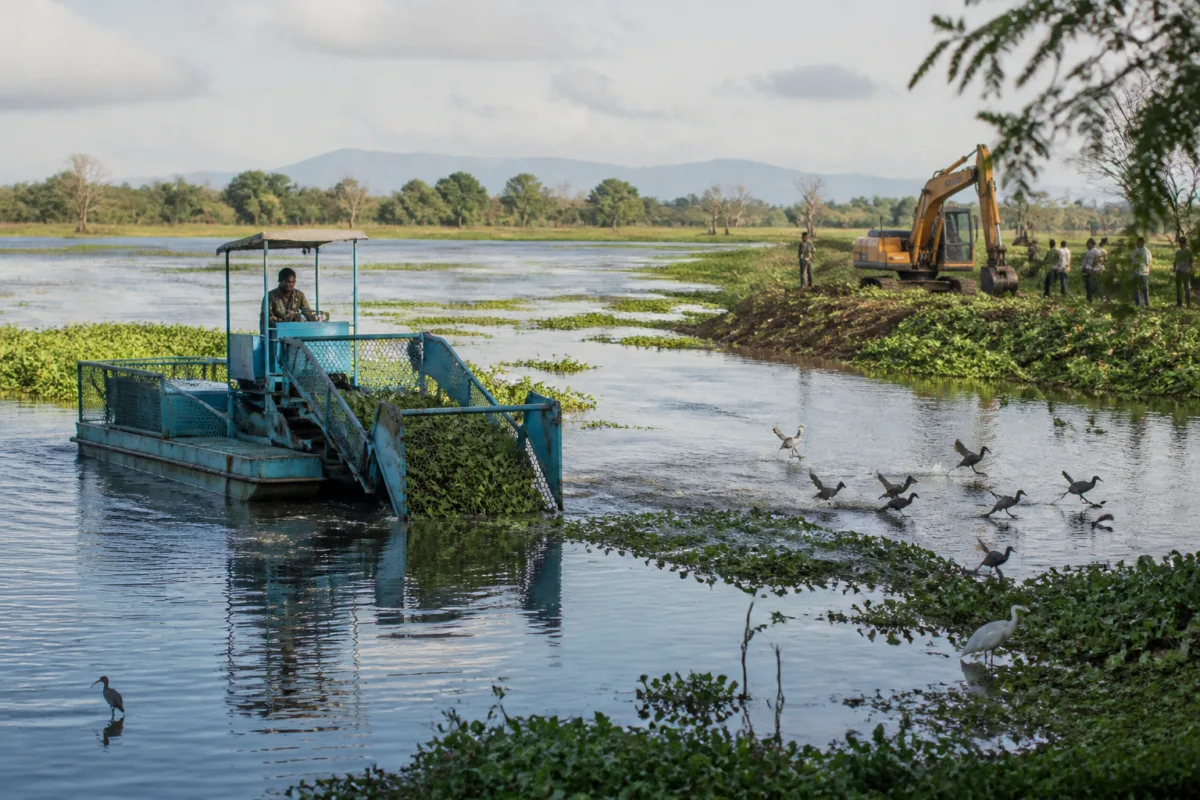
Around 85% of the invasive water hyacinth choking Nanjarayan Bird Sanctuary lake in Tirupur district has been removed during an ongoing 98-day restoration operation, allowing open-water areas to expand and birds to begin returning to the wetland.
The progress was reviewed during a joint site inspection by D Venkatesh, chief conservator of forests and field director of Anamalai Tiger Reserve; Rajesh Boje, district forest officer, Tirupur division and deputy director, Anamalai Tiger Reserve; and Tirupur collector Dr Manish Narnaware. The sanctuary is the district’s only notified bird sanctuary.
The operation is being led by the forest department with funding support from VETRY Trust, an environment organisation. VETRY Trust president T R Sivaram said the organisation was prepared to support the sanctuary “financially, with materials, and with manpower for the next 10 years” to help protect the habitat used by resident and migratory birds.
According to VETRY CEO Natraj Muthusamy, aerial mapping showed that water hyacinth had covered about 200 acres of the lake, whose total area is roughly 400 acres. The spread of the invasive weed was linked to a decline in bird visits after the sanctuary was notified in 2022.
The removal work is being carried out mechanically. A customised Komatsu aquatic boat cuts and shifts the weed mats towards the bund. An excavator fitted with a modified back bucket then drains and loads the biomass into tractors. Two tractors and additional vehicles have been deployed continuously to transport the removed material.
The restoration has already cost about ₹30 lakh, while the total expenditure is projected to reach between ₹40 lakh and ₹45 lakh. Officials and the supporting organisation said ducks and geese had started returning in larger numbers. Deep-swimming birds, including cormorants, were also being seen more frequently as sunlight and oxygen levels improved in the cleared sections.
The remaining pockets of water hyacinth will be removed by manual teams. Bamboo or steel filters are also planned at the lake’s inlets to reduce the risk of the invasive plant returning. The proposed long-term support arrangement is intended to extend the maintenance effort beyond the current clearance operation.

