


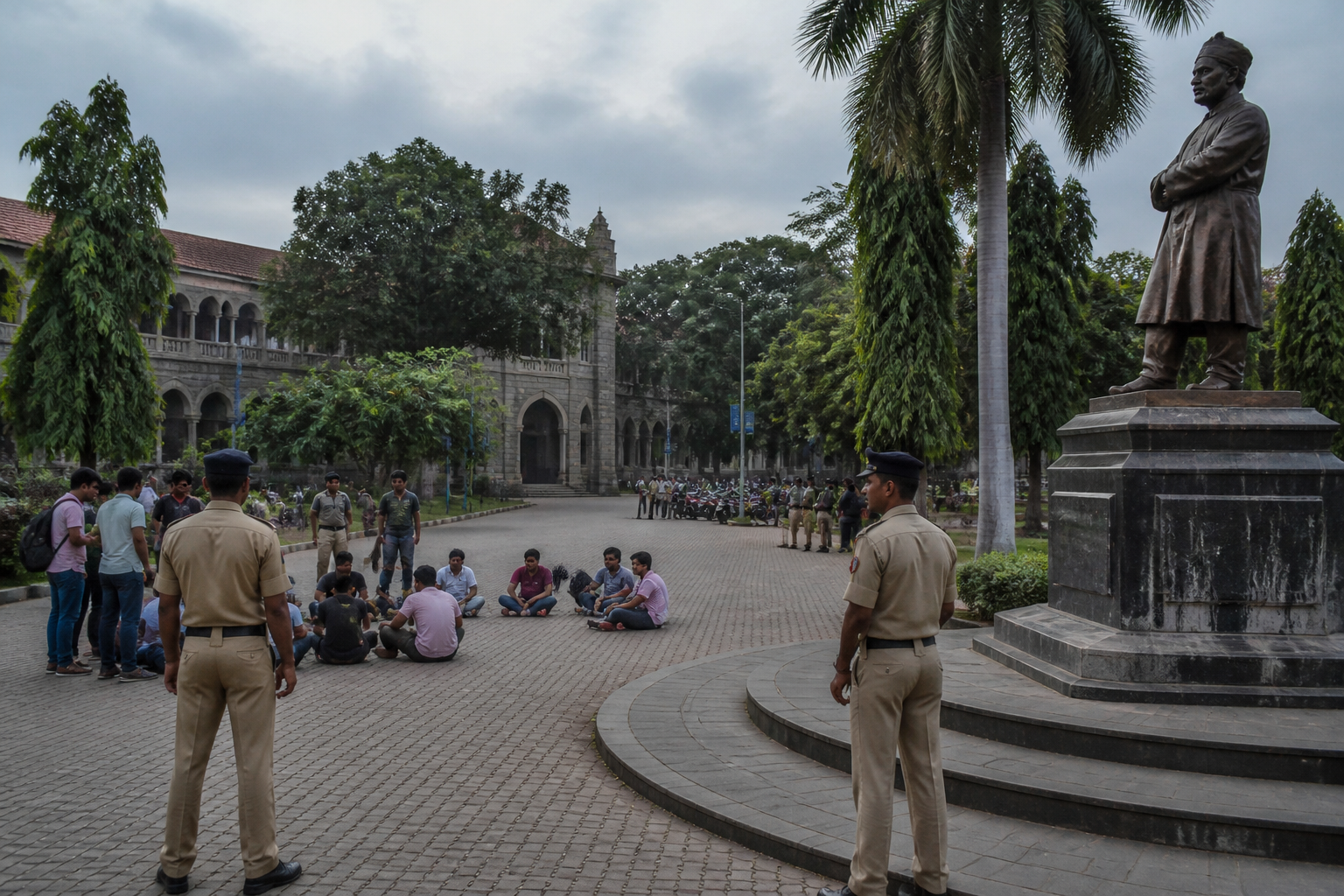
Savitribai Phule Pune University’s decision to restrict protests, marches, meetings and demonstrations on its campus has turned an administrative order into a wider dispute over how public universities manage dissent. The university says large gatherings can create the possibility of untoward incidents and disrupt academic activity. Student organisations say the circular threatens constitutional freedoms and appears to raise questions about whether restrictions will be applied equally.
The order, announced through a circular issued by university registrar Dr Prafull Pawar on the basis of a Management Council resolution, specifically prevents protests and meetings in the area around the Dr Babasaheb Ambedkar statue. It also states that demonstrations, agitations, meetings and marches by political parties, organisations, groups and other persons connected with such activities will not be permitted on the university campus.
That distinction matters because the university grounds have been used not only for issues directly connected with campus administration, but also for protests on national and broader public questions. According to the circular as reported by Pudhari, such events have occurred repeatedly, sometimes drawing thousands of participants. The university has also noted that police authorities had, on several occasions, granted permission for these demonstrations.
The dispute therefore concerns more than the location of a student gathering. It concerns the rules governing a large institutional space that has functioned as a venue for public mobilisation. The university’s stated rationale is operational: preventing possible incidents and protecting the academic process. The response from student organisations is rights-based: they argue that a blanket or broadly framed restriction could limit freedom of expression and peaceful assembly.
The University Student Struggle Action Committee, SPPU unit, has opposed the circular and demanded its immediate withdrawal. The committee referred to Articles 19(1)(a) and 19(1)(b) of the Constitution, which it said protect freedom of expression and the right to assemble peacefully. Its position is that students’ democratic rights must be respected.
The committee has also questioned the wording of the circular. It said the document refers to the Centre for Joint Progress, Samyak Vidyarthi Andolan and other Shiv-Birsa-Phule-Shahu-Ambedkarite and progressive organisations. On that basis, the committee asked whether the restrictions would apply equally to every organisation, including groups associated with the ruling party. It called for the university to clarify its position transparently.
The source material does not establish whether the circular creates a complete prohibition on every form of student gathering or whether the university intends to provide alternative locations, permissions or procedures for activities that do not obstruct academic work. It also does not indicate whether the order contains exemptions for events formally connected to the university, or how violations will be handled. Those details are central to understanding how the decision will operate in practice.
This is the institutional difficulty at the heart of the dispute. A university campus is an academic workplace and learning environment, but it can also be an important civic space. The presence of classrooms, laboratories, offices and hostels creates a legitimate administrative responsibility to manage noise, crowd movement, safety and interruptions. At the same time, a campus with a large student population can become a natural setting for collective representation, particularly when the issues concern education, public policy or social rights.
The university’s justification focuses on the scale and nature of recent gatherings. The reported circular says that demonstrations on issues not directly related to the university have repeatedly taken place on campus and that thousands of protesters have sometimes participated. This creates a distinction between a small, campus-related representation and a large external mobilisation using university land. However, the available material does not state how the university defines that distinction or whether it has adopted a graduated system based on crowd size, duration, location and potential disruption.
That missing framework is important for governance. A prohibition is easy to communicate, but it does not by itself explain how competing public interests will be balanced. If the core concern is disruption, an administrative system could theoretically distinguish between peaceful and unsafe activity, large and small gatherings, or events affecting classes and those held outside academic hours. The source does not say whether such alternatives were considered or rejected. It only records the university’s decision and the student committee’s demand for its withdrawal.
The timing has added another layer to the controversy. The Higher and Technical Education Department constituted a committee on 24 September to conduct student elections in educational institutions across the state, according to the report. Student organisations have described the university’s restrictions on protests as contradictory to the prospect of reviving or organising student representation through elections.
The relationship between student elections and campus protest rules is not explained in detail in the supplied material. They are not identical activities: elections concern the formal selection of representatives, while demonstrations concern collective expression or demands. Yet both depend on whether students can organise, assemble and communicate within an institutional framework. The students’ argument is that expanding formal participation while restricting visible protest would create an inconsistent approach to student democracy.
For the university administration, the challenge is to define the campus not merely as property under institutional control, but as a managed environment with multiple users and competing obligations. The circular appears to treat crowd size, possible untoward incidents and disruption to academic work as reasons to deny permission. That may provide an administrative basis for action, but the reported response shows that students want greater clarity on the criteria, scope and equal application of the rule.
The question of equal application is particularly significant because the committee has raised it explicitly. The source does not establish that the university has favoured or discriminated against any particular organisation. It does establish that student representatives believe the mention of certain groups requires clarification about whether the rule will cover all political and social organisations in the same way. The university’s response to that question will affect whether the order is understood as a general campus-management measure or as a restriction perceived to target particular forms of mobilisation.
The reported decision also illustrates how the use of university land can become entangled with city-level public administration. The campus is in Pune, a major educational centre, and the article records that police permissions had been granted for some demonstrations. This suggests that different authorities may have overlapping roles: the university controls access to its premises, while the police manage public-order permissions. The source does not specify how those permissions will be coordinated after the circular or whether previous police approvals will remain relevant.
That institutional overlap creates practical questions for future events. A police permission may not be sufficient to use university property if the university denies access. Conversely, a university rule restricting campus activity may shift demonstrations to public roads or other spaces, where crowd management and traffic implications would fall on civic and police authorities. The supplied report does not say whether any alternative venue or coordination mechanism has been announced.
The immediate facts are clear: the Management Council resolution has been used as the basis for a circular restricting campus protests, marches, meetings and demonstrations; the Dr Babasaheb Ambedkar statue area has been specifically identified; the university has cited safety and academic disruption; and student organisations have demanded withdrawal, invoking constitutional freedoms and equal treatment. The wider consequences remain dependent on the text of the circular, its enforcement and the administration’s response to the objections.
For students, the practical issue is whether the campus will continue to provide any formal channel for collective representation beyond classroom or administrative processes. For the university, the issue is how to prevent disruption without creating rules that are viewed as selective or excessively broad. For public authorities, the issue is how responsibility will be divided when a university campus is used for demonstrations involving people and organisations beyond the institution.
The next significant development will be the university’s clarification on the scope of the restriction, the organisations covered, the treatment of campus-related activities and any alternative process for seeking permission. Until those details are made public, the decision remains both a campus-management order and an unresolved test of how an urban university balances institutional control with democratic participation.

