


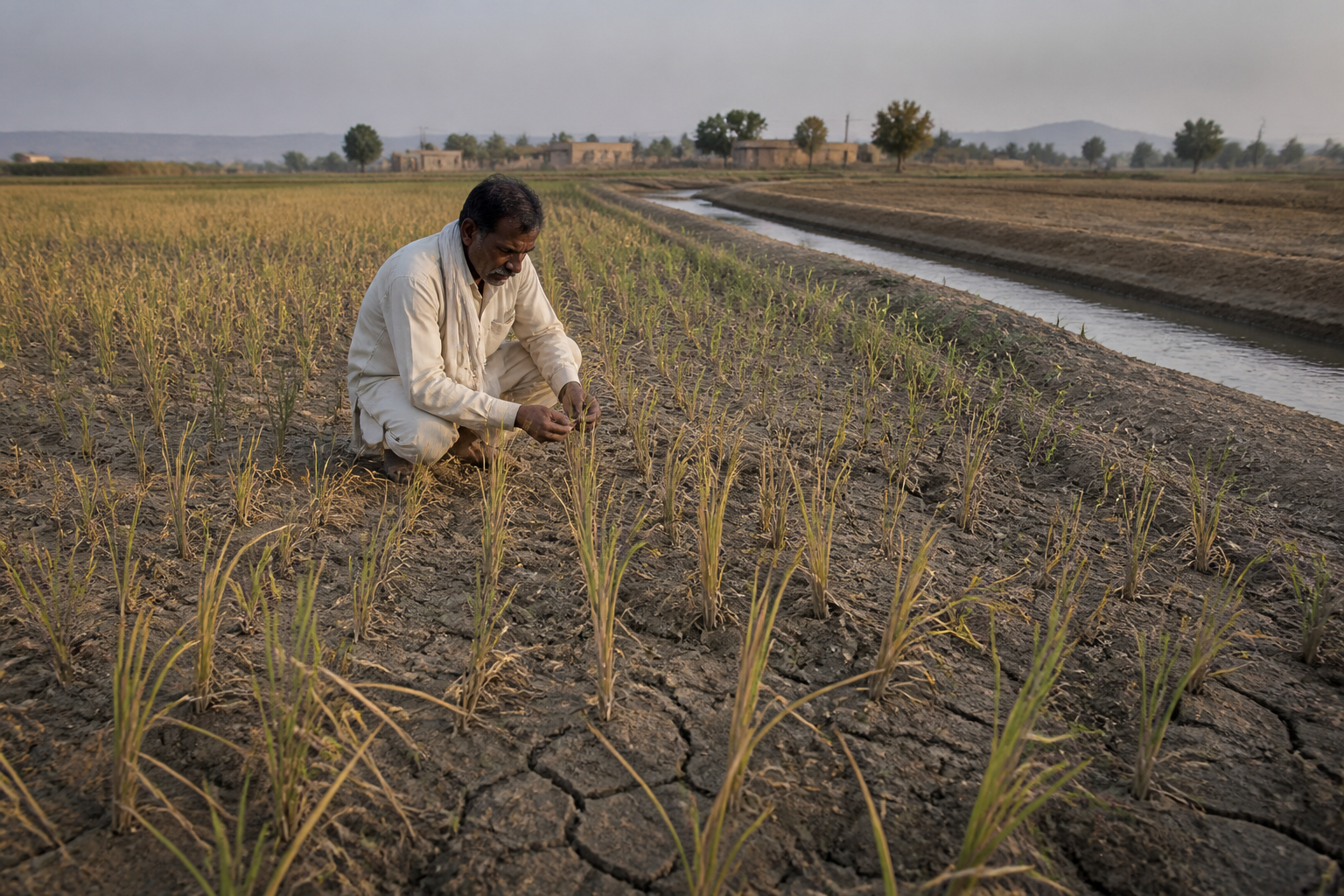
Karnataka rice prices are coming under pressure as rainfall deficits, inadequate irrigation releases and crop losses threaten supplies of paddy and tur dal across the state. A report by Prajavani says the disruption is being felt simultaneously in major paddy-growing districts and in the tur-producing belt around Kalaburagi, creating a food-price problem that extends beyond farms into rice mills, markets and household budgets.
The immediate issue is a supply shock. The report identifies Ballari, Raichur, Gangavathi, Koppal, Shivamogga, Mysuru and Mandya among the important paddy-growing areas affected by insufficient rainfall. In some locations, water was also not released from reservoirs when crops required it. Paddy is particularly exposed to water stress because it requires substantial moisture during cultivation. The report says there is concern that crop losses in key paddy districts could exceed 50 per cent, although it does not provide a district-wise official assessment of the damage.
The tur-growing districts face a related but not identical problem. In and around Kalaburagi, low soil moisture and unusually high temperatures have reportedly delayed flowering in tur plants. Traders and mill owners cited in the report said adverse weather had affected both yields and quality. The report also links current price pressure partly to flood damage in the Kalaburagi region during the previous year, showing how agricultural supply can be affected by successive seasons of weather stress rather than by one isolated event.
How Karnataka rice prices are moving through the supply chain
The transmission from farm conditions to consumers is visible in the procurement market. Karnataka has about 700 rice mills, according to the report, but lower stocks in the market have forced mill owners to buy paddy at higher prices. Paddy that was being purchased at about ₹3,500 per quintal two months ago is now reportedly being bought for ₹4,600 to ₹4,700 per quintal. That is an increase of roughly ₹1,100 to ₹1,200 per quintal, or close to one-third of the earlier purchase price.
This change matters because the price of paddy is one part of the cost structure that eventually shapes the retail price of rice. Higher procurement costs can raise milling and distribution costs, though the report does not establish how much of the increase has reached consumers or how prices differ across varieties and markets. The available evidence nevertheless shows a clear pressure point: when stocks decline and mills compete for a smaller supply of paddy, the purchase price rises before the final retail price is fully visible.
Tur dal is facing a similar supply-side constraint. Maharashtra, Gujarat and Karnataka are identified in the report as major tur-producing states. Weather conditions have affected not only the expected quantity but also the quality of the crop, according to traders and tur dal mill owners. If arrivals are lower and quality varies, processors and wholesalers may face higher sorting, procurement and replacement costs. The report does not provide current retail prices or a quantified estimate of the decline in tur production, so the scale of the impact on consumers remains to be established.
The report points to a possible short-term variable: rainfall at the end of October and in November. Traders said improved rainfall during that period could help stabilise rice and tur dal prices, while continued shortages could push prices higher. This is not a forecast of the final market outcome; it highlights how dependent the current supply position is on weather conditions during the remaining part of the season. The central uncertainty is therefore not only how much crop has already been lost, but also whether later rainfall can improve yields, quality or market arrivals.
The irrigation question behind the crop loss
The account also raises an institutional question about water allocation. In some regions, the problem was not described only as rainfall failure; the report says water was not released from reservoirs at the time agriculture required it. That distinction is important. Rainfall is outside direct administrative control, but reservoir operations, release schedules and communication with farming areas involve water-management institutions and competing demands.
The supplied report does not identify the specific reservoirs, release decisions, agencies or irrigation commands involved. It therefore cannot establish whether delayed releases were caused by low storage, operational decisions, competing water requirements or another constraint. What it does establish is that farm-level vulnerability increased where rainfall was inadequate and irrigation support was unavailable at a critical stage of cultivation. For Karnataka’s food system, the reliability and timing of water can matter as much as the broad seasonal rainfall total.
That link between water management and food prices gives the story an urban dimension. Cities and towns do not experience agricultural water stress only as a rural production issue. They encounter it through the price of staple foods, the cost of meals and the purchasing power of households. The report says low- and middle-income families are facing a greater financial burden because they must spend more on everyday food items. It does not quantify the share of household income affected, but it identifies the channel through which a rural climate and irrigation problem becomes an urban affordability concern.
Why higher prices do not necessarily protect farmers
One of the most important distinctions in the report is between a higher market price and higher farm income. Farmers who stored produce from the previous season may benefit from current prices, but those who suffered crop losses in the present season may have little produce to sell. In that situation, the same shortage that raises prices can reduce the volume available for sale by affected farmers.
This creates an uneven distribution of the benefits and costs of a supply shock. Mill owners and traders may pay more for available stocks, consumers may pay more for rice and dal, while farmers facing crop failure may have limited quantities to market. The report attributes this assessment to market analysts and does not provide a quantified comparison of farmer returns, processor margins or retail margins. Even so, the distinction is essential to understanding why food inflation cannot automatically be treated as evidence that producers are better off.
Storage is another part of the chain. The report attributes the present pressure partly to a shortage of rice stocks and says that the availability of stored produce influences who can benefit from higher prices. This points to a gap between production and market access: the timing of harvest, the ability to store safely and the need to sell quickly can determine whether a farmer participates in a later price increase. The supplied material does not specify storage capacity, warehouse ownership or procurement volumes, so those institutional details remain open.
What the evidence confirms—and what remains unclear
The evidence in the report supports four connected findings. Rainfall deficits and adverse weather have affected paddy and tur cultivation in several Karnataka regions. Irrigation constraints have compounded the problem in some paddy-growing areas. Market arrivals and stocks are under pressure, with paddy procurement prices rising from about ₹3,500 to ₹4,600-₹4,700 per quintal in two months. The resulting cost burden is reaching consumers, particularly households already sensitive to staple-food prices.
Several important questions remain unanswered. The report does not provide official crop-cutting data, district-wise loss estimates, reservoir storage figures, current retail prices, or a statewide comparison with previous seasons. It also does not establish the precise contribution of rainfall, irrigation releases, earlier flood damage, stock levels and market behaviour to the price increase. These gaps do not erase the warning, but they limit how precisely the scale of the crisis can be measured.
The next meaningful indicators will be actual rainfall in late October and November, crop assessments from paddy and tur-growing districts, market arrivals, stock levels at mills and wholesale prices paid by consumers. The report’s central message is that food affordability is being shaped well before a household reaches the retail market. It begins with water availability, crop resilience and the ability of farmers and processors to carry produce through a disrupted season.

