


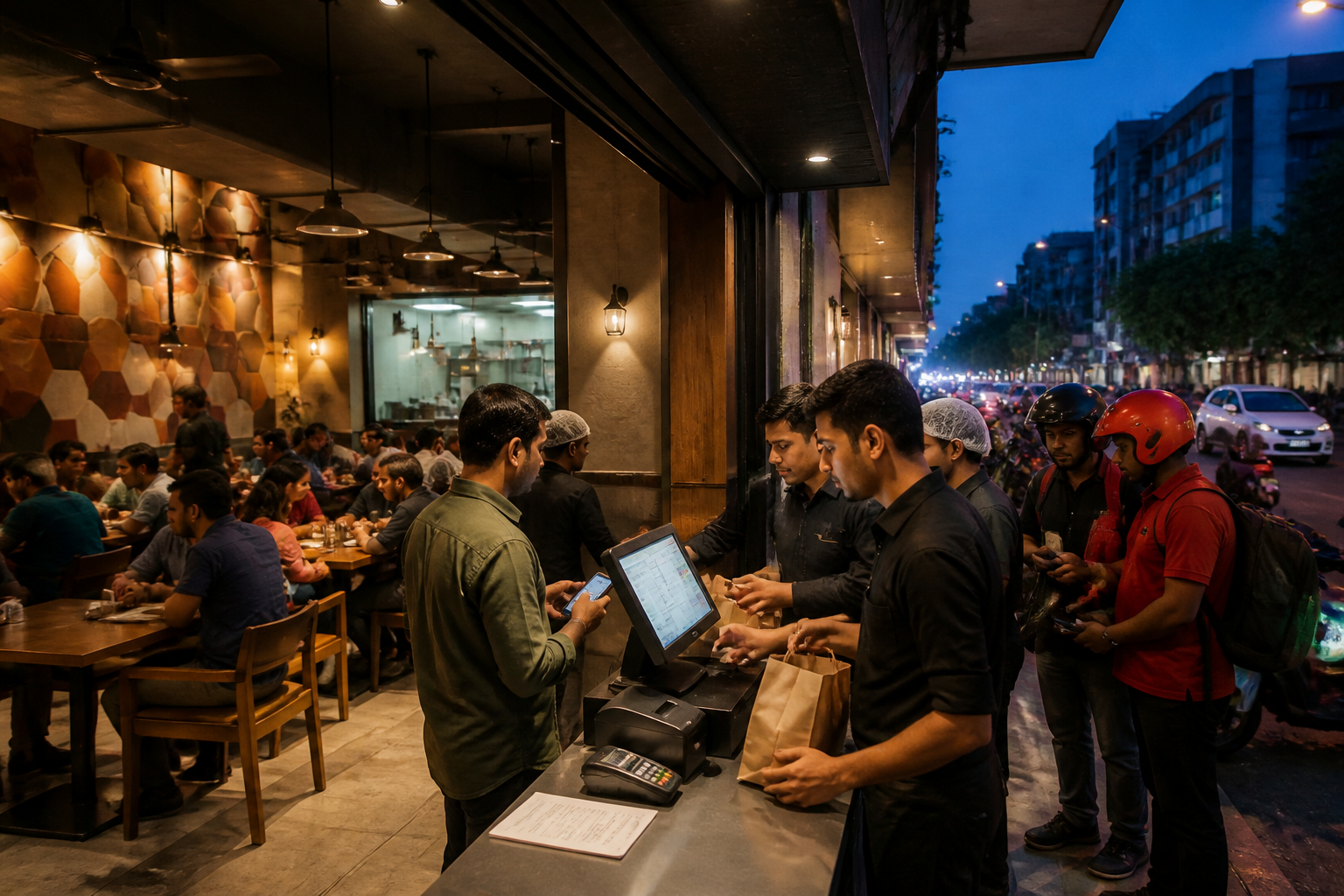
The restaurant tax evasion probe reported across Ahmedabad, Surat and Rajkot is not only a tax-enforcement story. It reveals how India’s urban food economy is increasingly split between transactions visible to digital platforms and sales that remain difficult for authorities to track, especially in dine-in and cash-heavy businesses.
The Income Tax Department has launched a nationwide investigation into alleged sales suppression and tax evasion by restaurants estimated at Rs 70,000 crore, according to Ahmedabad Mirror. Searches were carried out in the three Gujarat cities on Thursday as part of an inquiry into billing software and cloud-based systems allegedly used to conceal sales and reduce reported turnover.
The department’s action follows an earlier detection of suspected tax evasion exceeding Rs 25,000 crore in the restaurant sector. The latest investigation is reportedly focused on restaurants earning between Rs 2 crore and Rs 5 crore, particularly in major cities. That focus places mid-sized urban businesses at the centre of the compliance question: they may be large enough to generate substantial turnover across several channels but remain difficult to assess through any single tax data stream.
The evidence cited in the report comes partly from data linked to Swiggy and Zomato. Around 8,000 restaurants were identified as having tax deducted at source against their names but not filing income tax returns. An analysis covering 2021-22 to 2024-25 estimated tax evasion of Rs 7,500 crore through these restaurants.
The platform-linked numbers provide an important but incomplete view of the sector. In 2024-25, the restaurants identified through the data generated nearly Rs 2,700 crore in revenue and attracted about Rs 25 crore in TDS. Across four years, the government collected around Rs 75 crore in TDS, while the number of restaurants in the system increased by 65 per cent.
These figures do not represent the entire restaurant economy. They represent transactions visible through a particular compliance mechanism. The department’s concern, as reported, is that delivery-platform data may show only part of the business conducted by restaurants, while dine-in sales remain outside the same deduction system.
Food delivery orders currently attract TDS of 0.1 per cent, compared with 1 per cent in the initial years, according to the report. Dine-in sales are not covered by this deduction. The report states that dine-in revenue can be three to four times delivery revenue, suggesting that actual business turnover could be considerably higher than the amount visible through platform-linked TDS data. That comparison is an indication of the potential scale of the gap, not a final measurement of unreported income.
This distinction matters because restaurants are now operating through several overlapping channels. A single business may receive payments through delivery platforms, point-of-sale terminals, cash counters and other digital or non-digital systems. A tax authority examining only one channel may see a reliable but partial picture. The department’s investigation into billing software and cloud-based systems indicates that the concern is not limited to whether a restaurant filed a return. It also concerns the integrity of the records used to calculate sales.
The reported use of billing software to conceal sales, if established, would make the compliance issue more institutional than accidental. A restaurant’s reported income can depend on how bills are generated, stored and reconciled with bank transactions, platform settlements, supplier purchases and employee payments. The report says authorities also suspect unreported cash flows through employees’ accounts and concealed bills in cloud-based systems. These remain allegations under investigation, not established findings against every restaurant covered by the inquiry.
The department’s earlier survey of nearly 1.8 lakh restaurants found average income underreporting of 30-35 per cent, Ahmedabad Mirror reported. The figure points to a broad compliance concern, but the supplied report does not provide the survey’s methodology, geographic coverage, business-size breakdown or the number of establishments ultimately subjected to action. Those details will be important in assessing how representative the finding is.
The 8,000 restaurants flagged through platform data illustrate the changing relationship between private digital companies and public administration. Swiggy and Zomato are not tax authorities, but the transaction information associated with their services can help identify differences between declared business activity and recorded commercial activity. The department’s use of such information shows how urban governance increasingly depends on data generated by private platforms.
At the same time, platform data cannot by itself establish total income or tax evasion. Delivery sales may differ from dine-in sales in pricing, commissions, discounts and payment arrangements. Restaurants can also have multiple outlets, separate legal entities or varying business structures. A mismatch between TDS records and tax returns can trigger scrutiny, but it does not automatically prove that the entire difference represents concealed income.
The department is planning a fresh compliance drive to encourage restaurants to file returns and pay outstanding taxes. This signals a two-track approach: use data and searches to identify possible suppression, while also seeking voluntary compliance from businesses that have not filed or have unpaid liabilities. The effectiveness of that approach will depend on how clearly the department distinguishes between deliberate concealment, weak bookkeeping, business losses, incorrect reporting and genuine disputes over tax treatment.
The focus on restaurants earning Rs 2 crore to Rs 5 crore is also significant for urban administration. These businesses sit between small informal establishments and large organised chains. They may employ substantial workforces, occupy commercial premises, contract with delivery platforms and serve neighbourhood-level demand, yet their financial records may not be integrated across all sales channels. The report does not establish that every business in this range has suppressed income. It shows that the department considers the segment important enough to receive targeted scrutiny.
The urban dimension extends beyond taxation. Restaurants are part of the service economy that supports commercial streets, shopping districts, office areas and residential neighbourhoods. Their revenues are linked to local footfall, delivery networks, digital payments and employment. A compliance drive therefore affects not only government collections but also the administrative relationship between city businesses and the state. However, the supplied material does not quantify possible effects on employment, prices, rents or restaurant closures, and those consequences should not be assumed.
The case also raises a structural question about the limits of transaction visibility. Delivery orders are relatively easy to associate with an intermediary, a restaurant and a payment trail. Dine-in transactions may be distributed across cash, cards, digital wallets and point-of-sale systems. If the department’s estimate that dine-in sales can be three to four times delivery revenue is broadly applicable, relying heavily on delivery data would understate the scale of urban food businesses. But the report does not say that this ratio applies uniformly across cities, restaurant formats or income groups.
What the evidence confirms is narrower but still important. The Income Tax Department has begun searches in three Gujarat cities as part of a wider restaurant-sector investigation. It has identified thousands of restaurants through TDS and return-filing data, estimated substantial tax evasion for the period from 2021-22 to 2024-25, and raised concerns about software, cloud records, cash flows and bills. It is also preparing a fresh compliance drive.
What remains unclear is how many restaurants will face confirmed demands, how the alleged Rs 70,000 crore figure has been calculated, how much relates to income tax rather than other liabilities, and whether the suspected practices are concentrated among particular chains, formats or locations. The next significant evidence will come from official findings, assessment orders, departmental disclosures and the outcome of the planned compliance exercise. Until then, the investigation shows the scale of the data gap authorities are trying to close, but not the final liability of the businesses under scrutiny.

