


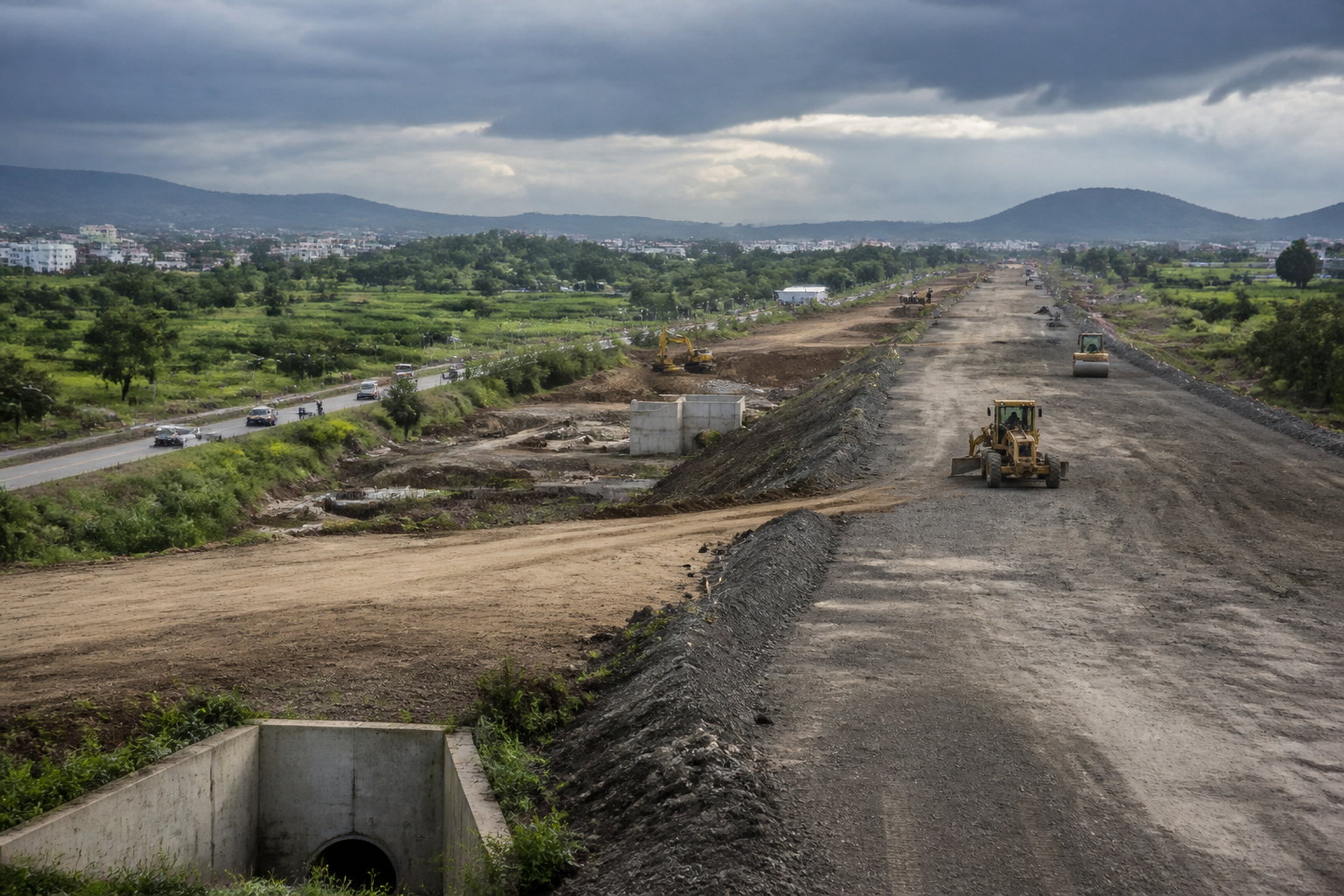
The Pune Ring Road’s estimated cost has increased significantly due to the decision to transfer a key project package from the National Highways Authority of India (NHAI) to the Maharashtra State Road Development Corporation (MSRDC). The additional sanction of Rs 10,502 crore pushes the total project cost to Rs 53,213.39 crore.
The government resolution approved on August 18, 2026, explains that NHAI did not prioritize the relevant road stretch, prompting the state to entrust MSRDC with both land acquisition and construction responsibilities. This move aims to align the project delivery with the Centre-approved configuration and ensure the ring road fulfills its intended purpose to ease traffic congestion around Pune.
This transfer highlights ongoing institutional challenges in coordinating between national and state agencies. While MSRDC gains clearer administrative control, the state also assumes increased financial liability. The project has experienced repeated cost revisions, including a 2024 escalation from Rs 42,711.03 crore to Rs 53,213.39 crore with the latest inclusion.
The Pune Ring Road consists of eastern and western sections, each undergoing scope and cost changes. The eastern stretch’s length and cost have risen, reflecting design and project scope adjustments. A 31.805 km overlap with the proposed Pune-Chhatrapati Sambhajinagar Greenfield Expressway further complicates coordination across agencies and departments.
Fiscal pressures add urgency to this decision. Maharashtra’s projected public debt for 2026-27 stands at Rs 11.02 lakh crore, with significant revenue and fiscal deficits. The ring road’s rising cost competes with other government financial commitments including social welfare and drought relief schemes.
Ultimately, the transfer to MSRDC formalizes financial and operational responsibilities that were partly in effect already. It underscores the complexities of urban infrastructure governance and the financial risks associated with shifting institutional arrangements mid-project. Key outstanding questions concern completion timelines, physical progress, and how the additional costs are financed.

