


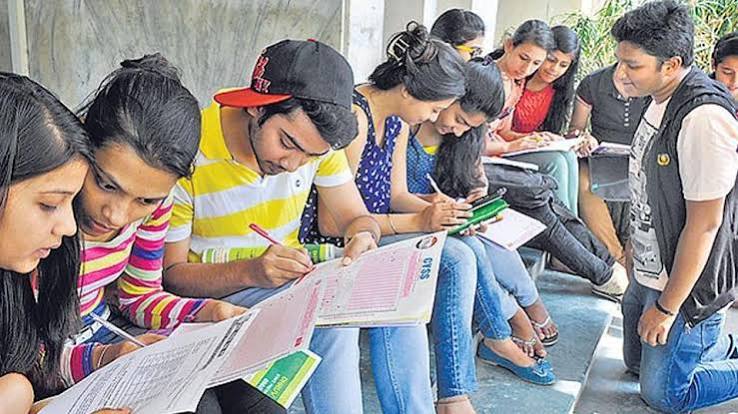
The uncertainty surrounding Maharashtra Public Service Commission examinations is becoming an urban problem in Pimpri-Chinchwad, where more than 50,000 aspirants are reported to be preparing for government careers. For these students, examination delays and alleged paper leaks do not merely disrupt a study calendar. They extend the cost of renting a room, paying for coaching and maintaining access to study spaces while leaving the timing of the next opportunity unclear.
The report by Lokmat – Pune describes a student population drawn from Marathwada, Vidarbha, western Maharashtra and Khandesh. Many are from farming, agricultural labour, landless labour and salaried households, while candidates from business and professional families form a smaller share. Their movement into Pimpri-Chinchwad has created an education-support ecosystem around competitive examinations: private classes, libraries and study rooms, rented accommodation, food services and local transport all depend, in part, on the continuing presence of aspirants.
That makes the examination system part of the city’s informal economic geography. A candidate who relocates to Pimpri-Chinchwad is not only preparing for an examination. The candidate is also entering a local market for housing and services, often with limited financial flexibility. When an examination is postponed, the immediate consequence is a longer preparation period. The report says candidates are already carrying the cost of education, private coaching and study facilities, with some considering abandoning preparation altogether.
The reported figure of more than 50,000 aspirants indicates the scale of this dependence, although the report does not identify the methodology or agency behind the estimate. Even without a detailed survey, the concentration of candidates is significant enough to show how public recruitment can shape a locality. A city that attracts examination aspirants must absorb their demand for affordable rooms, reliable study environments, connectivity and everyday services. These needs are different from those of permanent employees or conventional student populations because the duration of stay is tied to an uncertain examination cycle.
The uncertainty also changes how households plan expenditure. Candidates are reported to study for eight to ten hours a day, but remain unsure whether an examination will be held on time, whether results will be declared promptly and whether an appointment will follow. The report identifies age limits, the number of available posts and rising daily expenses as additional pressures. These are not separate problems. Together, they turn delay into a cumulative financial risk: every additional month can mean another month of rent, food, coaching and study-space fees, while the candidate’s eligibility window may narrow.
Paper-leak allegations create a different form of damage. A postponed examination imposes a visible cost, but a compromised examination process can undermine the value of preparation itself. Candidates who have studied consistently may conclude that effort cannot guarantee a fair opportunity. The report links such incidents to declining confidence in the examination system and to questions about transparency. That concern is particularly important for candidates from lower-income rural households, for whom competitive examinations are presented as a route into stable public employment.
Bharat Sirsat, secretary of the Mahavihar Former Students Social Welfare Organisation, described the continuing paper-leak cases as deeply concerning and said poor and hardworking students were facing severe mental stress. He further claimed that around 20 per cent of students were no longer interested in preparing for competitive examinations because of such incidents. The report does not provide an independent survey for this figure, so it should be treated as an attributed assessment rather than an established statewide trend. Sirsat also said some students were experiencing suicidal thoughts, underscoring the seriousness of the distress being reported, although the article does not document individual cases or provide an official assessment of mental-health outcomes.
This distinction matters for public administration. A recruitment examination is usually viewed as an administrative event managed by a commission. For candidates, however, it is a long urban project involving migration, accommodation, education spending and repeated interaction with public institutions. A failure at one point in the process can therefore produce consequences across several systems. Delays affect landlords and coaching providers as well as candidates; uncertainty affects family remittances and household borrowing; and allegations of leaks affect the perceived legitimacy of the recruitment channel.
The report also describes a reactive pattern in which government action is perceived to follow student protests rather than precede them. This is an allegation about institutional response, not independently established evidence in the supplied material. If that perception persists, the administration faces a trust problem in addition to an examination-management problem. Candidates are likely to judge the system not only by whether a paper is conducted, but also by how quickly authorities communicate, investigate irregularities and publish a credible timetable for the next stage.
Transparency is therefore not limited to preventing a leak. It includes communicating examination calendars, postponement decisions, revised schedules, results and appointment procedures in a way that candidates can plan around. The report specifically points to uncertainty about whether examinations will be held on time and whether successful candidates will receive appointments after results. Each unresolved stage lengthens the period during which candidates must spend money without knowing when the process will conclude.
The urban dimension is also visible in the geography of opportunity. Candidates from several regions move to Pimpri-Chinchwad because the city offers access to coaching and study facilities. Their presence reflects an uneven distribution of preparation infrastructure: educational support is concentrated in cities, while many candidates originate in rural or smaller-town households. This arrangement transfers the cost of preparation to the candidate. A student may need to travel to a city to access coaching, then remain there through postponements that are decided elsewhere.
No figures are supplied in the report on rents, coaching fees, library charges, household debt or the number of businesses serving aspirants. Nor does the report establish how many candidates have left the city or abandoned preparation. Those gaps limit the precision with which the economic impact can be measured. They do not erase the central issue: the consequences of recruitment uncertainty are distributed through an urban ecosystem that official examination statistics may not capture.
The policy responsibility is similarly spread across institutions. The Maharashtra Public Service Commission is central to the examination process, while the state government is connected to recruitment decisions, vacancies and appointments. Local authorities are not responsible for conducting the examination, but the effects of large student concentrations are experienced locally through housing, mobility, public safety and access to services. The source material does not specify any municipal response, candidate-support programme or formal mechanism linking examination authorities with cities that host large aspirant populations.
That institutional separation can make accountability difficult to see. A candidate may experience one continuous period of uncertainty, while different authorities control separate parts of the process. The commission may determine an examination schedule; the state may determine posts and appointments; private providers control coaching and study facilities; and local markets determine accommodation costs. Without clear communication across these layers, delays can appear arbitrary even when individual decisions have separate administrative explanations.
The immediate evidence confirms three pressures: a large reported concentration of aspirants in Pimpri-Chinchwad, repeated uncertainty associated with postponements and paper-leak cases, and growing financial and psychological strain among candidates. It also points to a wider structural question about who bears the cost when public recruitment systems become unpredictable. In the supplied material, those costs are being carried mainly by candidates and their families, many of whom come from rural and lower-income backgrounds.
What remains unclear is the verified scale of paper-leak incidents, the exact number of affected examinations and candidates, the status of investigations, the number of vacancies and the timetable for upcoming recruitment stages. Those facts will determine whether the present uncertainty is a temporary disruption or a deeper failure of examination governance. For Pimpri-Chinchwad, the next developments to watch are an official examination schedule, clarification on affected tests, action against those responsible for any proven irregularities, and information on results and appointments. Until those are available, the city’s aspirants remain tied to an expensive preparation cycle whose end date they cannot reliably identify.

